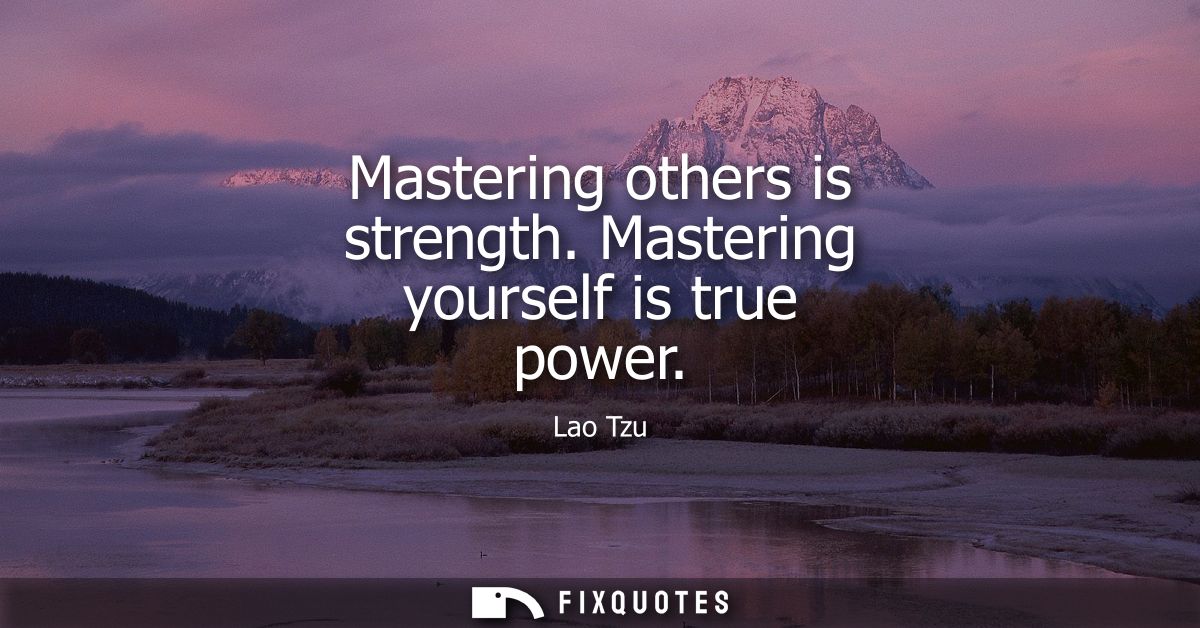
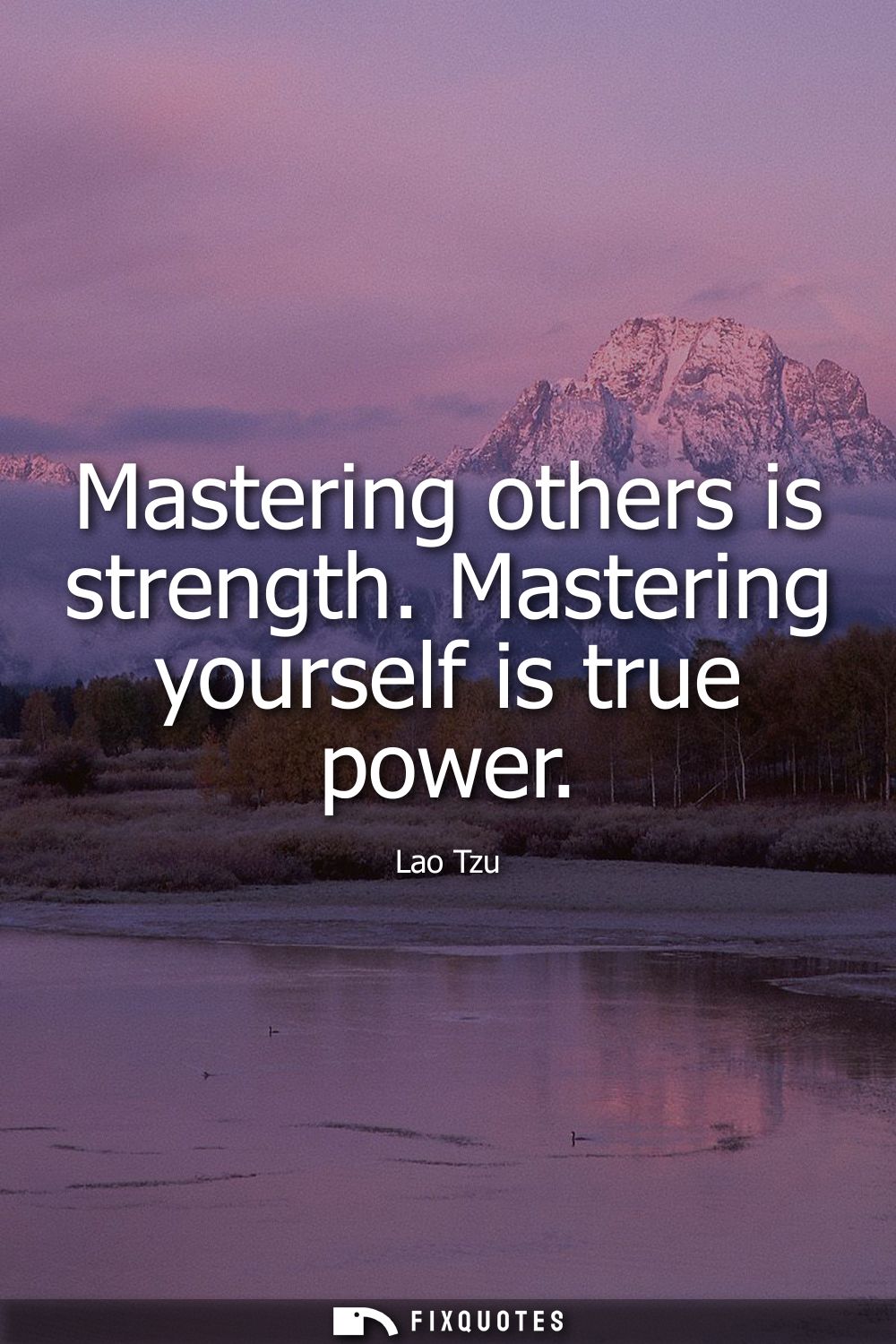
"Mastering others is strength. Mastering yourself is true power"
About this Quote
Power, in Lao Tzu's framing, isn’t the loud kind that wins a room; it’s the quiet kind that doesn’t need the room at all. “Mastering others is strength” grants a concession to the obvious: coercion, strategy, force, charisma - these can move people, build empires, settle disputes. That’s strength in the way a lever is strength: effective, external, measurable.
Then the line pivots and changes the scoreboard. “Mastering yourself is true power” swaps dominance for discipline, conquest for calibration. The subtext is a critique of status-driven control: if you need to master others, you’ve already admitted dependence on them. Your mood, identity, and security are being outsourced to what you can make other people do. Self-mastery, by contrast, is power that can’t be revoked by a rival, a changing crowd, or bad luck. It’s portable. It survives loss.
Context matters: Lao Tzu’s Taoist worldview distrusts rigid striving and the ego’s hunger to impose order. In the Dao De Jing, the best ruler governs lightly; the best fighter wins without fighting. This quote condenses that ethic into a modern aphorism: the deepest authority is internal, not performative. It flatters no one’s ambition, which is precisely why it endures. It suggests a radical hierarchy: the hardest battlefield isn’t society but the self - appetites, fear, pride - and victory there produces a steadiness no external win can guarantee.
Then the line pivots and changes the scoreboard. “Mastering yourself is true power” swaps dominance for discipline, conquest for calibration. The subtext is a critique of status-driven control: if you need to master others, you’ve already admitted dependence on them. Your mood, identity, and security are being outsourced to what you can make other people do. Self-mastery, by contrast, is power that can’t be revoked by a rival, a changing crowd, or bad luck. It’s portable. It survives loss.
Context matters: Lao Tzu’s Taoist worldview distrusts rigid striving and the ego’s hunger to impose order. In the Dao De Jing, the best ruler governs lightly; the best fighter wins without fighting. This quote condenses that ethic into a modern aphorism: the deepest authority is internal, not performative. It flatters no one’s ambition, which is precisely why it endures. It suggests a radical hierarchy: the hardest battlefield isn’t society but the self - appetites, fear, pride - and victory there produces a steadiness no external win can guarantee.
Quote Details
| Topic | Wisdom |
|---|---|
| Source | Lao Tzu (Laozi), Tao Te Ching, chapter 33 , commonly translated (variously) as “He who conquers others is strong; he who conquers himself is mighty,” source of the paraphrase provided. |
| Cite |
Citation Formats
APA Style (7th ed.)
Tzu, Lao. (2026, January 14). Mastering others is strength. Mastering yourself is true power. FixQuotes. https://fixquotes.com/quotes/mastering-others-is-strength-mastering-yourself-33766/
Chicago Style
Tzu, Lao. "Mastering others is strength. Mastering yourself is true power." FixQuotes. January 14, 2026. https://fixquotes.com/quotes/mastering-others-is-strength-mastering-yourself-33766/.
MLA Style (9th ed.)
"Mastering others is strength. Mastering yourself is true power." FixQuotes, 14 Jan. 2026, https://fixquotes.com/quotes/mastering-others-is-strength-mastering-yourself-33766/. Accessed 12 Feb. 2026.
More Quotes by Lao
Add to List