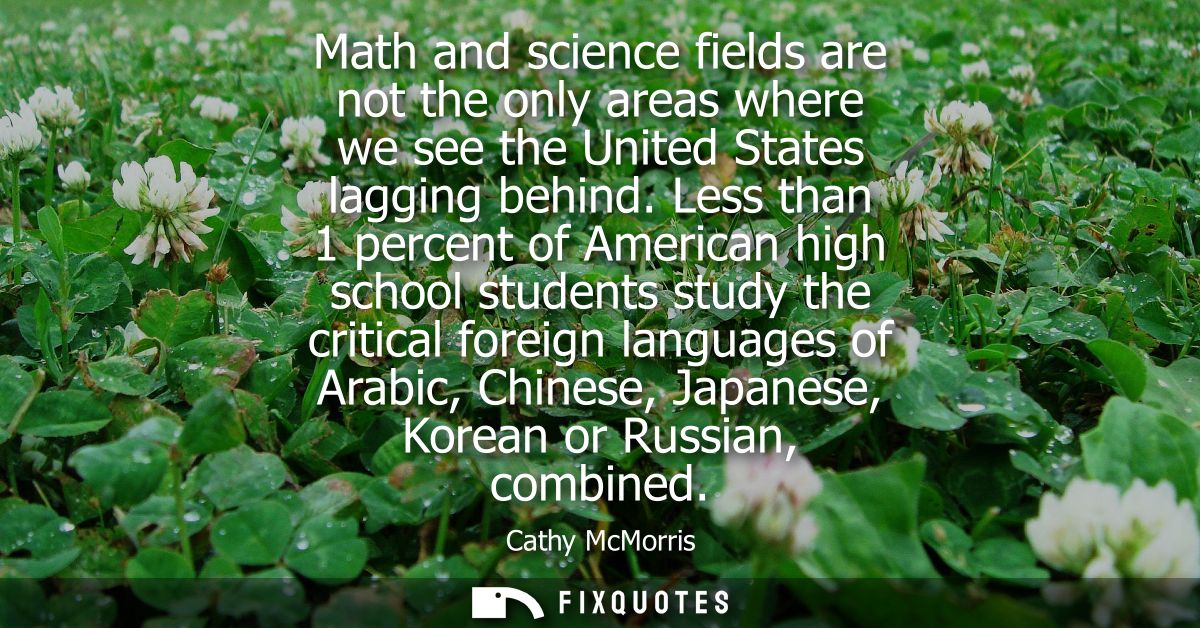
"Math and science fields are not the only areas where we see the United States lagging behind. Less than 1 percent of American high school students study the critical foreign languages of Arabic, Chinese, Japanese, Korean or Russian, combined"
About this Quote
As a politician, she’s also doing coalition work. Education reformers hear "lagging behind" and think workforce competitiveness. Defense hawks hear Arabic and Russian and think intelligence gaps. Asia-focused strategists hear Chinese, Japanese, and Korean and think trade, technology, and geopolitical leverage. One sentence, multiple constituencies, one shared anxiety: America is undereducated for the century it’s already living in.
The context matters: post-9/11 security logic and the rise of China made foreign language study feel less like a liberal arts elective and more like a strategic asset. That framing is effective, but it comes with a tell. By defining languages primarily as "critical", she leans into an instrumental view of other societies - valuable insofar as they affect us. It’s a call to broaden American competence, delivered through the familiar political language of threat and competition.
Quote Details
| Topic | Learning |
|---|---|
| Source | Help us find the source |
| Cite |
Citation Formats
APA Style (7th ed.)
McMorris, Cathy. (2026, January 17). Math and science fields are not the only areas where we see the United States lagging behind. Less than 1 percent of American high school students study the critical foreign languages of Arabic, Chinese, Japanese, Korean or Russian, combined. FixQuotes. https://fixquotes.com/quotes/math-and-science-fields-are-not-the-only-areas-45806/
Chicago Style
McMorris, Cathy. "Math and science fields are not the only areas where we see the United States lagging behind. Less than 1 percent of American high school students study the critical foreign languages of Arabic, Chinese, Japanese, Korean or Russian, combined." FixQuotes. January 17, 2026. https://fixquotes.com/quotes/math-and-science-fields-are-not-the-only-areas-45806/.
MLA Style (9th ed.)
"Math and science fields are not the only areas where we see the United States lagging behind. Less than 1 percent of American high school students study the critical foreign languages of Arabic, Chinese, Japanese, Korean or Russian, combined." FixQuotes, 17 Jan. 2026, https://fixquotes.com/quotes/math-and-science-fields-are-not-the-only-areas-45806/. Accessed 27 Mar. 2026.