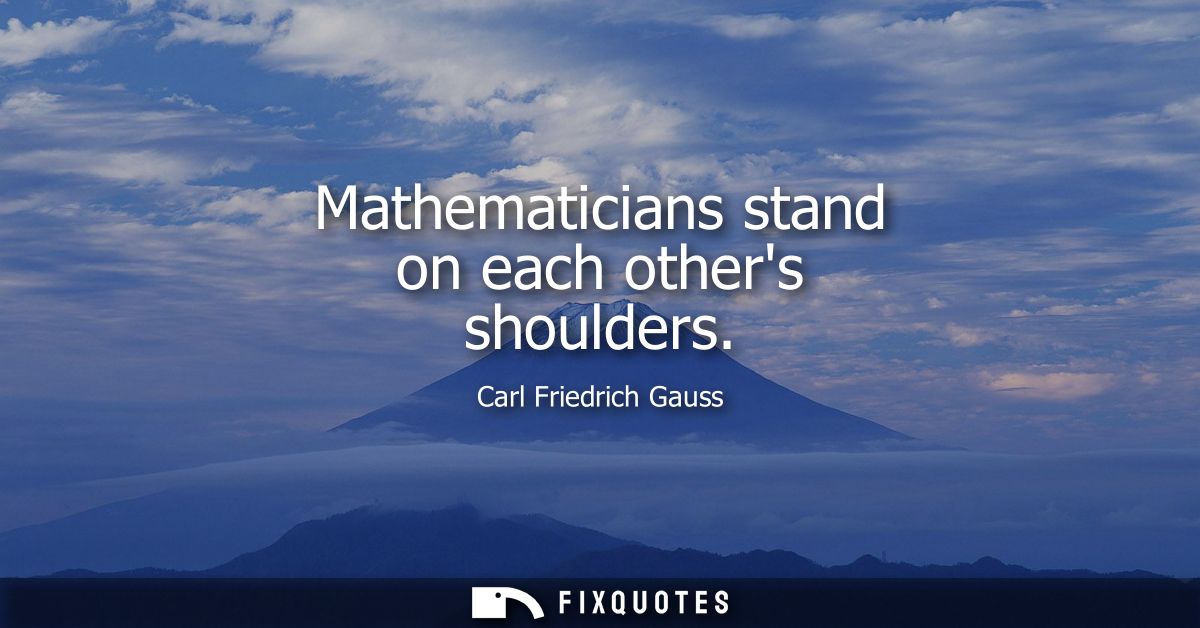
"Mathematicians stand on each other's shoulders"
About this Quote
Mathematicians don’t arrive like lone meteors; they show up as the latest visible layer of a slow, collective eruption. Gauss’s line compresses that reality into a blunt correction of the “great man” myth that tends to cling to genius, especially his own. Coming from someone routinely labeled the Prince of Mathematicians, it reads less like modesty than like a power move: he’s reminding you that the field’s real protagonist is accumulation.
The phrase “stand on each other’s shoulders” deliberately shifts credit from solitary insight to structure. Shoulders imply support, but also hierarchy: some people do the lifting, others get the view. That’s the subtext that makes the quote sting a little. Mathematics is cooperative in outcome while intensely selective in recognition. You can’t see farther without someone else beneath you, but not everyone’s name ends up attached to a theorem.
Context matters. Gauss worked at a moment when modern mathematics was hardening into professional discipline: journals, correspondence networks, and the expectation that results be proved, archived, and extended. In that ecosystem, originality isn’t just inspiration; it’s placement within an existing scaffold of lemmas, methods, and notation. His aphorism is basically a theory of progress: the “new” is often a clever recombination plus a sharper proof.
It also carries a quiet ethic. If knowledge is stacked, then teaching, clarity, and publishing aren’t ancillary chores; they’re the shoulders. Gauss isn’t romanticizing collaboration. He’s describing the machinery that makes brilliance legible and, eventually, inevitable.
The phrase “stand on each other’s shoulders” deliberately shifts credit from solitary insight to structure. Shoulders imply support, but also hierarchy: some people do the lifting, others get the view. That’s the subtext that makes the quote sting a little. Mathematics is cooperative in outcome while intensely selective in recognition. You can’t see farther without someone else beneath you, but not everyone’s name ends up attached to a theorem.
Context matters. Gauss worked at a moment when modern mathematics was hardening into professional discipline: journals, correspondence networks, and the expectation that results be proved, archived, and extended. In that ecosystem, originality isn’t just inspiration; it’s placement within an existing scaffold of lemmas, methods, and notation. His aphorism is basically a theory of progress: the “new” is often a clever recombination plus a sharper proof.
It also carries a quiet ethic. If knowledge is stacked, then teaching, clarity, and publishing aren’t ancillary chores; they’re the shoulders. Gauss isn’t romanticizing collaboration. He’s describing the machinery that makes brilliance legible and, eventually, inevitable.
Quote Details
| Topic | Knowledge |
|---|---|
| Source | Help us find the source |
| Cite |
Citation Formats
APA Style (7th ed.)
Gauss, Carl Friedrich. (2026, January 15). Mathematicians stand on each other's shoulders. FixQuotes. https://fixquotes.com/quotes/mathematicians-stand-on-each-others-shoulders-142314/
Chicago Style
Gauss, Carl Friedrich. "Mathematicians stand on each other's shoulders." FixQuotes. January 15, 2026. https://fixquotes.com/quotes/mathematicians-stand-on-each-others-shoulders-142314/.
MLA Style (9th ed.)
"Mathematicians stand on each other's shoulders." FixQuotes, 15 Jan. 2026, https://fixquotes.com/quotes/mathematicians-stand-on-each-others-shoulders-142314/. Accessed 5 Mar. 2026.
More Quotes by Carl
Add to List