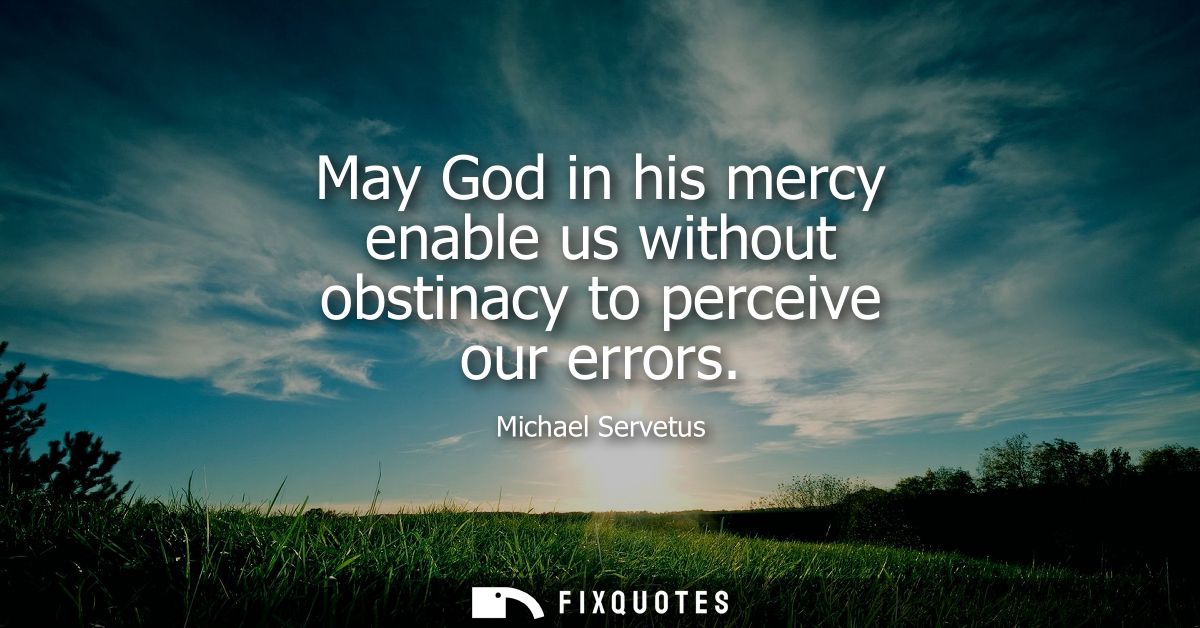
"May God, in his mercy, enable us, without obstinacy, to perceive our errors"
About this Quote
That’s not abstract piety. Servetus lived in an era when “error” was policed by church and state, and when theological disagreement could end in trial and fire. He was a physician and scientific thinker, but also a heretical theologian; he challenged orthodox Trinitarian doctrine and paid for it with execution in Calvin’s Geneva. In that context, “without obstinacy” reads like a quiet indictment of the institutions around him: the real scandal isn’t that humans err, it’s that authorities cannot admit error without losing power.
Invoking God’s mercy does rhetorical double duty. It’s a shield (who can object to humility?) and a provocation (if correction requires divine help, then certainty looks less like faith and more like vanity). The line’s intent is self-scrutiny, but its subtext is political: a culture that treats revision as weakness will keep burning people to defend yesterday’s conclusions. Servetus is asking for epistemic grace in a world that confused infallibility with righteousness.
Quote Details
| Topic | Prayer |
|---|---|
| Source | Help us find the source |
| Cite |
Citation Formats
APA Style (7th ed.)
Servetus, Michael. (2026, February 18). May God, in his mercy, enable us, without obstinacy, to perceive our errors. FixQuotes. https://fixquotes.com/quotes/may-god-in-his-mercy-enable-us-without-obstinacy-82281/
Chicago Style
Servetus, Michael. "May God, in his mercy, enable us, without obstinacy, to perceive our errors." FixQuotes. February 18, 2026. https://fixquotes.com/quotes/may-god-in-his-mercy-enable-us-without-obstinacy-82281/.
MLA Style (9th ed.)
"May God, in his mercy, enable us, without obstinacy, to perceive our errors." FixQuotes, 18 Feb. 2026, https://fixquotes.com/quotes/may-god-in-his-mercy-enable-us-without-obstinacy-82281/. Accessed 6 Apr. 2026.