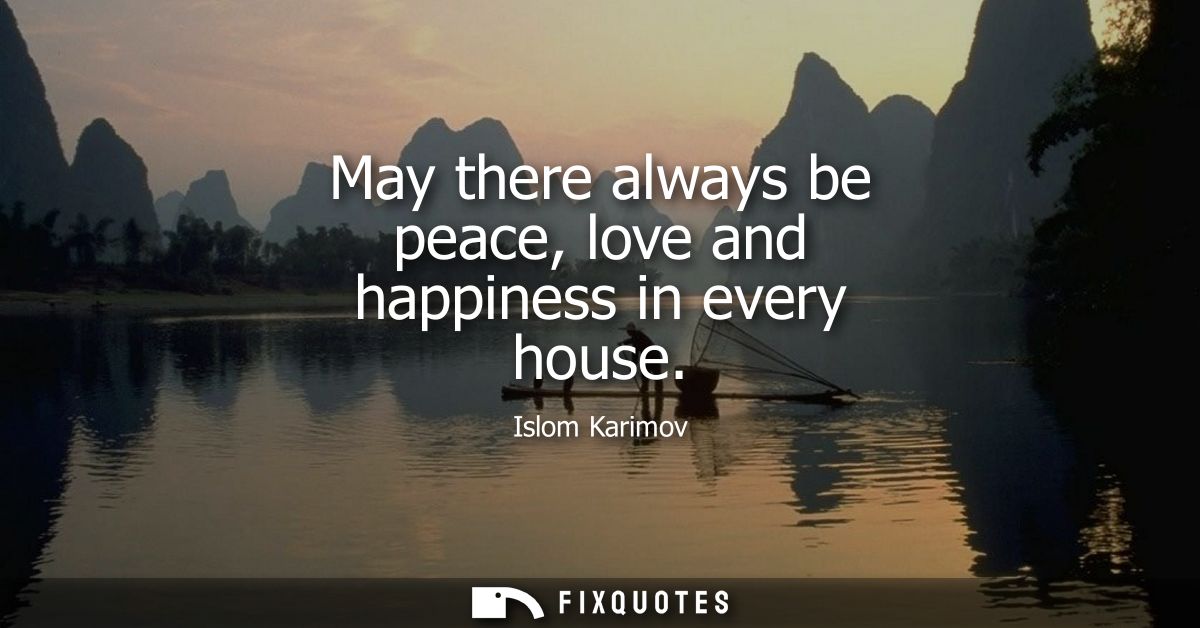
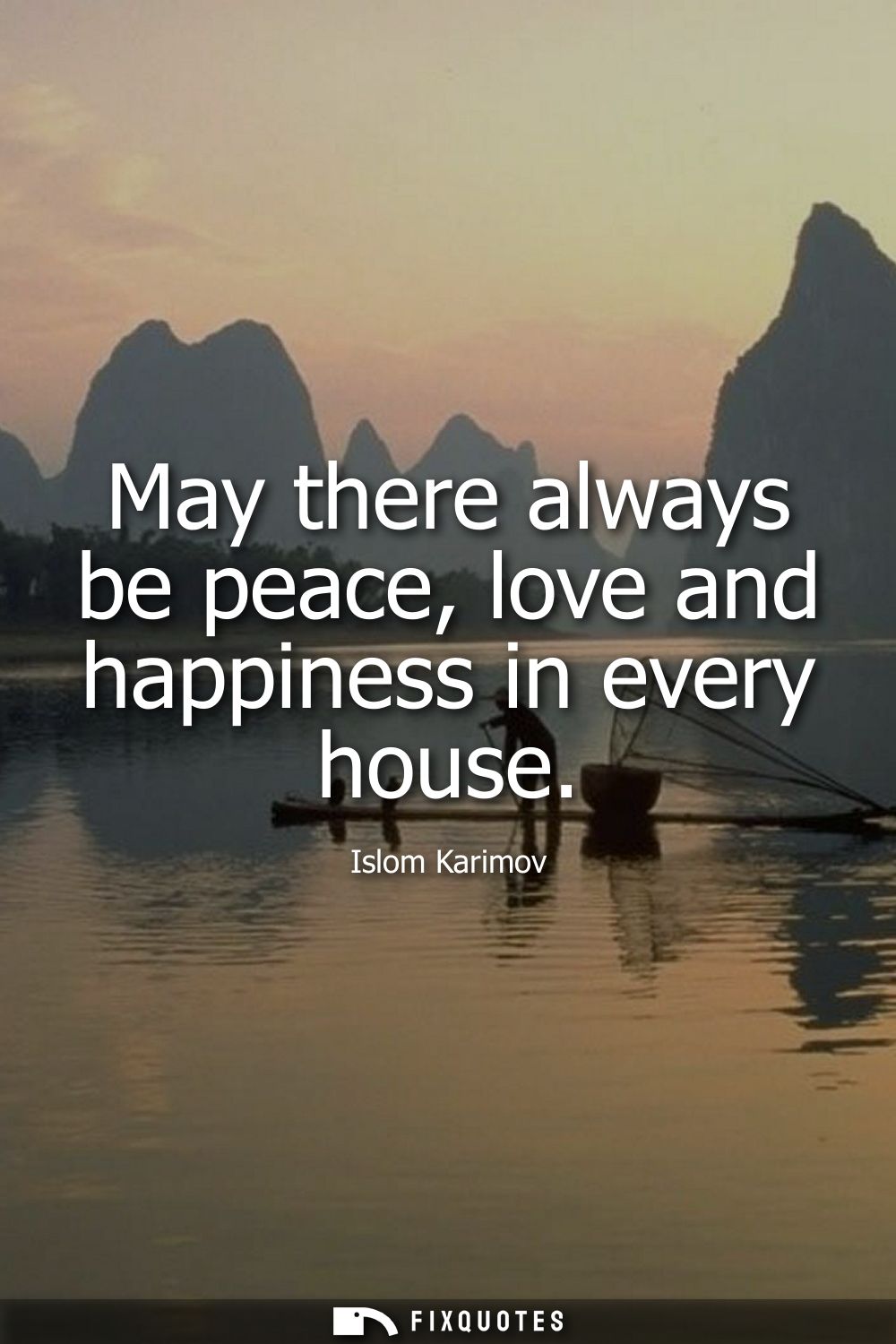
"May there always be peace, love and happiness in every house"
About this Quote
A blessing like this is never just a blessing when it comes from a head of state. "May there always be peace, love and happiness in every house" works as political language precisely because it sounds apolitical: soft nouns, domestic scale, no policy, no enemies. Karimov’s genius - and danger - was to wrap authority in the texture of everyday life. "Every house" shrinks the nation to a kitchen table, making loyalty feel like family duty and stability feel like a moral good rather than a negotiated outcome.
The key word is "peace", which in post-Soviet Central Asia often carried a double meaning: security from real instability, and a rationale for tightening the screws. Under Karimov, Uzbekistan was defined by a hard promise of order after the Soviet collapse and amid regional conflict. In that context, peace becomes an argument: accept strong rule, and you get normal life. The addition of "love" and "happiness" isn’t sentimental decoration; it’s inoculation. It recasts the state’s priorities as parental care, implying that dissent is not just political disagreement but a threat to the home.
The line’s religious-adjacent cadence ("May there...") also matters. It borrows the authority of prayer without naming God, a neat fit for a secular regime governing a culturally Muslim society: spiritual warmth, political control. It’s a slogan that asks to be repeated at weddings, holidays, and televised addresses - a portable, uncontroversial wish that quietly defines the highest public virtue as private calm.
The key word is "peace", which in post-Soviet Central Asia often carried a double meaning: security from real instability, and a rationale for tightening the screws. Under Karimov, Uzbekistan was defined by a hard promise of order after the Soviet collapse and amid regional conflict. In that context, peace becomes an argument: accept strong rule, and you get normal life. The addition of "love" and "happiness" isn’t sentimental decoration; it’s inoculation. It recasts the state’s priorities as parental care, implying that dissent is not just political disagreement but a threat to the home.
The line’s religious-adjacent cadence ("May there...") also matters. It borrows the authority of prayer without naming God, a neat fit for a secular regime governing a culturally Muslim society: spiritual warmth, political control. It’s a slogan that asks to be repeated at weddings, holidays, and televised addresses - a portable, uncontroversial wish that quietly defines the highest public virtue as private calm.
Quote Details
| Topic | Happiness |
|---|---|
| Source | Help us find the source |
| Cite |
Citation Formats
APA Style (7th ed.)
Karimov, Islom. (2026, January 14). May there always be peace, love and happiness in every house. FixQuotes. https://fixquotes.com/quotes/may-there-always-be-peace-love-and-happiness-in-56292/
Chicago Style
Karimov, Islom. "May there always be peace, love and happiness in every house." FixQuotes. January 14, 2026. https://fixquotes.com/quotes/may-there-always-be-peace-love-and-happiness-in-56292/.
MLA Style (9th ed.)
"May there always be peace, love and happiness in every house." FixQuotes, 14 Jan. 2026, https://fixquotes.com/quotes/may-there-always-be-peace-love-and-happiness-in-56292/. Accessed 4 Apr. 2026.
More Quotes by Islom
Add to List