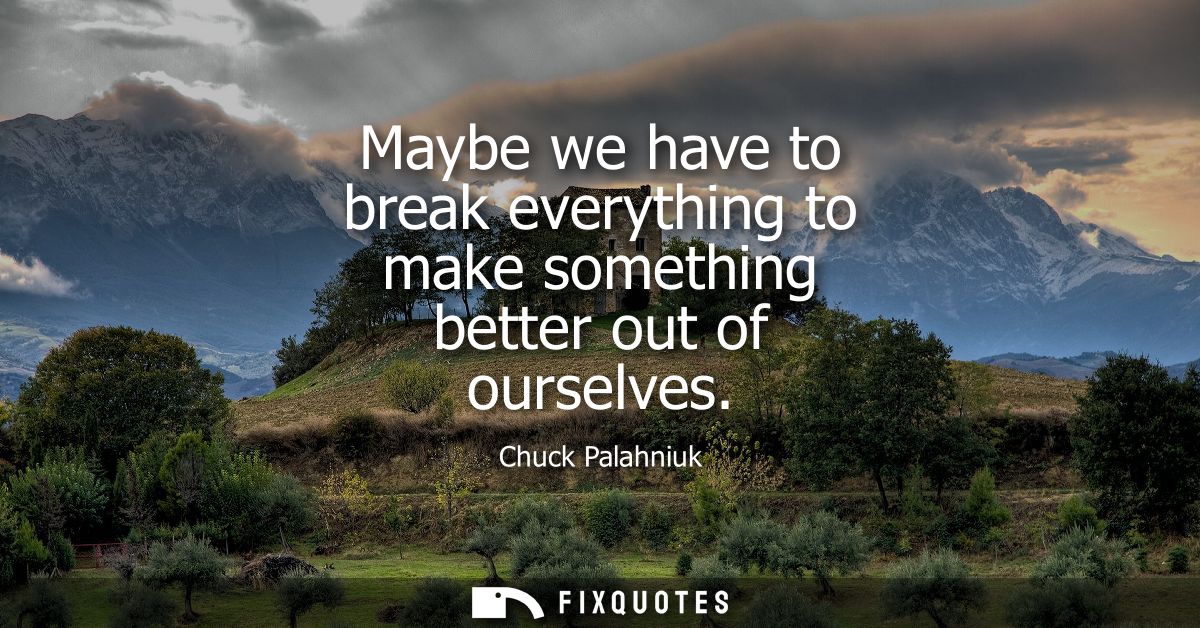
"Maybe we have to break everything to make something better out of ourselves"
About this Quote
The engine is the collective “we,” which turns private crisis into a shared diagnosis. This isn’t just about one person hitting bottom; it’s about a whole culture marinating in comfort and calling it identity. “Break everything” is deliberately blunt, almost childish in its totality, and that’s the point: the fantasy of total reset. Palahniuk understands the seduction of clean slates, the way scorched earth can masquerade as clarity when your life feels like clutter.
The subtext is thornier: the idea that pain is proof of authenticity, that transformation requires spectacle, that becoming “better” justifies collateral damage. It’s a critique and a temptation at once. The phrase “out of ourselves” suggests the raw material is already there, but buried under habits, consumer scripts, and inherited narratives. You don’t acquire a new self; you carve one out by wrecking the old scaffolding.
Context matters. Coming from Palahniuk’s world of disaffected men, late-capitalist malaise, and transgressive reinvention, the line doubles as satire of masculine salvation myths and a sincere admission of how change often arrives: not politely, but through rupture.
Quote Details
| Topic | Reinvention |
|---|---|
| Source | Help us find the source |
| Cite |
Citation Formats
APA Style (7th ed.)
Palahniuk, Chuck. (2026, January 17). Maybe we have to break everything to make something better out of ourselves. FixQuotes. https://fixquotes.com/quotes/maybe-we-have-to-break-everything-to-make-30599/
Chicago Style
Palahniuk, Chuck. "Maybe we have to break everything to make something better out of ourselves." FixQuotes. January 17, 2026. https://fixquotes.com/quotes/maybe-we-have-to-break-everything-to-make-30599/.
MLA Style (9th ed.)
"Maybe we have to break everything to make something better out of ourselves." FixQuotes, 17 Jan. 2026, https://fixquotes.com/quotes/maybe-we-have-to-break-everything-to-make-30599/. Accessed 12 Feb. 2026.