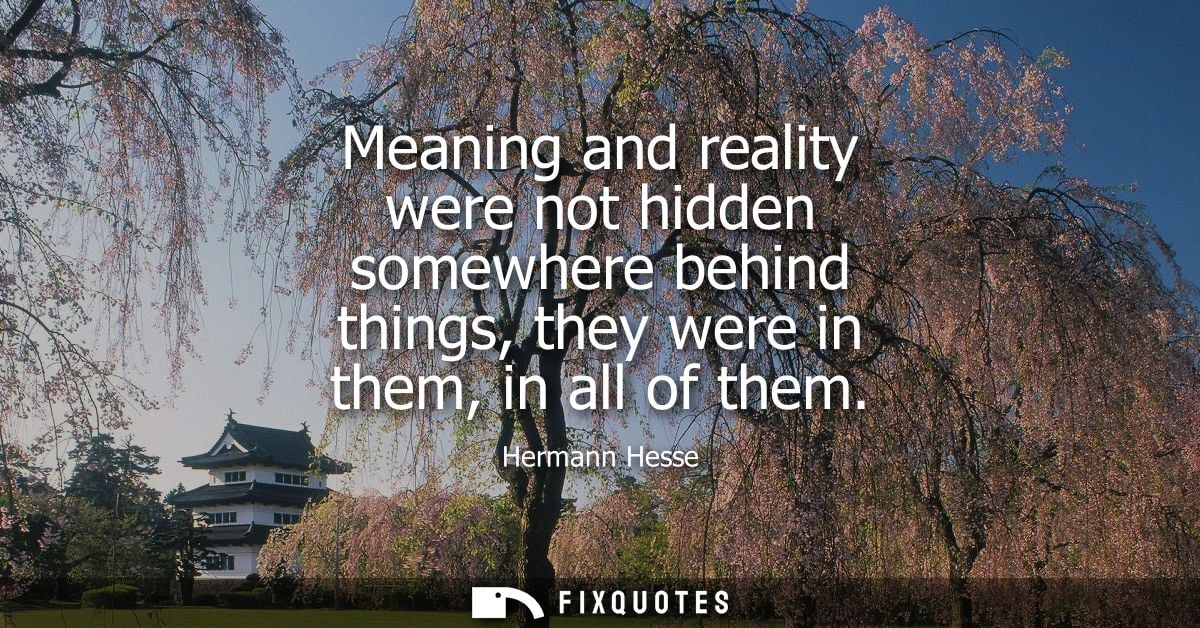
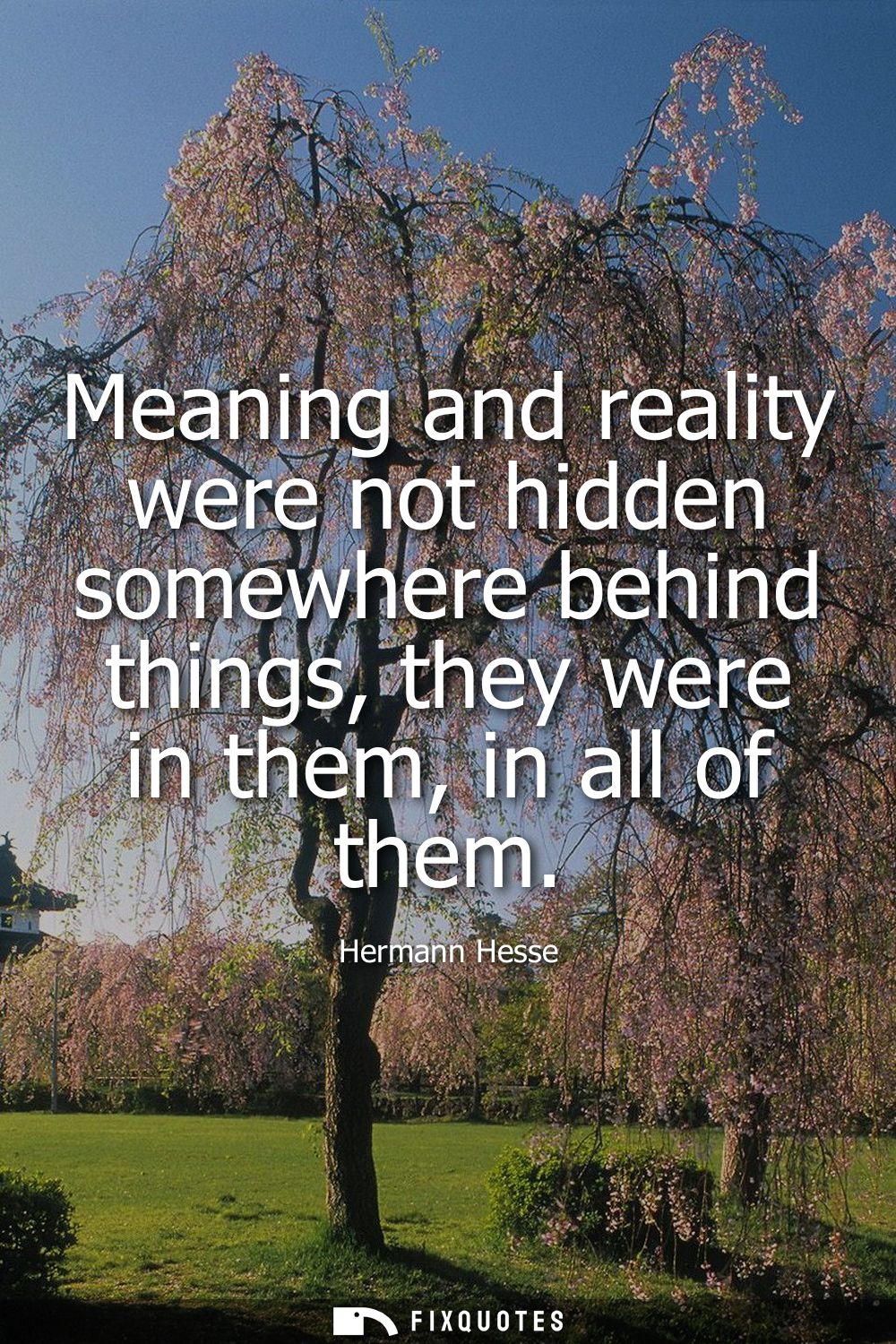
"Meaning and reality were not hidden somewhere behind things, they were in them, in all of them"
About this Quote
The intent is philosophical, but the move is psychological. Hesse wrote in a Europe where industrial rationality and religious certainty were both wobbling, and his novels often stage the same crisis: a self split between intellect and spirit, longing for unity. This sentence tries to close that split. It undercuts the idea that reality is secondary to symbols, doctrines, or abstract systems - the very habits that make people feel alienated from their own days.
The subtext is a critique of spiritual escapism dressed up as insight. If meaning is “behind things,” you can ignore the present and call it enlightenment. If meaning is “in” things, you’re accountable to the ordinary: the body, boredom, pleasure, other people, the small textures you’d rather rush past. The repetition (“in them... in all of them”) works like a mantra, not to soothe, but to retrain attention. Hesse isn’t offering a riddle. He’s proposing a discipline: stop hunting for hidden doors and learn to inhabit what’s already open.
Quote Details
| Topic | Meaning of Life |
|---|---|
| Source | Help us find the source |
| Cite |
Citation Formats
APA Style (7th ed.)
Hesse, Hermann. (2026, January 17). Meaning and reality were not hidden somewhere behind things, they were in them, in all of them. FixQuotes. https://fixquotes.com/quotes/meaning-and-reality-were-not-hidden-somewhere-53773/
Chicago Style
Hesse, Hermann. "Meaning and reality were not hidden somewhere behind things, they were in them, in all of them." FixQuotes. January 17, 2026. https://fixquotes.com/quotes/meaning-and-reality-were-not-hidden-somewhere-53773/.
MLA Style (9th ed.)
"Meaning and reality were not hidden somewhere behind things, they were in them, in all of them." FixQuotes, 17 Jan. 2026, https://fixquotes.com/quotes/meaning-and-reality-were-not-hidden-somewhere-53773/. Accessed 12 Feb. 2026.