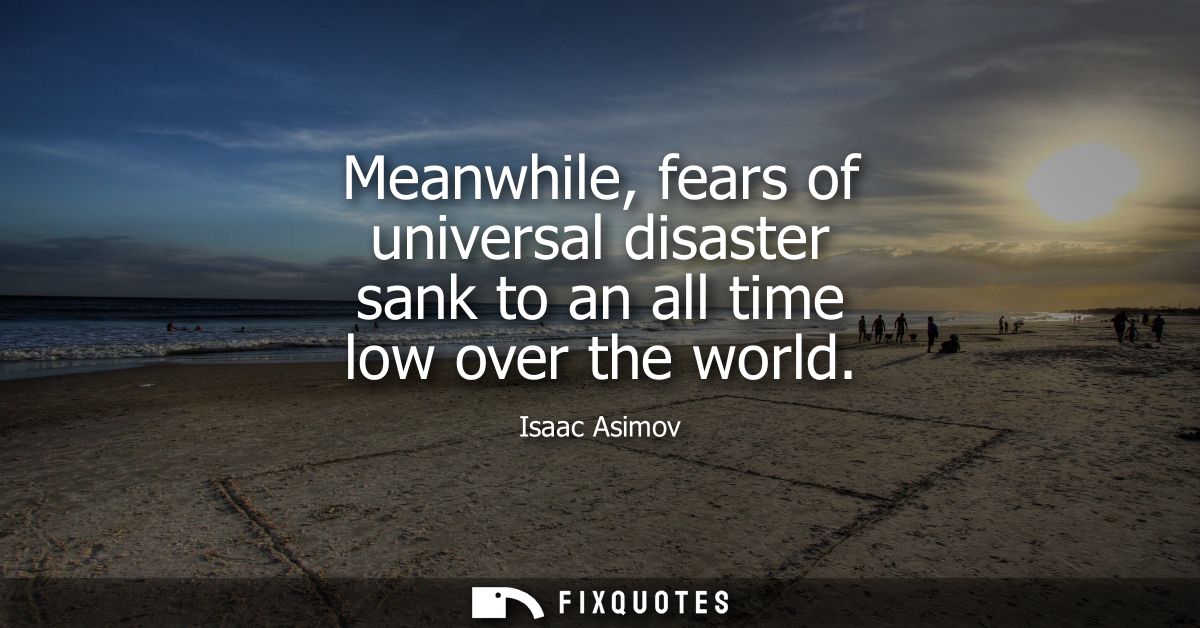
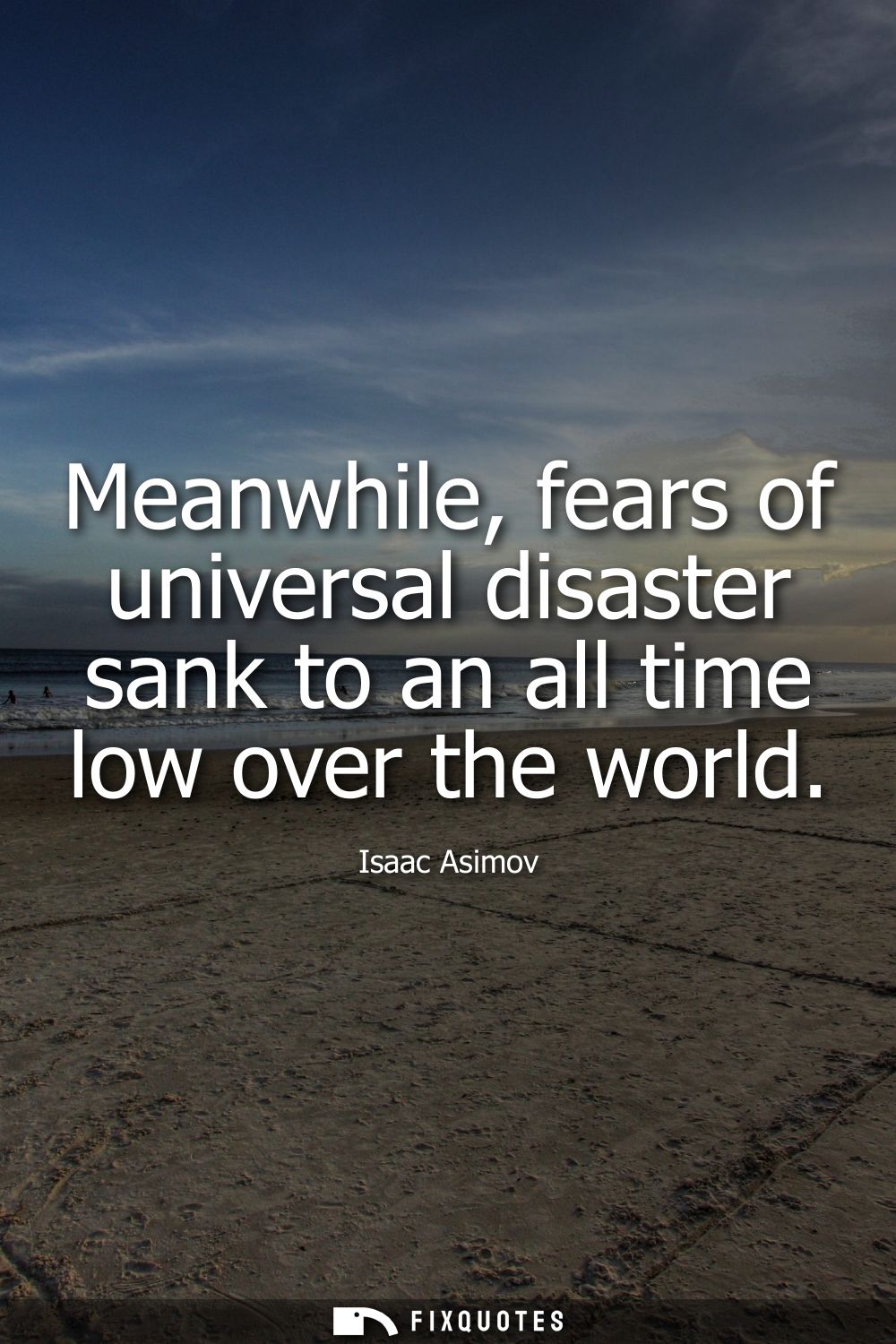
"Meanwhile, fears of universal disaster sank to an all time low over the world"
About this Quote
As a scientist-writer, Asimov understood that public anxiety behaves less like rational risk assessment and more like a weather system: shifting, cyclical, easily redirected. The subtext is not “relax, we’re safe,” but “your fear is fickle, and that should worry you.” If terror can “sink” globally, it can rise just as fast, often in response to spectacle rather than probability. There’s also an implicit critique of progress narratives. Modernity promises control over catastrophe, yet the emotional economy of catastrophe persists; we simply experience it in trends.
Contextually, this feels tuned to the Cold War era Asimov lived through, when nuclear annihilation was both unthinkable and constantly thinkable. The line captures a cultural rhythm: apocalypse as a background hum that occasionally dips, not because the world is less fragile, but because attention has moved on. The irony lands because the measurement itself is absurd - and because it sounds uncomfortably plausible.
Quote Details
| Topic | Witty One-Liners |
|---|---|
| Source | Help us find the source |
| Cite |
Citation Formats
APA Style (7th ed.)
Asimov, Isaac. (2026, January 18). Meanwhile, fears of universal disaster sank to an all time low over the world. FixQuotes. https://fixquotes.com/quotes/meanwhile-fears-of-universal-disaster-sank-to-an-20039/
Chicago Style
Asimov, Isaac. "Meanwhile, fears of universal disaster sank to an all time low over the world." FixQuotes. January 18, 2026. https://fixquotes.com/quotes/meanwhile-fears-of-universal-disaster-sank-to-an-20039/.
MLA Style (9th ed.)
"Meanwhile, fears of universal disaster sank to an all time low over the world." FixQuotes, 18 Jan. 2026, https://fixquotes.com/quotes/meanwhile-fears-of-universal-disaster-sank-to-an-20039/. Accessed 11 Mar. 2026.