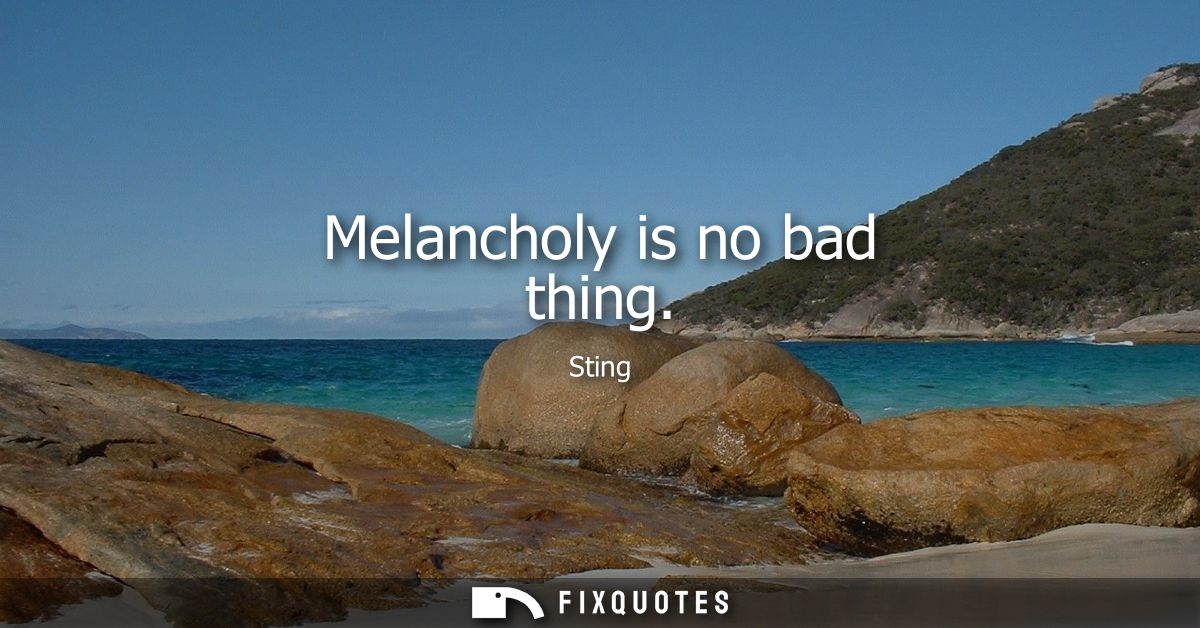
"Melancholy is no bad thing"
About this Quote
"Melancholy is no bad thing" lands like a quiet correction in a culture that treats sadness as a software bug. Coming from Sting, it reads less like self-help and more like a musician defending a tonal choice. His catalog has always made room for the minor key: romance that curdles into regret, politics that bleeds into private life, spiritual longing that never quite resolves. The line validates that emotional palette without turning it into a brand of suffering.
The intent isn’t to glamorize depression; it’s to rehabilitate melancholy as a useful human register. Melancholy has shape and distance. It’s sadness with perspective, the feeling you get when you can name what you’ve lost and still keep moving. That’s why it’s fertile territory for songwriting: it slows time, sharpens memory, and gives desire a shadow. Pop music often sells catharsis on demand; Sting’s best work sells ambivalence, the ache that doesn’t neatly conclude by the final chorus.
The subtext is also mildly defiant. In the productivity era, emotional discomfort is pathologized and monetized: optimize your mood, fix your head, return to baseline. Sting’s phrase pushes back by implying melancholy can be reflective rather than broken, even elegant rather than embarrassing. It nods to an older, more European sensibility (think literate, rain-streaked, post-romantic) while staying plainspoken.
Contextually, it fits an artist who’s spent decades writing about the costs of wanting things: love, peace, meaning, youth. Melancholy, here, becomes not a problem to solve but a signal that you’ve lived attentively.
The intent isn’t to glamorize depression; it’s to rehabilitate melancholy as a useful human register. Melancholy has shape and distance. It’s sadness with perspective, the feeling you get when you can name what you’ve lost and still keep moving. That’s why it’s fertile territory for songwriting: it slows time, sharpens memory, and gives desire a shadow. Pop music often sells catharsis on demand; Sting’s best work sells ambivalence, the ache that doesn’t neatly conclude by the final chorus.
The subtext is also mildly defiant. In the productivity era, emotional discomfort is pathologized and monetized: optimize your mood, fix your head, return to baseline. Sting’s phrase pushes back by implying melancholy can be reflective rather than broken, even elegant rather than embarrassing. It nods to an older, more European sensibility (think literate, rain-streaked, post-romantic) while staying plainspoken.
Contextually, it fits an artist who’s spent decades writing about the costs of wanting things: love, peace, meaning, youth. Melancholy, here, becomes not a problem to solve but a signal that you’ve lived attentively.
Quote Details
| Topic | Sadness |
|---|---|
| Source | Help us find the source |
| Cite |
Citation Formats
APA Style (7th ed.)
Sting. (2026, January 16). Melancholy is no bad thing. FixQuotes. https://fixquotes.com/quotes/melancholy-is-no-bad-thing-96404/
Chicago Style
Sting. "Melancholy is no bad thing." FixQuotes. January 16, 2026. https://fixquotes.com/quotes/melancholy-is-no-bad-thing-96404/.
MLA Style (9th ed.)
"Melancholy is no bad thing." FixQuotes, 16 Jan. 2026, https://fixquotes.com/quotes/melancholy-is-no-bad-thing-96404/. Accessed 26 Mar. 2026.
More Quotes by Sting
Add to List