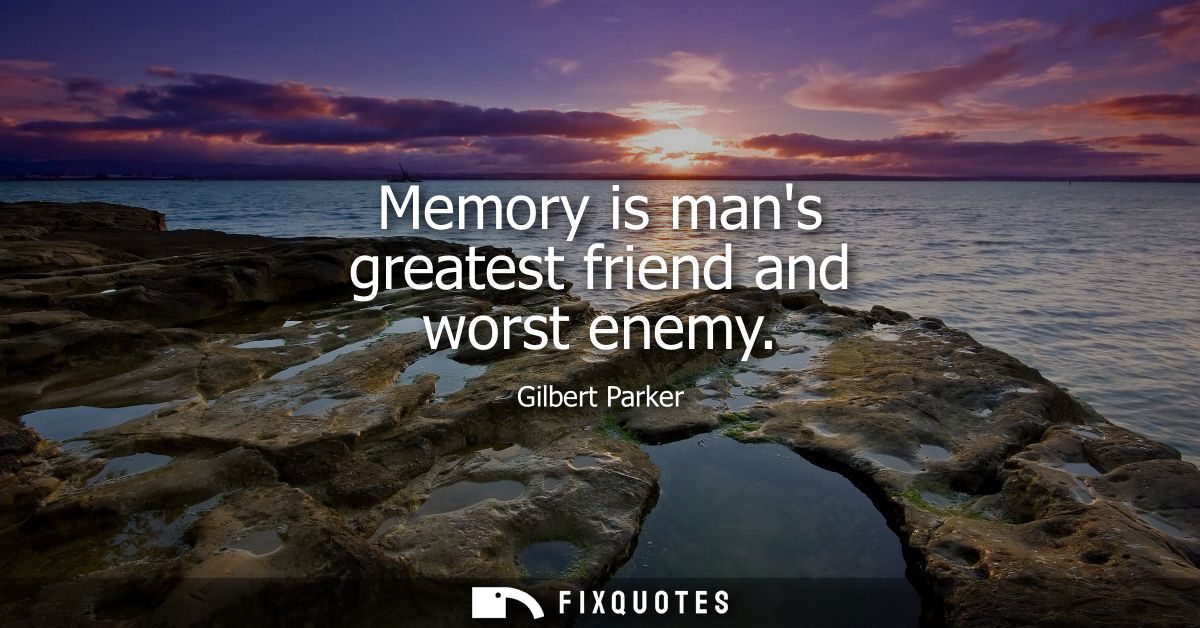
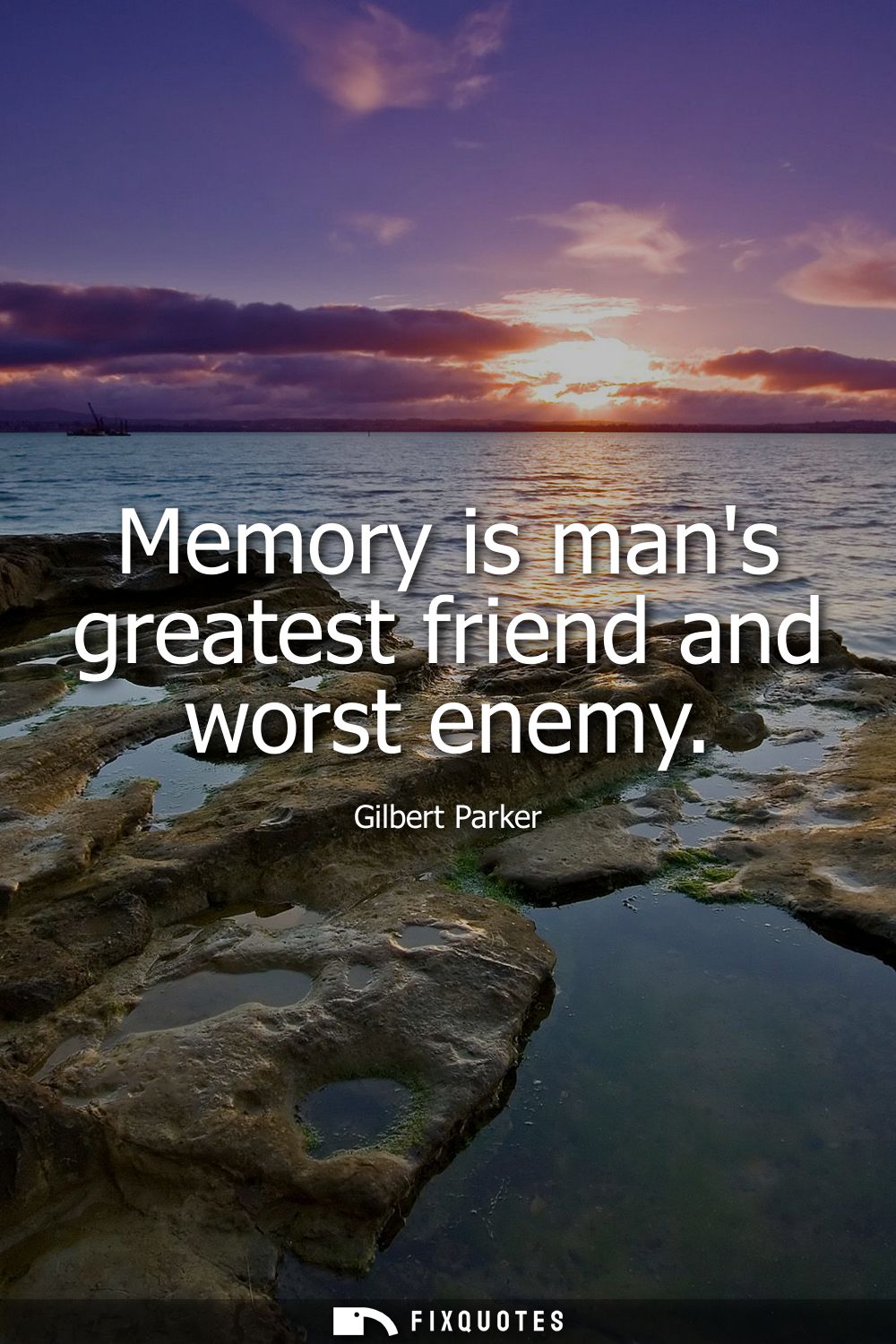
"Memory is man's greatest friend and worst enemy"
About this Quote
Memory is the one roommate you can never evict: it pays the rent when you need a name, a lesson, a way back home; it also breaks your things in the dark. Gilbert Parker, a politician steeped in the late-Victorian faith in character and the early-20th-century dread of decline, frames memory as a double agent precisely because public life depends on it. For a statesman, memory isn t a cozy scrapbook. It is the machinery of accountability: what you promised, what you voted for, what you once said before the stenographer made it permanent. That is the friend. It keeps continuity alive in a world that loves novelty and amnesia.
The enemy is more interesting. Parker s line recognizes that memory does not just preserve truth; it preserves grievance. Nations remember slights, families remember wounds, voters remember failures. In politics, the past is never past; it is a weapon that can be pulled from the holster on demand. The subtext is a warning about how identity hardens when it is built out of remembered injury, how nostalgia can be recruited as policy, how remorse can be useful until it becomes paralysis.
The sentence works because it refuses a comforting moral: memory is not inherently noble. The symmetry of "greatest friend" and "worst enemy" mimics the way remembrance swings from guidance to sabotage in a single moment. Parker isn t romanticizing trauma or praising forgetfulness; he is naming the real hazard of a modern public sphere where history can educate, and also endlessly indict.
The enemy is more interesting. Parker s line recognizes that memory does not just preserve truth; it preserves grievance. Nations remember slights, families remember wounds, voters remember failures. In politics, the past is never past; it is a weapon that can be pulled from the holster on demand. The subtext is a warning about how identity hardens when it is built out of remembered injury, how nostalgia can be recruited as policy, how remorse can be useful until it becomes paralysis.
The sentence works because it refuses a comforting moral: memory is not inherently noble. The symmetry of "greatest friend" and "worst enemy" mimics the way remembrance swings from guidance to sabotage in a single moment. Parker isn t romanticizing trauma or praising forgetfulness; he is naming the real hazard of a modern public sphere where history can educate, and also endlessly indict.
Quote Details
| Topic | Wisdom |
|---|---|
| Source | Help us find the source |
| Cite |
Citation Formats
APA Style (7th ed.)
Parker, Gilbert. (2026, January 15). Memory is man's greatest friend and worst enemy. FixQuotes. https://fixquotes.com/quotes/memory-is-mans-greatest-friend-and-worst-enemy-142526/
Chicago Style
Parker, Gilbert. "Memory is man's greatest friend and worst enemy." FixQuotes. January 15, 2026. https://fixquotes.com/quotes/memory-is-mans-greatest-friend-and-worst-enemy-142526/.
MLA Style (9th ed.)
"Memory is man's greatest friend and worst enemy." FixQuotes, 15 Jan. 2026, https://fixquotes.com/quotes/memory-is-mans-greatest-friend-and-worst-enemy-142526/. Accessed 12 Feb. 2026.
More Quotes by Gilbert
Add to List