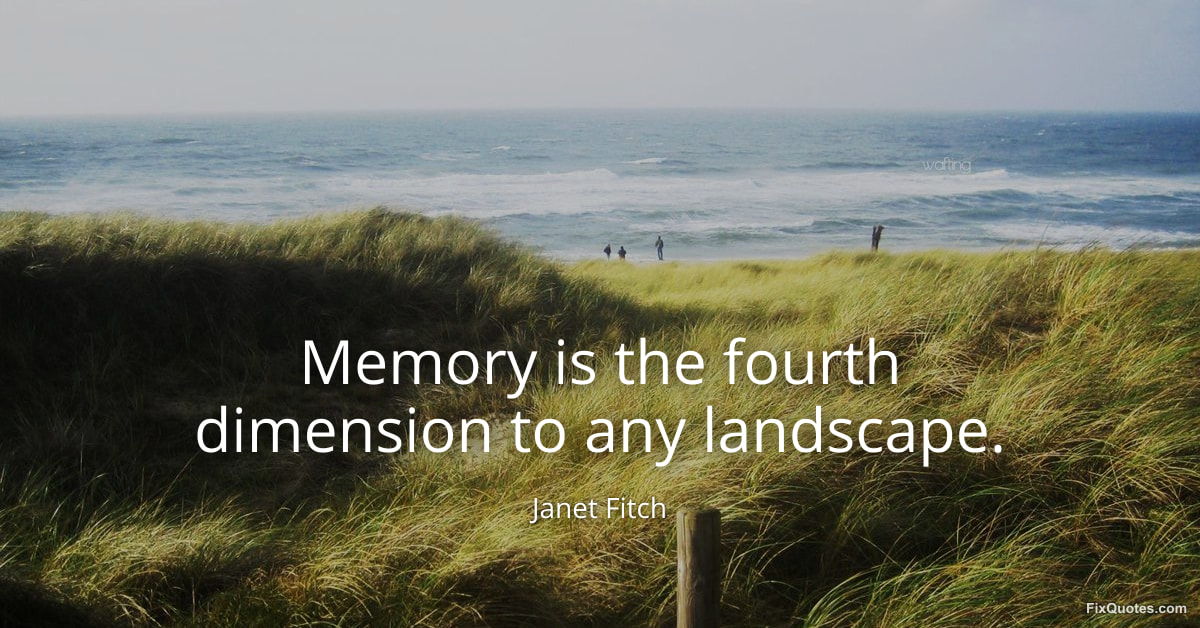
"Memory is the fourth dimension to any landscape"
About this Quote
Landscape is supposed to be the stable part of a story: mountains don’t flinch, streets don’t confess. Janet Fitch quietly detonates that illusion by adding “memory” as a fourth dimension, the unseen axis that turns a place into a personal time machine. It’s a move that feels especially Fitch: her fiction is saturated with the way environments absorb trauma, desire, and reinvention, then hand them back to us later like a scent you can’t name but can’t ignore.
The line works because it treats geography as incomplete without interior history. “Fourth dimension” borrows the authority of physics, but Fitch uses it to describe something messier: the way past experiences warp perception. A childhood bedroom isn’t a set of measurements; it’s a pressure system. A city block is never just “there” once you’ve been broken on it, loved on it, survived on it. Memory adds depth, but it also adds distortion. You can stand in the same spot and occupy different emotional coordinates depending on what you’re carrying.
There’s subtext here about ownership and power. Maps claim objectivity; memory refuses it. Two people can share a landscape and live in different worlds, because the “dimension” Fitch names is private, unequal, and sometimes involuntary. It’s also political in a quiet way: whose memories get preserved, whose are erased, which neighborhoods become “historic” and which become disposable.
Fitch’s intent isn’t to romanticize nostalgia. It’s to insist that place is always haunted - and that those hauntings are part of the real terrain.
The line works because it treats geography as incomplete without interior history. “Fourth dimension” borrows the authority of physics, but Fitch uses it to describe something messier: the way past experiences warp perception. A childhood bedroom isn’t a set of measurements; it’s a pressure system. A city block is never just “there” once you’ve been broken on it, loved on it, survived on it. Memory adds depth, but it also adds distortion. You can stand in the same spot and occupy different emotional coordinates depending on what you’re carrying.
There’s subtext here about ownership and power. Maps claim objectivity; memory refuses it. Two people can share a landscape and live in different worlds, because the “dimension” Fitch names is private, unequal, and sometimes involuntary. It’s also political in a quiet way: whose memories get preserved, whose are erased, which neighborhoods become “historic” and which become disposable.
Fitch’s intent isn’t to romanticize nostalgia. It’s to insist that place is always haunted - and that those hauntings are part of the real terrain.
Quote Details
| Topic | Nostalgia |
|---|---|
| Source | Help us find the source |
| Cite |
Citation Formats
APA Style (7th ed.)
Fitch, Janet. (2026, January 11). Memory is the fourth dimension to any landscape. FixQuotes. https://fixquotes.com/quotes/memory-is-the-fourth-dimension-to-any-landscape-183833/
Chicago Style
Fitch, Janet. "Memory is the fourth dimension to any landscape." FixQuotes. January 11, 2026. https://fixquotes.com/quotes/memory-is-the-fourth-dimension-to-any-landscape-183833/.
MLA Style (9th ed.)
"Memory is the fourth dimension to any landscape." FixQuotes, 11 Jan. 2026, https://fixquotes.com/quotes/memory-is-the-fourth-dimension-to-any-landscape-183833/. Accessed 12 Feb. 2026.
More Quotes by Janet
Add to List