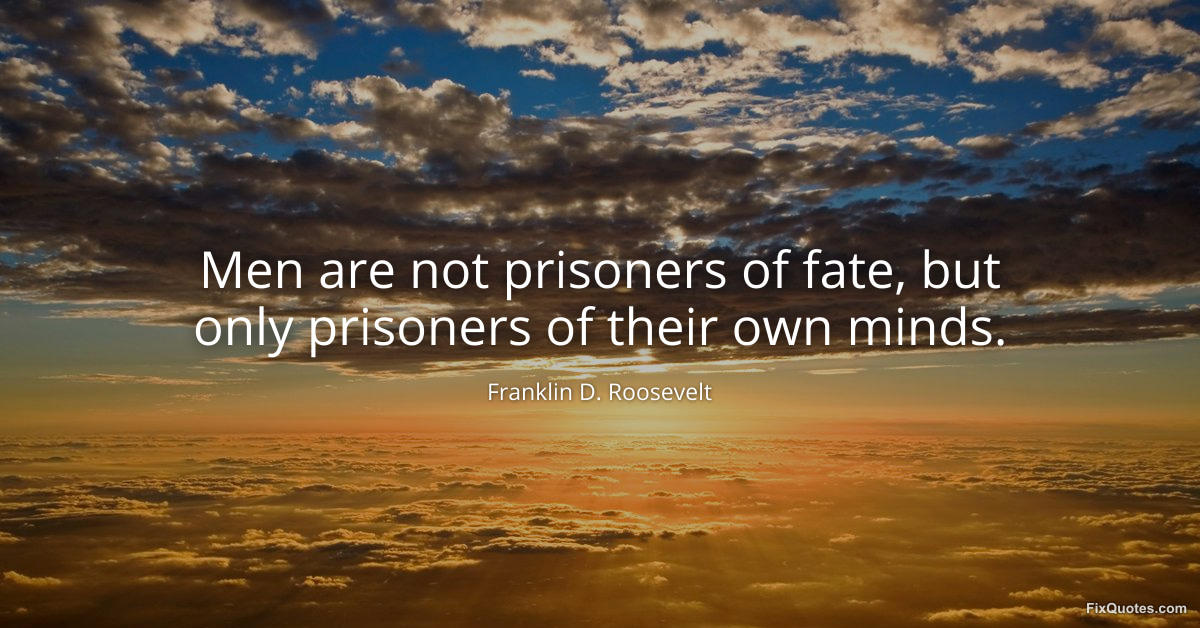
"Men are not prisoners of fate, but only prisoners of their own minds"
About this Quote
The subtext is political as much as personal. Roosevelt governed through the Depression and a world war, eras when “fate” would have been an easy alibi for paralysis. His presidency was built on the opposite claim: that public confidence is a material force. “Fear itself” wasn’t just rhetoric; it was an operating theory of government in crisis. If panic can collapse banks, then courage and collective belief can reopen them. The mind becomes infrastructure.
There’s also a sharp, almost paternal edge: if you’re stuck, you’re complicit. That’s motivating, and potentially scolding. It risks downplaying structural constraints - poverty, discrimination, illness - that are more than bad attitudes. But the sentence works because it’s not a policy memo; it’s a moral reframe. Roosevelt offers a democracy-friendly version of stoicism: you may not control the storm, but you can refuse to be hypnotized by it. In a century defined by mass anxiety and mass persuasion, that’s less self-help than civic survival.
Quote Details
| Topic | Free Will & Fate |
|---|---|
| Source | Help us find the source |
| Cite |
Citation Formats
APA Style (7th ed.)
Roosevelt, Franklin D. (2026, January 15). Men are not prisoners of fate, but only prisoners of their own minds. FixQuotes. https://fixquotes.com/quotes/men-are-not-prisoners-of-fate-but-only-prisoners-35984/
Chicago Style
Roosevelt, Franklin D. "Men are not prisoners of fate, but only prisoners of their own minds." FixQuotes. January 15, 2026. https://fixquotes.com/quotes/men-are-not-prisoners-of-fate-but-only-prisoners-35984/.
MLA Style (9th ed.)
"Men are not prisoners of fate, but only prisoners of their own minds." FixQuotes, 15 Jan. 2026, https://fixquotes.com/quotes/men-are-not-prisoners-of-fate-but-only-prisoners-35984/. Accessed 25 Mar. 2026.