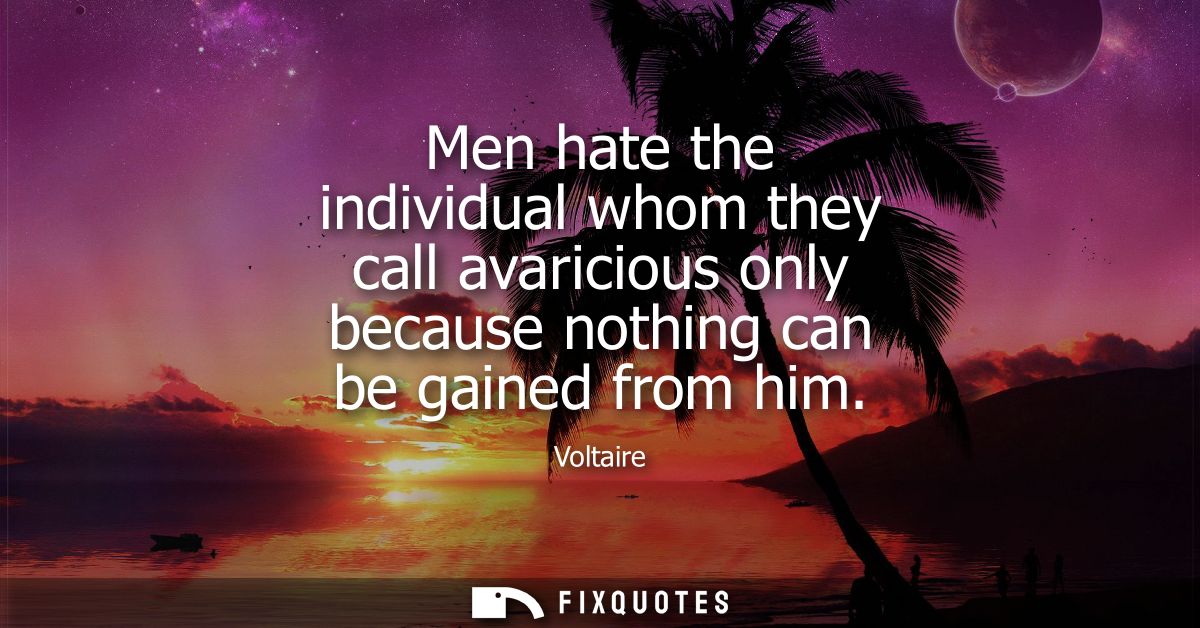
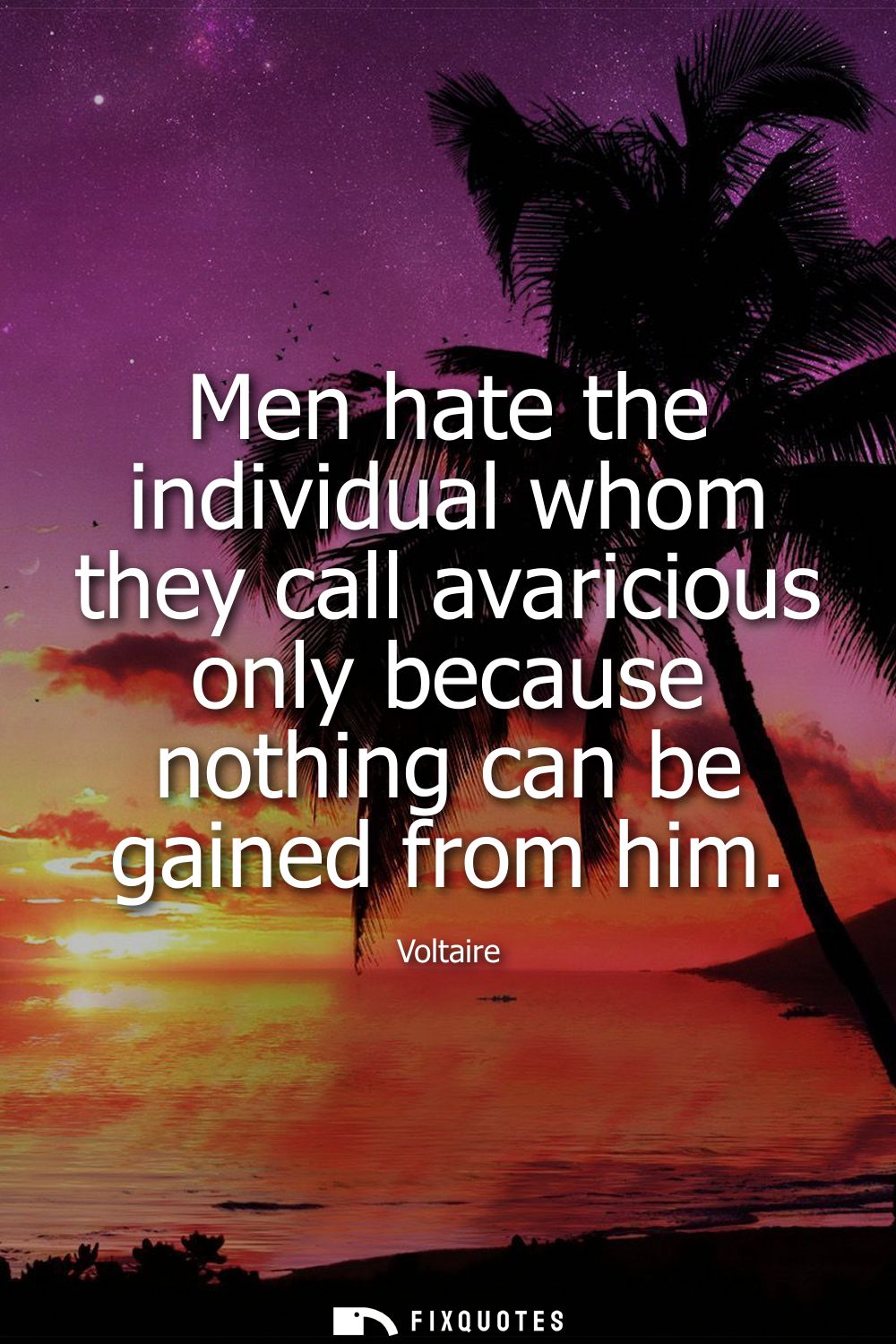
"Men hate the individual whom they call avaricious only because nothing can be gained from him"
About this Quote
The line works because it flips the moral script. “Avaricious” reads like an ethical diagnosis, but Voltaire treats it as a label deployed by people who feel cheated of a payout. It’s cynicism with surgical timing: the hatred is less about virtue than about a blocked pipeline of benefit. Even the grammar is accusatory - “whom they call” suggests hearsay, a verdict reached by consensus rather than evidence, the kind of public morality that runs on gossip and self-interest.
In Voltaire’s France, this lands as more than a cocktail-party epigram. An ancien regime society ran on patronage, pensions, courtly access, church preferments - networks where survival and status depended on who could be induced to give. A person who won’t distribute, sponsor, or bribe doesn’t just seem ungenerous; he threatens the system’s informal payments. Voltaire, lifelong skeptic of sanctimony and institutional pieties, uses the “avaricious” figure as a mirror: the crowd’s righteousness is just frustrated appetite dressed up as ethics.
Quote Details
| Topic | Wisdom |
|---|---|
| Source | Help us find the source |
| Cite |
Citation Formats
APA Style (7th ed.)
Voltaire. (2026, January 14). Men hate the individual whom they call avaricious only because nothing can be gained from him. FixQuotes. https://fixquotes.com/quotes/men-hate-the-individual-whom-they-call-avaricious-10656/
Chicago Style
Voltaire. "Men hate the individual whom they call avaricious only because nothing can be gained from him." FixQuotes. January 14, 2026. https://fixquotes.com/quotes/men-hate-the-individual-whom-they-call-avaricious-10656/.
MLA Style (9th ed.)
"Men hate the individual whom they call avaricious only because nothing can be gained from him." FixQuotes, 14 Jan. 2026, https://fixquotes.com/quotes/men-hate-the-individual-whom-they-call-avaricious-10656/. Accessed 11 Feb. 2026.