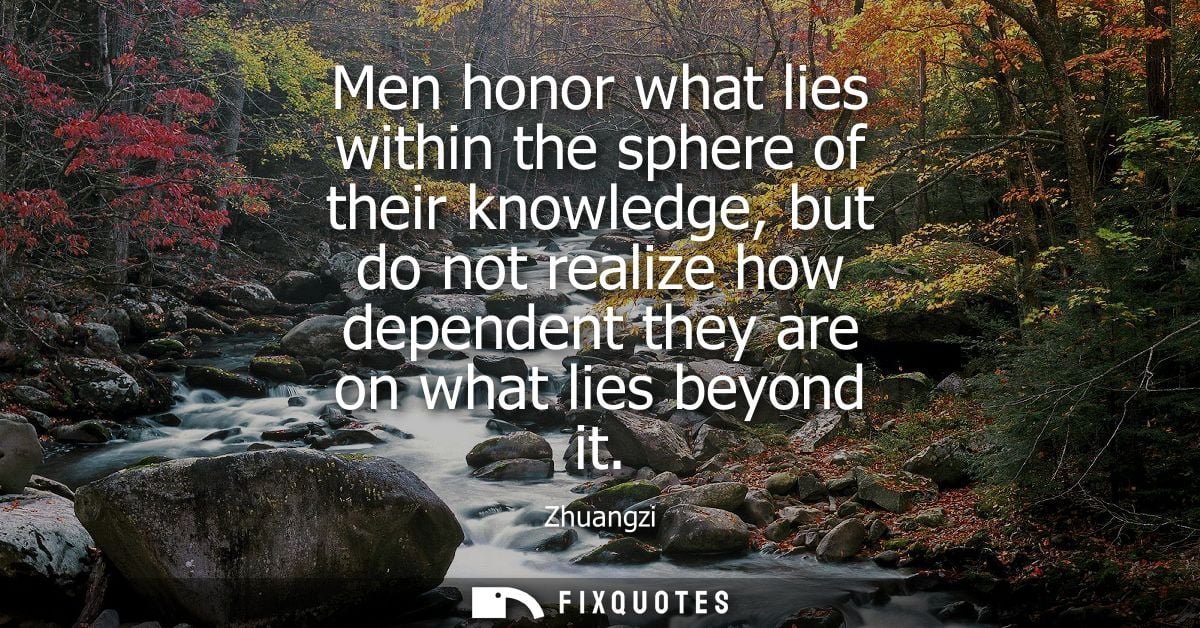
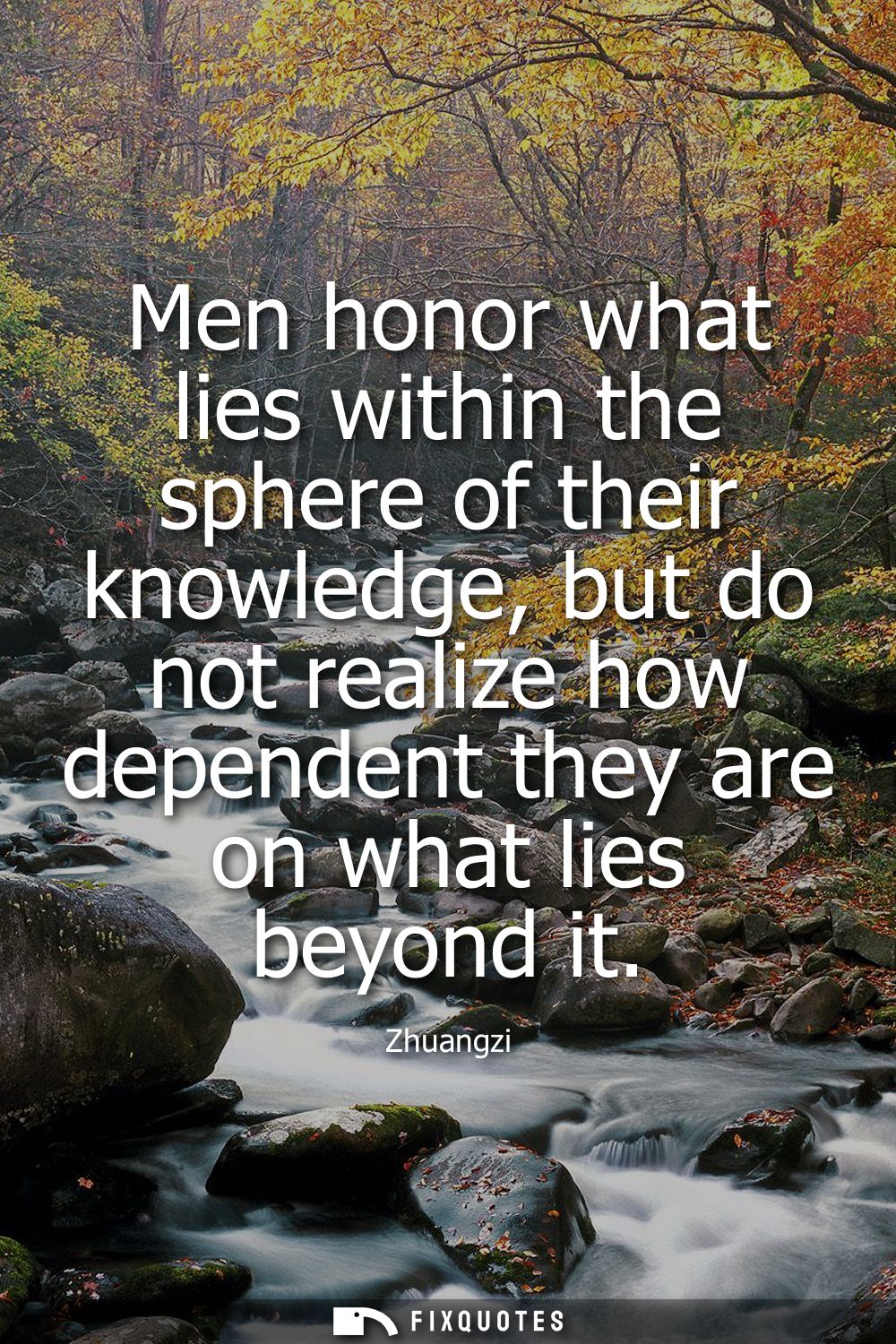
"Men honor what lies within the sphere of their knowledge, but do not realize how dependent they are on what lies beyond it"
About this Quote
Certainty, Zhuangzi suggests, is a local custom: we praise what we can name, measure, and domesticate, then mistake that small province for the whole map. The line flatters and punctures the reader at once. Of course we honor knowledge - it keeps us alive, organized, respectable. But the twist is the quiet humiliation: the parts of reality we treat as marginal or unknowable are the very things holding up our lives, our systems, our self-image. Dependence is the unglamorous truth beneath intellectual pride.
The intent isn’t anti-knowledge so much as anti-arrogance. In Zhuangzi’s Daoist context, human categories are useful tools that become tyrants when confused for nature itself. “Sphere” matters: knowledge is a bounded zone, and boundaries create an inside that feels safe and an outside we can dismiss. That structure mirrors how societies work: experts, rituals, and orthodoxies gain prestige by policing the edge of what counts as “known,” while everything else is labeled superstition, noise, or irrelevance - until it returns as chaos, luck, weather, illness, or political backlash.
The subtext lands as a critique of status. People don’t just “know”; they build identities and hierarchies around knowing. Zhuangzi’s jab is that reality doesn’t reward that vanity. The unknowable isn’t a romantic abyss; it’s the infrastructure of existence: contingency, context, the Dao itself. The quote’s power is its reversal of control. We don’t stand on knowledge; knowledge stands on what we cannot fully grasp.
The intent isn’t anti-knowledge so much as anti-arrogance. In Zhuangzi’s Daoist context, human categories are useful tools that become tyrants when confused for nature itself. “Sphere” matters: knowledge is a bounded zone, and boundaries create an inside that feels safe and an outside we can dismiss. That structure mirrors how societies work: experts, rituals, and orthodoxies gain prestige by policing the edge of what counts as “known,” while everything else is labeled superstition, noise, or irrelevance - until it returns as chaos, luck, weather, illness, or political backlash.
The subtext lands as a critique of status. People don’t just “know”; they build identities and hierarchies around knowing. Zhuangzi’s jab is that reality doesn’t reward that vanity. The unknowable isn’t a romantic abyss; it’s the infrastructure of existence: contingency, context, the Dao itself. The quote’s power is its reversal of control. We don’t stand on knowledge; knowledge stands on what we cannot fully grasp.
Quote Details
| Topic | Chinese Proverbs |
|---|
More Quotes by Zhuangzi
Add to List