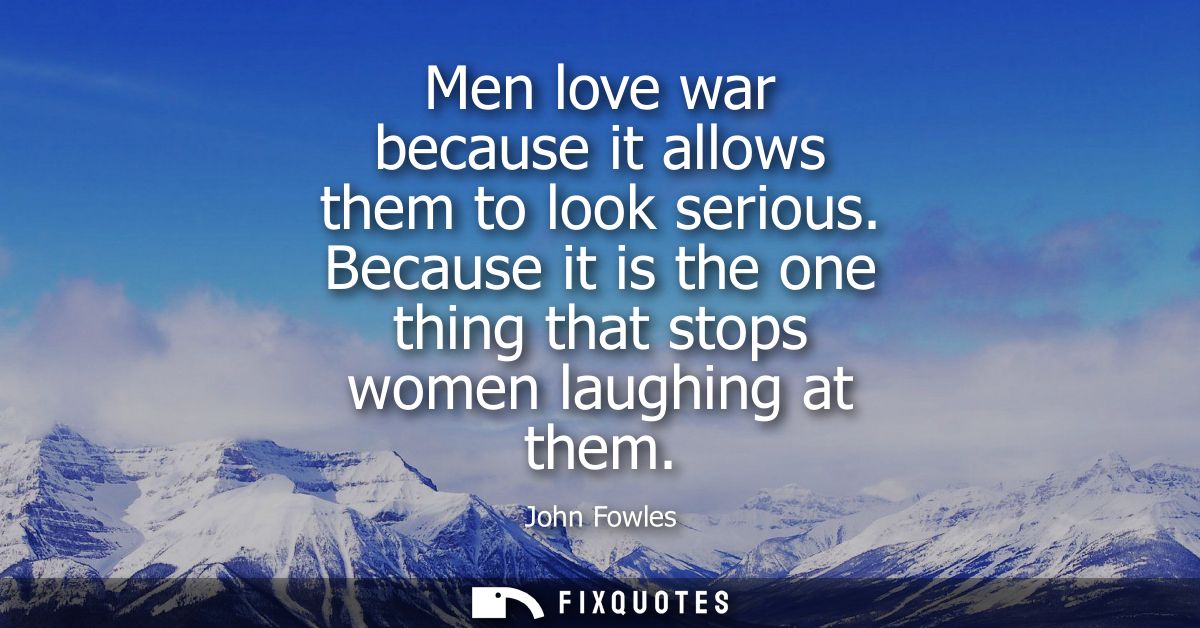
"Men love war because it allows them to look serious. Because it is the one thing that stops women laughing at them"
About this Quote
The second sentence sharpens into a cruel little theory of gendered power. Women’s laughter stands in for a specific threat: being seen through. To be laughed at is to have the script rewritten from hero to boy, from commander to pretender. Fowles implies that war offers an escape hatch from that vulnerability, because war sanctifies male posturing. It makes emotional illiteracy read as stoicism, aggression read as duty, and insecurity read as honor.
Context matters: Fowles writes in the long shadow of World War II and alongside the late-20th-century dismantling of traditional male authority. As feminism and postwar skepticism strip away the automatic respect once granted to “men being men,” war becomes, in his cynical diagnosis, the last refuge of unquestioned male significance. It’s not an argument that women cause war; it’s an indictment of a culture that trains men to fear ridicule more than bloodshed, and then hands them a socially approved arena where nobody’s allowed to laugh.
Quote Details
| Topic | War |
|---|---|
| Source | Help us find the source |
| Cite |
Citation Formats
APA Style (7th ed.)
Fowles, John. (2026, January 17). Men love war because it allows them to look serious. Because it is the one thing that stops women laughing at them. FixQuotes. https://fixquotes.com/quotes/men-love-war-because-it-allows-them-to-look-56586/
Chicago Style
Fowles, John. "Men love war because it allows them to look serious. Because it is the one thing that stops women laughing at them." FixQuotes. January 17, 2026. https://fixquotes.com/quotes/men-love-war-because-it-allows-them-to-look-56586/.
MLA Style (9th ed.)
"Men love war because it allows them to look serious. Because it is the one thing that stops women laughing at them." FixQuotes, 17 Jan. 2026, https://fixquotes.com/quotes/men-love-war-because-it-allows-them-to-look-56586/. Accessed 28 Mar. 2026.