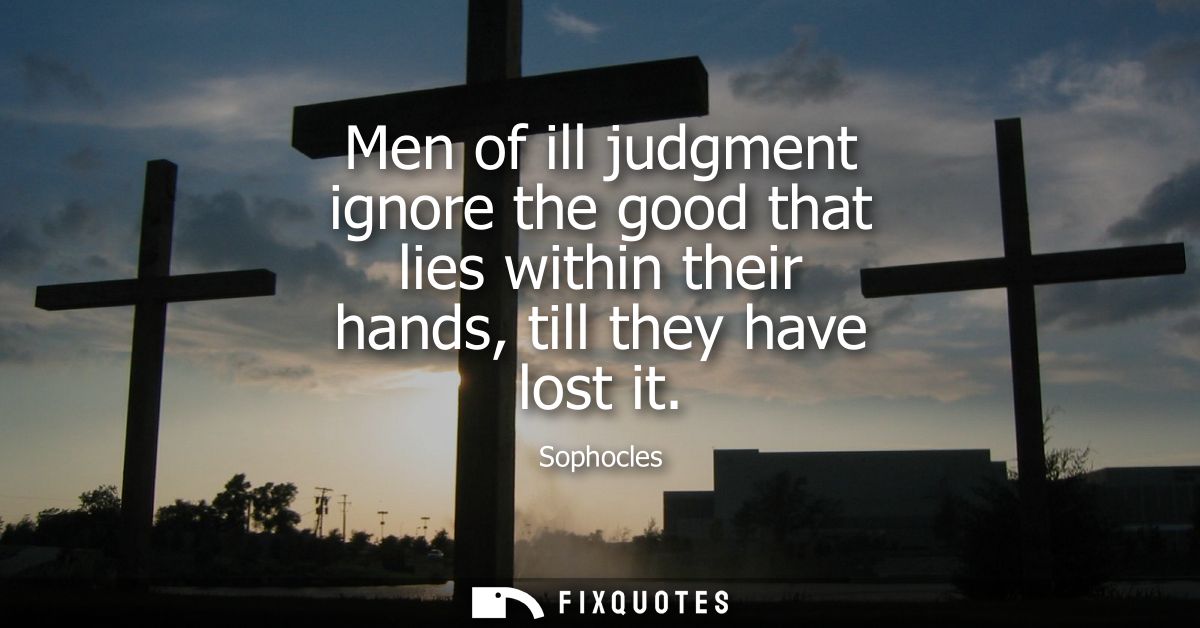
"Men of ill judgment ignore the good that lies within their hands, till they have lost it"
About this Quote
The subtext is sharply Greek: fate may set the stage, but character delivers the catastrophe. Sophoclean tragedy often turns on a protagonist’s inability to see what’s right in front of him, a blindness that is moral as much as perceptual. This is the logic of hubris in miniature - the belief that what you have is secure, replaceable, or beneath you, until the gods, the city, or time itself proves otherwise. The line also implies a cruel economy of attention: the good is not self-advertising. It requires discernment, gratitude, restraint - virtues that don’t feel heroic until they’re gone.
Contextually, Sophocles wrote for an Athens obsessed with judgment: juries, assemblies, military decisions, reputation. “Within their hands” could be a household, a political settlement, a moment of mercy. His warning doubles as civic criticism: communities, like men, squander stability and then mythologize the collapse as inevitable. The power of the sentence is its timing: it speaks from the after, from the instant when hindsight becomes punishment.
Quote Details
| Topic | Gratitude |
|---|---|
| Source | Help us find the source |
| Cite |
Citation Formats
APA Style (7th ed.)
Sophocles. (2026, January 17). Men of ill judgment ignore the good that lies within their hands, till they have lost it. FixQuotes. https://fixquotes.com/quotes/men-of-ill-judgment-ignore-the-good-that-lies-32917/
Chicago Style
Sophocles. "Men of ill judgment ignore the good that lies within their hands, till they have lost it." FixQuotes. January 17, 2026. https://fixquotes.com/quotes/men-of-ill-judgment-ignore-the-good-that-lies-32917/.
MLA Style (9th ed.)
"Men of ill judgment ignore the good that lies within their hands, till they have lost it." FixQuotes, 17 Jan. 2026, https://fixquotes.com/quotes/men-of-ill-judgment-ignore-the-good-that-lies-32917/. Accessed 12 Feb. 2026.