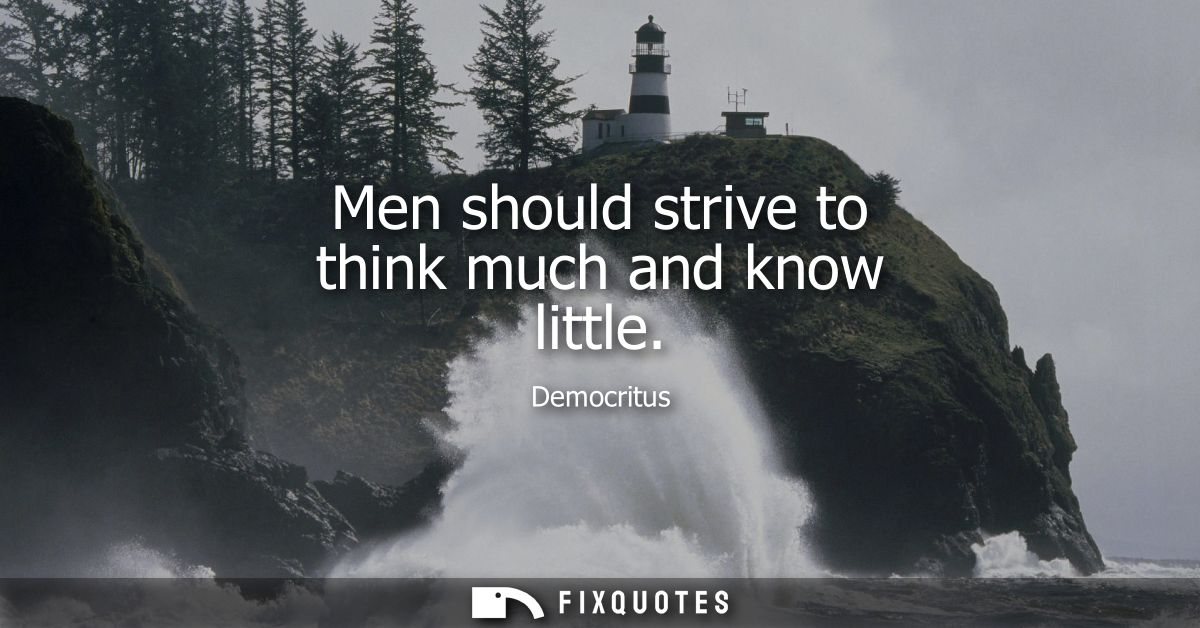
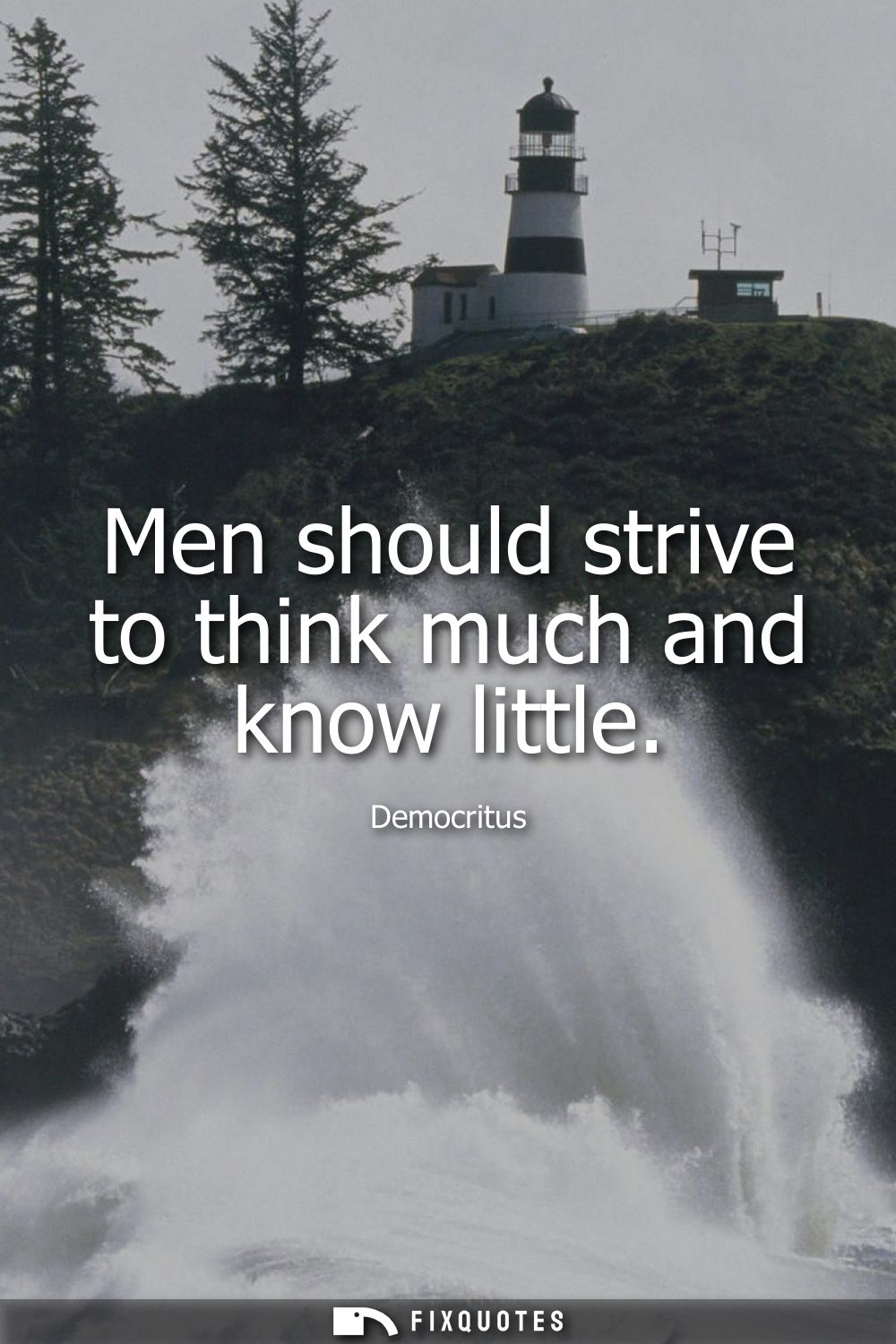
"Men should strive to think much and know little"
About this Quote
Aphorisms like this are meant to sting a little, and Democritus aims it at the most flattering kind of self-deception: the belief that stockpiling facts makes you wise. “Think much and know little” isn’t an anti-intellectual shrug; it’s a disciplined provocation. He’s separating two activities that people love to blur. “Knowing” can be inert: names, dates, doctrines, the reassuring feeling that the world is cataloged. “Thinking,” in his usage, is active labor - testing assumptions, pulling apart appearances, living with uncertainty long enough to see what holds.
The subtext is almost ethical. To “know much” is to risk the arrogance that your mental inventory equals reality; to “know little” is to keep your mind porous, responsive, less tempted by dogma. Democritus, the atomist, had every reason to be suspicious of overconfident knowledge claims. His whole project depended on arguing that what we perceive is not what fundamentally is: the senses report surfaces; the mind has to infer structures. That makes humility a method, not a personality trait.
There’s also a cultural edge. In a Greece where rhetorical display and public certainty were social currencies, advising “know little” is a quiet rebuke to intellectual status-seeking. Think more than you posture. Trade the performance of mastery for the harder work of inquiry. The line works because it flips the normal hierarchy: ignorance becomes not a deficit, but a guardrail against the smugness that kills thought.
The subtext is almost ethical. To “know much” is to risk the arrogance that your mental inventory equals reality; to “know little” is to keep your mind porous, responsive, less tempted by dogma. Democritus, the atomist, had every reason to be suspicious of overconfident knowledge claims. His whole project depended on arguing that what we perceive is not what fundamentally is: the senses report surfaces; the mind has to infer structures. That makes humility a method, not a personality trait.
There’s also a cultural edge. In a Greece where rhetorical display and public certainty were social currencies, advising “know little” is a quiet rebuke to intellectual status-seeking. Think more than you posture. Trade the performance of mastery for the harder work of inquiry. The line works because it flips the normal hierarchy: ignorance becomes not a deficit, but a guardrail against the smugness that kills thought.
Quote Details
| Topic | Wisdom |
|---|---|
| Source | Help us find the source |
| Cite |
Citation Formats
APA Style (7th ed.)
Democritus. (2026, January 17). Men should strive to think much and know little. FixQuotes. https://fixquotes.com/quotes/men-should-strive-to-think-much-and-know-little-27225/
Chicago Style
Democritus. "Men should strive to think much and know little." FixQuotes. January 17, 2026. https://fixquotes.com/quotes/men-should-strive-to-think-much-and-know-little-27225/.
MLA Style (9th ed.)
"Men should strive to think much and know little." FixQuotes, 17 Jan. 2026, https://fixquotes.com/quotes/men-should-strive-to-think-much-and-know-little-27225/. Accessed 23 Mar. 2026.
More Quotes by Democritus
Add to List