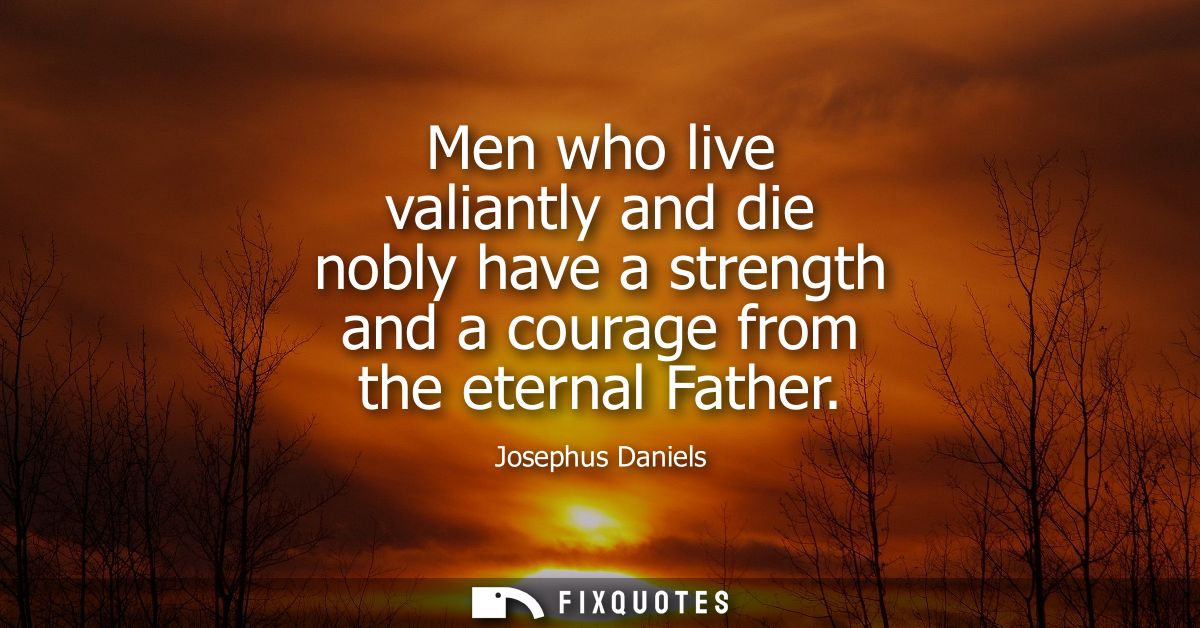
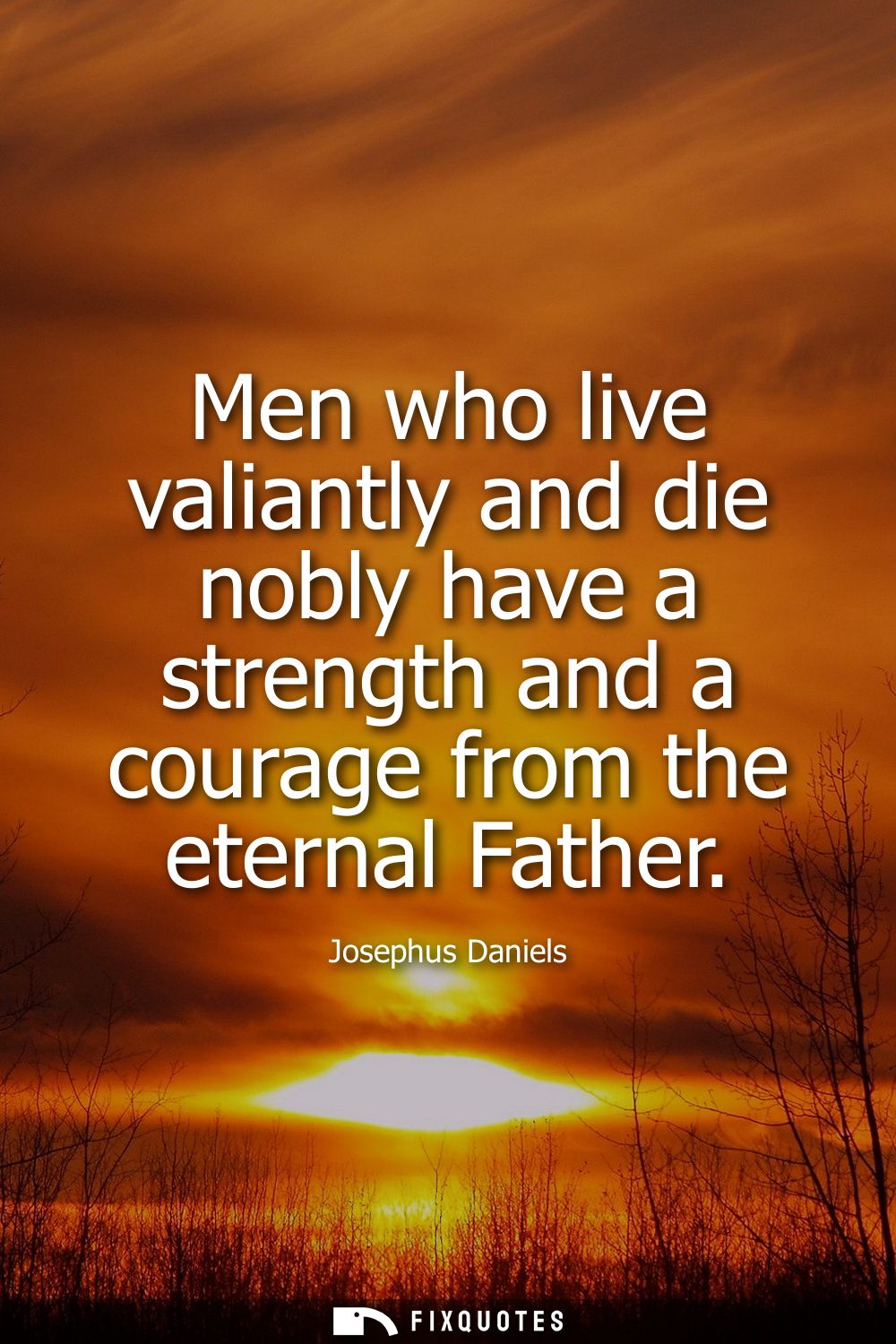
"Men who live valiantly and die nobly have a strength and a courage from the eternal Father"
About this Quote
The intent is political in the oldest sense: to bind private sacrifice to public purpose. "Live valiantly" sets a lifelong expectation of disciplined masculinity; "die nobly" completes the script, framing death not as catastrophe or waste but as a culminating act with meaning. The theological pivot matters. Once courage is sourced from an "eternal Father", dissent becomes harder to articulate without sounding faithless, ungrateful, or even unmanly. It’s a rhetorical shortcut that turns grief into affirmation and questions into impiety.
The subtext also reveals who is being addressed and who is being managed. This is the language of memorials, wartime speeches, and civic ceremonies where the state needs consent more than it needs nuance. Daniels is offering consolation, yes, but it’s the kind of consolation that keeps the machinery running: a promise that the cost paid in blood is not random, not political, not contingent, but cosmically accounted for. In that move, the quote performs its real work: it steadies the public narrative at the precise moment it might fracture.
Quote Details
| Topic | God |
|---|---|
| Source | Help us find the source |
| Cite |
Citation Formats
APA Style (7th ed.)
Daniels, Josephus. (2026, January 16). Men who live valiantly and die nobly have a strength and a courage from the eternal Father. FixQuotes. https://fixquotes.com/quotes/men-who-live-valiantly-and-die-nobly-have-a-107314/
Chicago Style
Daniels, Josephus. "Men who live valiantly and die nobly have a strength and a courage from the eternal Father." FixQuotes. January 16, 2026. https://fixquotes.com/quotes/men-who-live-valiantly-and-die-nobly-have-a-107314/.
MLA Style (9th ed.)
"Men who live valiantly and die nobly have a strength and a courage from the eternal Father." FixQuotes, 16 Jan. 2026, https://fixquotes.com/quotes/men-who-live-valiantly-and-die-nobly-have-a-107314/. Accessed 3 Apr. 2026.