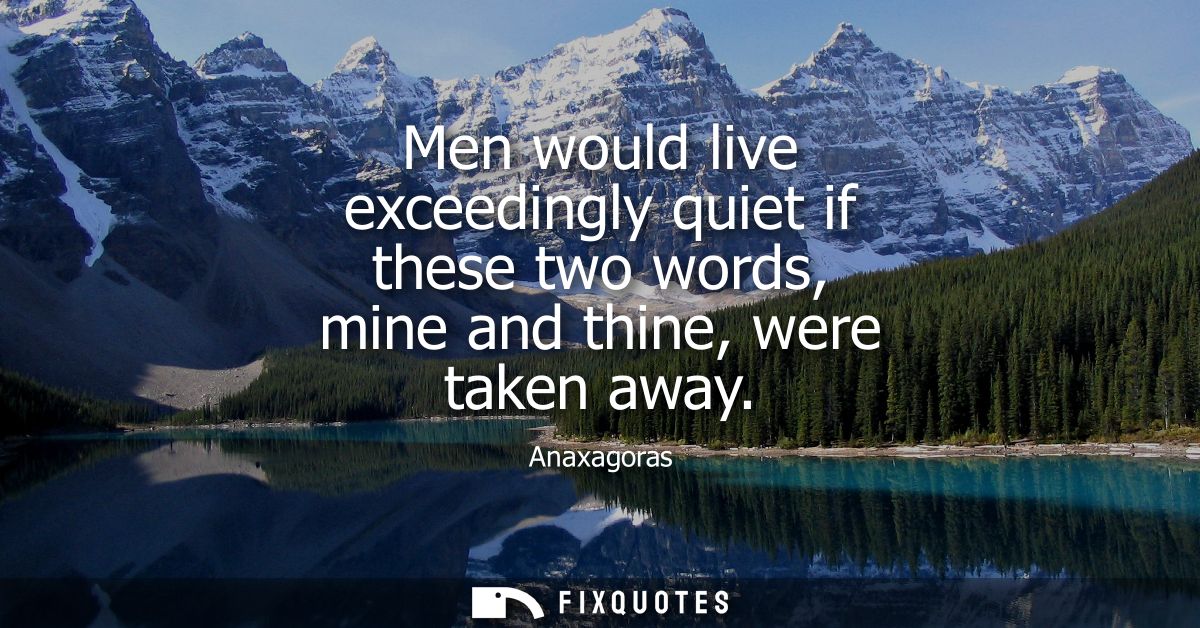
"Men would live exceedingly quiet if these two words, mine and thine, were taken away"
About this Quote
The intent is sharper than a plea for generosity. It’s a philosophical provocation about how social conflict is manufactured. "Mine" and "thine" are tiny words that create entire moral architectures: entitlement, envy, resentment, theft, honor, inheritance. They also imply exclusion. The moment something is "mine", someone else is necessarily not me, not included, not allowed. Quiet disappears because defense becomes perpetual: defending land, status, reputation, even ideas as intellectual property avant la lettre.
There’s subtexted austerity here, almost anti-political: peace isn’t achieved by better leaders or cleaner laws, but by shrinking the very category of ownership that law exists to protect. In an era when wealth and power were visibly tethered to property and citizenship, Anaxagoras’s claim reads like a heresy aimed at the civic order itself. It’s also psychologically modern: he’s pointing to how possessiveness colonizes attention, turning daily life into anxious bookkeeping. Remove the pronouns of possession and you don’t just redistribute goods; you de-escalate identity.
Quote Details
| Topic | Peace |
|---|---|
| Source | Verified source: Quote Junkie Funny Edition (Hagopian Institute, 2008)ISBN: 9781434895288 · ID: Zdvyw_Ui8_kC
Evidence:
... Men would live exceedingly quiet if these two words, mine and thine, were taken away. Anaxagoras Every act you have ever performed since the day you were born was performed because you wanted something. Andrew Carnegie Fear not, the ... |
| Cite |
Citation Formats
APA Style (7th ed.)
Anaxagoras. (2026, March 23). Men would live exceedingly quiet if these two words, mine and thine, were taken away. FixQuotes. https://fixquotes.com/quotes/men-would-live-exceedingly-quiet-if-these-two-108629/
Chicago Style
Anaxagoras. "Men would live exceedingly quiet if these two words, mine and thine, were taken away." FixQuotes. March 23, 2026. https://fixquotes.com/quotes/men-would-live-exceedingly-quiet-if-these-two-108629/.
MLA Style (9th ed.)
"Men would live exceedingly quiet if these two words, mine and thine, were taken away." FixQuotes, 23 Mar. 2026, https://fixquotes.com/quotes/men-would-live-exceedingly-quiet-if-these-two-108629/. Accessed 28 Mar. 2026.