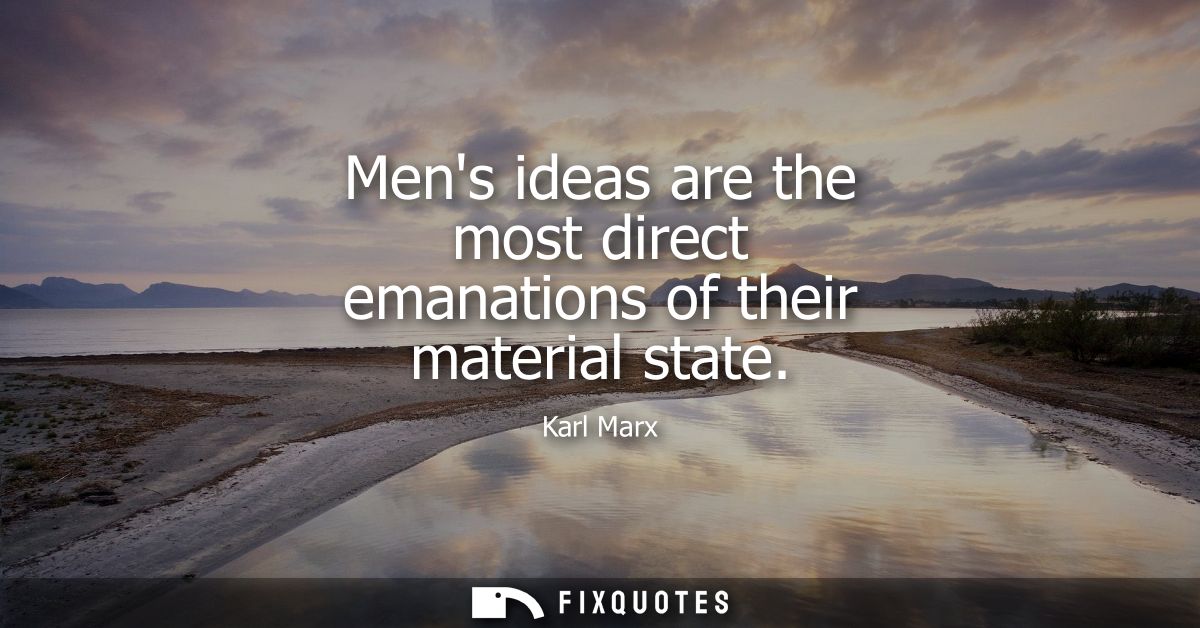
"Men's ideas are the most direct emanations of their material state"
About this Quote
Marx is throwing a Molotov cocktail at the flattering story people tell about themselves: that our politics, morals, and philosophies descend from pure reason, unsullied by money, work, hunger, or class. He’s insisting the opposite. What looks like lofty “ideas” is often the mind doing logistics for the body’s situation - translating paychecks, rents, property, and precarity into beliefs that feel principled. The line works because it’s bluntly anatomical: ideas “emanate,” like heat or breath. Thought isn’t an ivory-tower product; it’s a metabolic one.
The specific intent is polemical and tactical. Marx wants to demystify ideology - to show that dominant ideas don’t win because they’re truer, but because they’re convenient for the people whose material arrangements give them power. The subtext is accusatory: when a ruling class speaks in the language of “common sense” or “human nature,” it may be laundering self-interest into philosophy. At the same time, he’s also warning radicals against believing their own propaganda. If consciousness is shaped by conditions, then revolutionary clarity requires changing conditions, not just winning debates.
Context matters. Marx is writing against German Idealism, which treated history as the unfolding of Spirit or consciousness. He flips the causal arrow: factories, property relations, and labor discipline are the engine; politics and culture are the exhaust. That doesn’t reduce people to robots, but it does make “free thought” less heroic and more situated - an uncomfortable diagnosis that still explains why the same society can argue endlessly about values while refusing to touch wages, housing, and ownership.
The specific intent is polemical and tactical. Marx wants to demystify ideology - to show that dominant ideas don’t win because they’re truer, but because they’re convenient for the people whose material arrangements give them power. The subtext is accusatory: when a ruling class speaks in the language of “common sense” or “human nature,” it may be laundering self-interest into philosophy. At the same time, he’s also warning radicals against believing their own propaganda. If consciousness is shaped by conditions, then revolutionary clarity requires changing conditions, not just winning debates.
Context matters. Marx is writing against German Idealism, which treated history as the unfolding of Spirit or consciousness. He flips the causal arrow: factories, property relations, and labor discipline are the engine; politics and culture are the exhaust. That doesn’t reduce people to robots, but it does make “free thought” less heroic and more situated - an uncomfortable diagnosis that still explains why the same society can argue endlessly about values while refusing to touch wages, housing, and ownership.
Quote Details
| Topic | Deep |
|---|---|
| Source | Help us find the source |
| Cite |
Citation Formats
APA Style (7th ed.)
Marx, Karl. (2026, January 15). Men's ideas are the most direct emanations of their material state. FixQuotes. https://fixquotes.com/quotes/mens-ideas-are-the-most-direct-emanations-of-16579/
Chicago Style
Marx, Karl. "Men's ideas are the most direct emanations of their material state." FixQuotes. January 15, 2026. https://fixquotes.com/quotes/mens-ideas-are-the-most-direct-emanations-of-16579/.
MLA Style (9th ed.)
"Men's ideas are the most direct emanations of their material state." FixQuotes, 15 Jan. 2026, https://fixquotes.com/quotes/mens-ideas-are-the-most-direct-emanations-of-16579/. Accessed 20 Mar. 2026.
More Quotes by Karl
Add to List