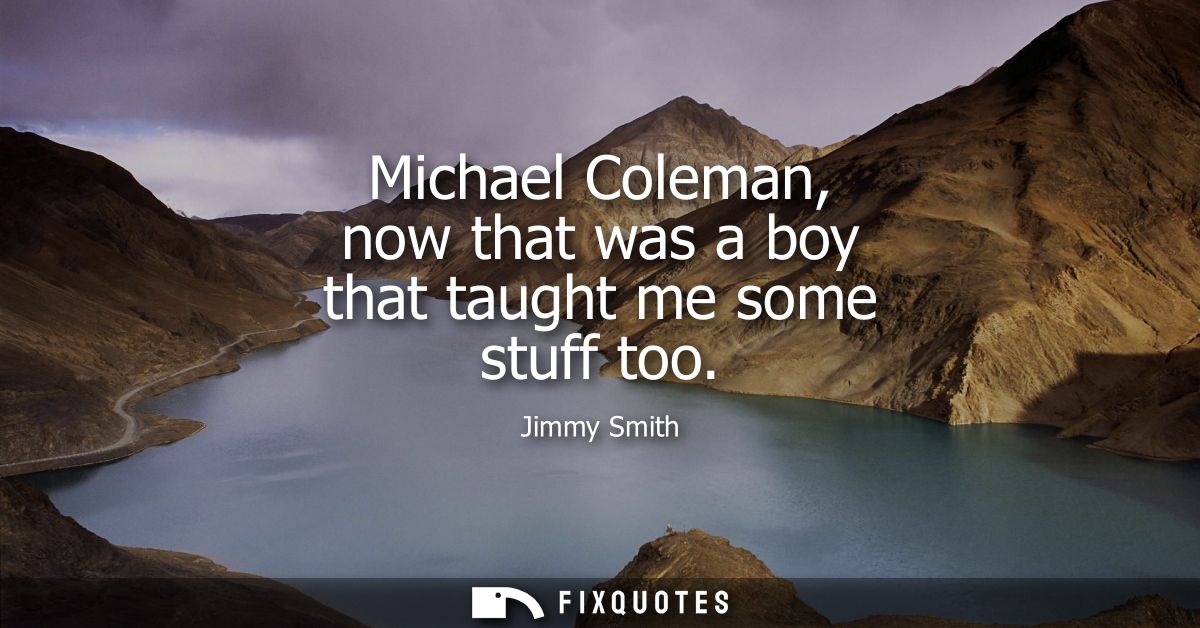
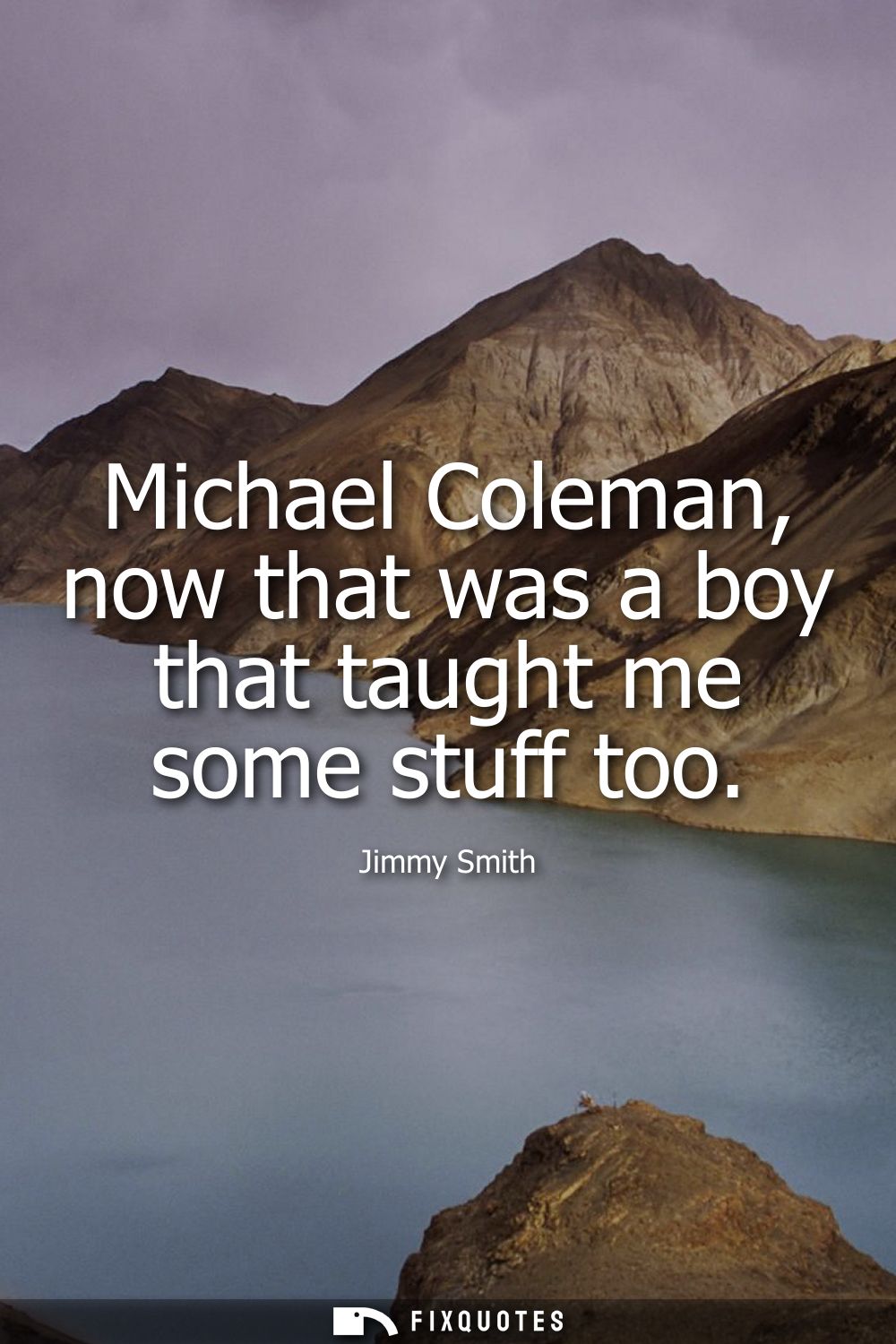
"Michael Coleman, now that was a boy that taught me some stuff too"
About this Quote
Michael Coleman is name-dropped like a private legend, and the casual grammar is doing half the work. "Now that was a boy" sounds throwaway, even folksy, but it’s a deliberate elevation: not a formal tribute, not a press-release compliment, more like a memory slipped across a table. Calling him "a boy" can read as affectionate and local, the way older speakers mark someone as belonging to a shared neighborhood or scene. It also smuggles in a hierarchy: the speaker is older, presumably experienced, and the surprise is that this younger figure flipped the usual direction of learning.
The line’s real engine is "taught me some stuff too". That "too" matters. It implies there are other teachers, other influences, maybe a whole apprenticeship story behind Jimmy Smith. Coleman isn’t the single hero; he’s a standout in a chain of respect. "Some stuff" keeps the content vague on purpose, which is how oral history often signals intimacy: if you were there, you know what the lessons were; if you weren’t, you don’t get the full inventory. It’s a boundary-setting move as much as it is praise.
Because the profession is unknown, the safest context is communal rather than institutional: sports, music, street knowledge, work ethic, hustling, craft. The intent is to credit Coleman without sentimentalizing him, to admit vulnerability without melodrama. It’s masculinity coded as modesty: admiration expressed as anecdote, gratitude disguised as casual talk.
The line’s real engine is "taught me some stuff too". That "too" matters. It implies there are other teachers, other influences, maybe a whole apprenticeship story behind Jimmy Smith. Coleman isn’t the single hero; he’s a standout in a chain of respect. "Some stuff" keeps the content vague on purpose, which is how oral history often signals intimacy: if you were there, you know what the lessons were; if you weren’t, you don’t get the full inventory. It’s a boundary-setting move as much as it is praise.
Because the profession is unknown, the safest context is communal rather than institutional: sports, music, street knowledge, work ethic, hustling, craft. The intent is to credit Coleman without sentimentalizing him, to admit vulnerability without melodrama. It’s masculinity coded as modesty: admiration expressed as anecdote, gratitude disguised as casual talk.
Quote Details
| Topic | Teaching |
|---|---|
| Source | Help us find the source |
| Cite |
Citation Formats
APA Style (7th ed.)
Smith, Jimmy. (2026, January 16). Michael Coleman, now that was a boy that taught me some stuff too. FixQuotes. https://fixquotes.com/quotes/michael-coleman-now-that-was-a-boy-that-taught-me-83669/
Chicago Style
Smith, Jimmy. "Michael Coleman, now that was a boy that taught me some stuff too." FixQuotes. January 16, 2026. https://fixquotes.com/quotes/michael-coleman-now-that-was-a-boy-that-taught-me-83669/.
MLA Style (9th ed.)
"Michael Coleman, now that was a boy that taught me some stuff too." FixQuotes, 16 Jan. 2026, https://fixquotes.com/quotes/michael-coleman-now-that-was-a-boy-that-taught-me-83669/. Accessed 31 Mar. 2026.
More Quotes by Jimmy
Add to List