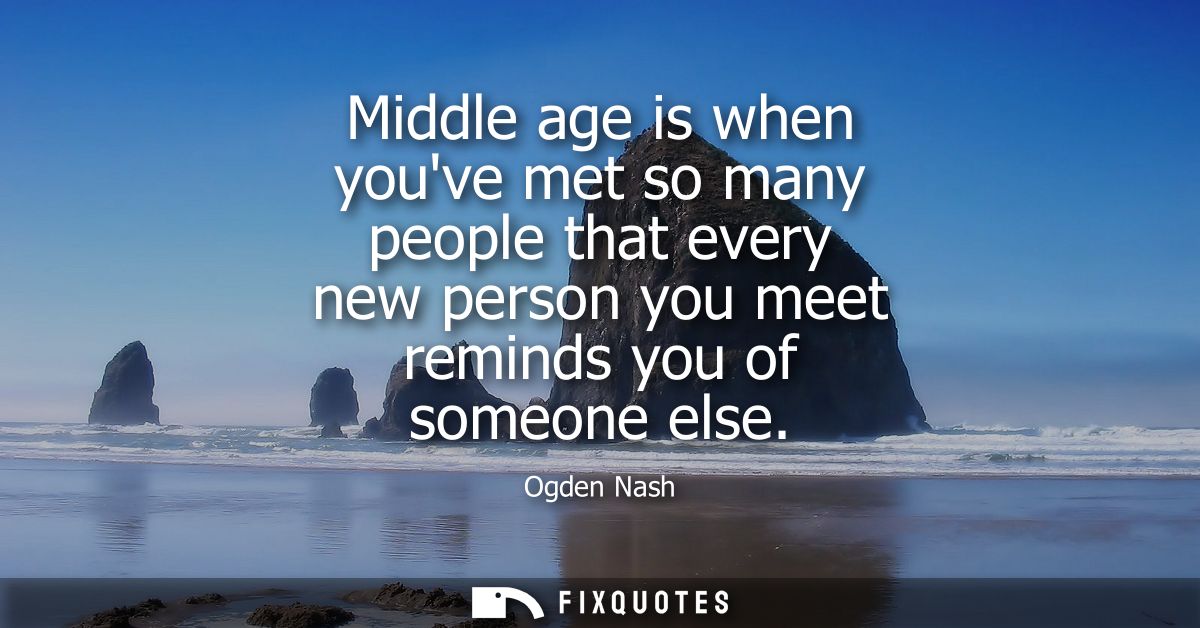
"Middle age is when you've met so many people that every new person you meet reminds you of someone else"
About this Quote
Nash was a poet of the punchline, but his humor has an edge: the joke isn't on "middle-aged people" so much as on the human brain, forever trying to save time by recycling impressions. There's an implied loss of attention here. When the mind reflexively says, "Oh, he's like so-and-so", it stops doing the harder work of seeing the person in front of you. The subtext is about empathy as an effortful practice, not a natural default.
Context matters: Nash wrote in an America newly fluent in mass culture and standardized types - the era of office life, suburbs, radio voices, and the rise of the "everyman" as a market category. His line reads like a wry defense mechanism against that sameness. If everyone starts to resemble someone else, it might be age, but it might also be modernity: the suspicion that we're all becoming versions of versions, and calling it wisdom.
Quote Details
| Topic | Aging |
|---|---|
| Source | Help us find the source |
| Cite |
Citation Formats
APA Style (7th ed.)
Nash, Ogden. (2026, January 15). Middle age is when you've met so many people that every new person you meet reminds you of someone else. FixQuotes. https://fixquotes.com/quotes/middle-age-is-when-youve-met-so-many-people-that-29010/
Chicago Style
Nash, Ogden. "Middle age is when you've met so many people that every new person you meet reminds you of someone else." FixQuotes. January 15, 2026. https://fixquotes.com/quotes/middle-age-is-when-youve-met-so-many-people-that-29010/.
MLA Style (9th ed.)
"Middle age is when you've met so many people that every new person you meet reminds you of someone else." FixQuotes, 15 Jan. 2026, https://fixquotes.com/quotes/middle-age-is-when-youve-met-so-many-people-that-29010/. Accessed 11 Mar. 2026.