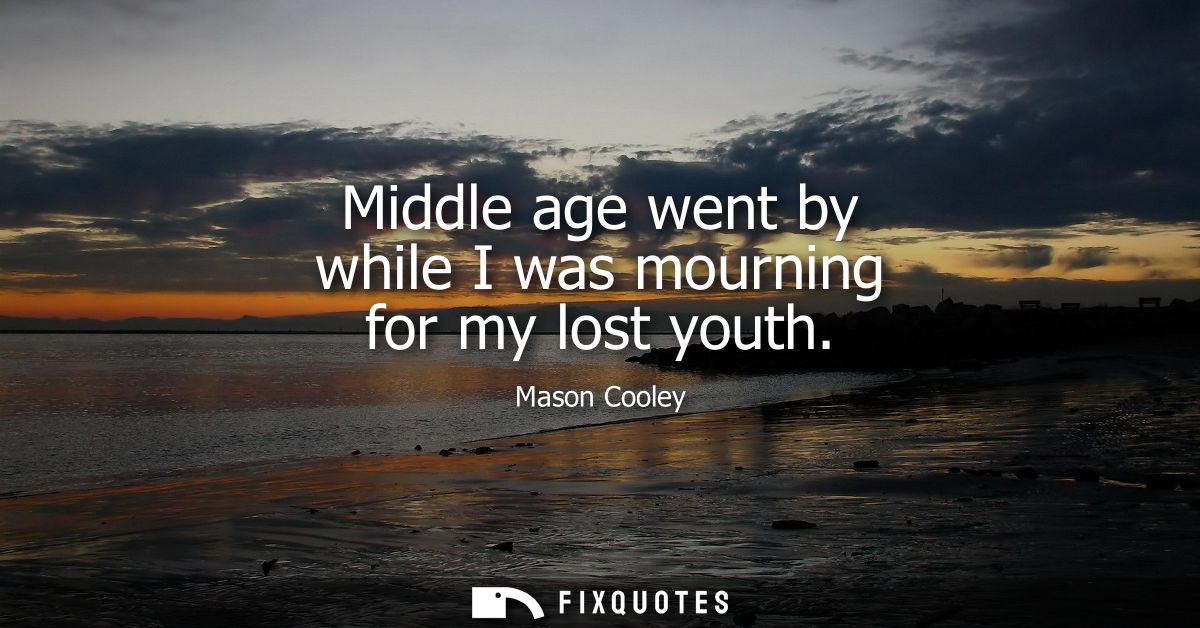
"Middle age went by while I was mourning for my lost youth"
About this Quote
Mason Cooley turns midlife into a quiet practical joke, and the punchline lands on the listener. "Middle age went by" is delivered with the flat inevitability of weather; the real sting is that it "went by" while the speaker was busy performing grief for something already gone. The line isn’t about vanity so much as misallocated attention: the self becomes a curator of loss, treating youth like a museum piece to be mourned, rather than a phase whose value was always partly imaginary.
Cooley’s intent is surgical. He compresses an entire modern pathology - nostalgia as lifestyle - into one sentence that reads like a confession and an indictment. The subtext is that mourning can be a form of procrastination. You can spend years honoring the past with elaborate rituals (regret, comparison, self-pity, the endless audit of what you "used to be") and call it sensitivity, when it’s really avoidance of the present. Youth becomes a convenient alibi: if you’re always grieving what you’ve lost, you don’t have to risk becoming what you still could.
Context matters: Cooley’s aphoristic style thrives on the snap of recognition, the way a short line exposes the long lie we tell ourselves. Written in a late-20th-century culture increasingly obsessed with self-narration, the quote anticipates today’s churn of memory and identity branding. It works because it’s ruthless about time: not tragic, not heroic, just squandered - and the waste is voluntary.
Cooley’s intent is surgical. He compresses an entire modern pathology - nostalgia as lifestyle - into one sentence that reads like a confession and an indictment. The subtext is that mourning can be a form of procrastination. You can spend years honoring the past with elaborate rituals (regret, comparison, self-pity, the endless audit of what you "used to be") and call it sensitivity, when it’s really avoidance of the present. Youth becomes a convenient alibi: if you’re always grieving what you’ve lost, you don’t have to risk becoming what you still could.
Context matters: Cooley’s aphoristic style thrives on the snap of recognition, the way a short line exposes the long lie we tell ourselves. Written in a late-20th-century culture increasingly obsessed with self-narration, the quote anticipates today’s churn of memory and identity branding. It works because it’s ruthless about time: not tragic, not heroic, just squandered - and the waste is voluntary.
Quote Details
| Topic | Nostalgia |
|---|---|
| Source | Help us find the source |
| Cite |
Citation Formats
APA Style (7th ed.)
Cooley, Mason. (2026, January 16). Middle age went by while I was mourning for my lost youth. FixQuotes. https://fixquotes.com/quotes/middle-age-went-by-while-i-was-mourning-for-my-100314/
Chicago Style
Cooley, Mason. "Middle age went by while I was mourning for my lost youth." FixQuotes. January 16, 2026. https://fixquotes.com/quotes/middle-age-went-by-while-i-was-mourning-for-my-100314/.
MLA Style (9th ed.)
"Middle age went by while I was mourning for my lost youth." FixQuotes, 16 Jan. 2026, https://fixquotes.com/quotes/middle-age-went-by-while-i-was-mourning-for-my-100314/. Accessed 27 Mar. 2026.
More Quotes by Mason
Add to List