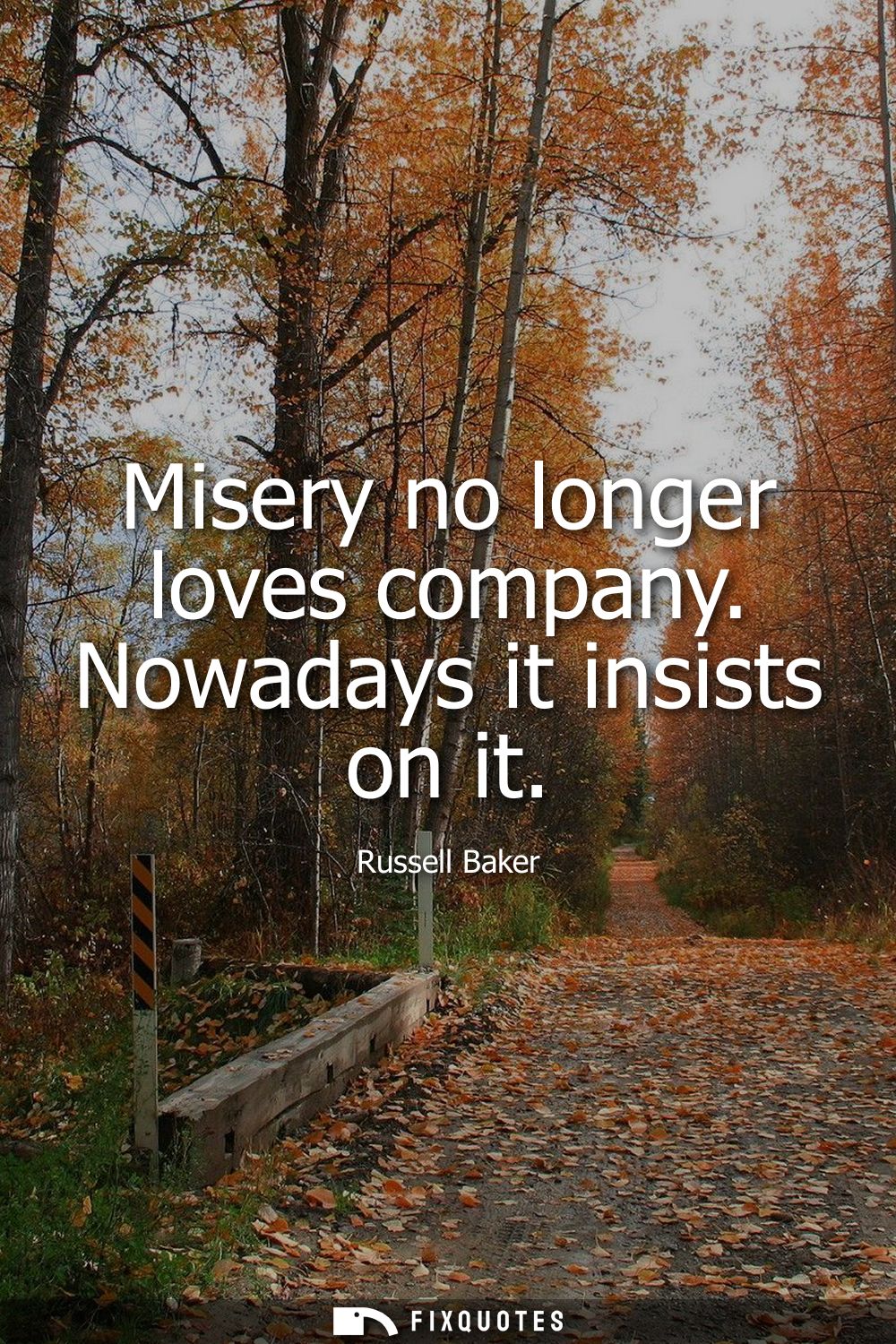
"Misery no longer loves company. Nowadays it insists on it"
About this Quote
Misery used to be a shared bench on a bad day; Baker argues it has become a mandatory group project. The line works because it flips a familiar proverb with the tiniest grammatical torque: “loves” becomes “insists.” That upgrade turns sadness from a private condition into a social demand, a kind of emotional enforcement. It’s funny in the way Baker often was funny: not with a punchline, but with a grim little recognition that feels too accurate to dismiss.
The subtext is less about individual gloom than about the culture that broadcasts it. “Company” here isn’t friendship; it’s an audience. Misery “insisting” suggests that complaining has acquired both entitlement and strategy, that grievance now expects validation, amplification, and communal participation. It’s the difference between confiding in a friend and recruiting a jury. Baker is needling the performative aspect of modern discontent: the pressure to convert every irritation into a story, every disappointment into a public identity, every pain into a shared liturgy.
Context matters because Baker’s career sits at the hinge between old mass media and the more participatory (and more demanding) attention economy that followed. A newspaper columnist watched the national mood up close: how outrage cycles, how victims and cynics trade costumes, how the public square rewards the loudest wound. The irony is that insisting on company doesn’t necessarily cure misery; it just gives it better distribution. Baker’s wit lands because it diagnoses a social habit while making us laugh at our complicity in it.
The subtext is less about individual gloom than about the culture that broadcasts it. “Company” here isn’t friendship; it’s an audience. Misery “insisting” suggests that complaining has acquired both entitlement and strategy, that grievance now expects validation, amplification, and communal participation. It’s the difference between confiding in a friend and recruiting a jury. Baker is needling the performative aspect of modern discontent: the pressure to convert every irritation into a story, every disappointment into a public identity, every pain into a shared liturgy.
Context matters because Baker’s career sits at the hinge between old mass media and the more participatory (and more demanding) attention economy that followed. A newspaper columnist watched the national mood up close: how outrage cycles, how victims and cynics trade costumes, how the public square rewards the loudest wound. The irony is that insisting on company doesn’t necessarily cure misery; it just gives it better distribution. Baker’s wit lands because it diagnoses a social habit while making us laugh at our complicity in it.
Quote Details
| Topic | Witty One-Liners |
|---|---|
| Source | Verified source: TIME: Books: The Difference (Russell Baker, 1972)
Evidence: “Misery no longer loves company. Nowadays it insists upon it.”. This quote appears in a TIME magazine book review by A. T. Baker dated February 28, 1972, introduced as “Russell Baker’s remark.” This is an early, clearly datable print appearance, but it is not itself Baker’s primary/first publication of the line; TIME is quoting (without giving a citation to the original Russell Baker piece). The wording here uses “insists upon it” (not “insists on it”). Other candidates (1) The Official Rules (Paul Dickson, 2014) compilation95.0% ... Baker, American Demographics, January 1982.) Baker's Law. Misery no longer loves company. Nowadays it insists on ... |
| Cite |
Citation Formats
APA Style (7th ed.)
Baker, Russell. (2026, February 21). Misery no longer loves company. Nowadays it insists on it. FixQuotes. https://fixquotes.com/quotes/misery-no-longer-loves-company-nowadays-it-77171/
Chicago Style
Baker, Russell. "Misery no longer loves company. Nowadays it insists on it." FixQuotes. February 21, 2026. https://fixquotes.com/quotes/misery-no-longer-loves-company-nowadays-it-77171/.
MLA Style (9th ed.)
"Misery no longer loves company. Nowadays it insists on it." FixQuotes, 21 Feb. 2026, https://fixquotes.com/quotes/misery-no-longer-loves-company-nowadays-it-77171/. Accessed 1 Apr. 2026.
More Quotes by Russell
Add to List