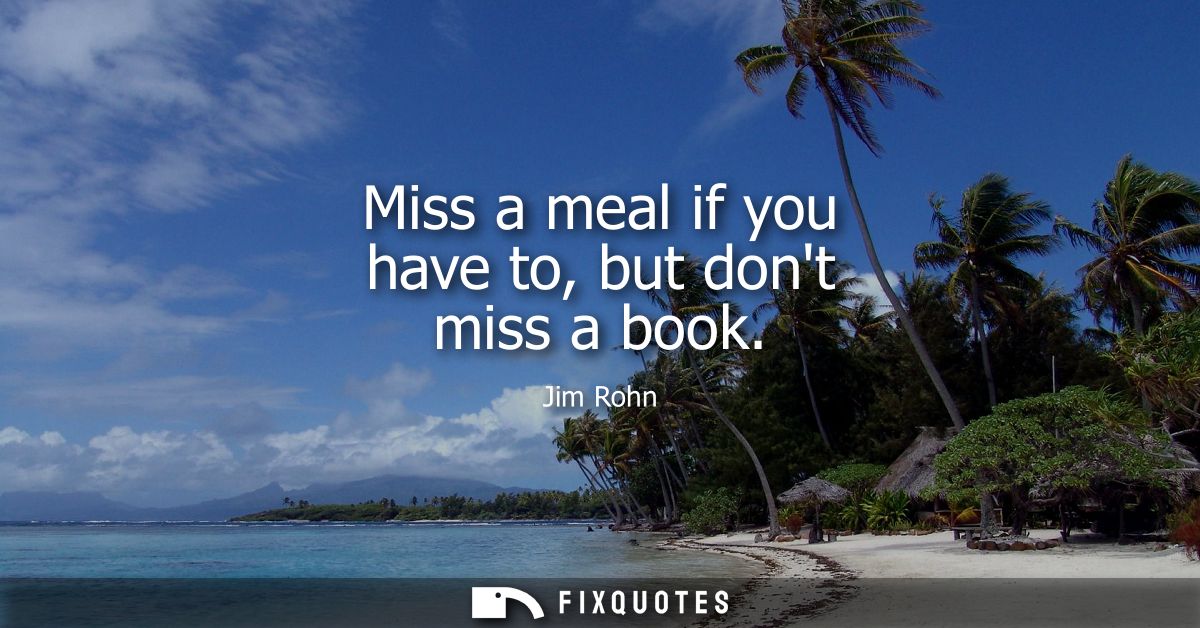
"Miss a meal if you have to, but don't miss a book"
About this Quote
A line like this only works if it’s a little outrageous. Jim Rohn isn’t literally prescribing hunger; he’s staging a provocation that flips the standard self-help hierarchy. Most people treat reading as a luxury activity you earn after the “real” work is done. Rohn drags it into the survival category. The shock value is the point: if you feel a jolt of guilt, he’s already won the attention economy battle he’s fighting.
The intent is pragmatic, not poetic. As a businessman-turned-motivational guru, Rohn is selling a worldview where inputs determine outcomes: feed your mind, and your bank account follows. “Miss a meal” is a blunt way of arguing that personal development is not decoration; it’s infrastructure. The subtext is also a quiet indictment of consumer culture. People will spend on convenience, status, and entertainment without hesitation, then balk at the cost (or time) of a book. Rohn frames that as a values problem, not a budget problem.
Context matters: this comes from an era of cassette-tape wisdom and upward-mobility coaching, when reading was positioned as the blue-collar ladder into the managerial class. It’s self-reliance rhetoric with a bookstore receipt attached. There’s also a subtle power move: books become a proxy for discipline. Anyone can claim ambition; fewer can build a daily habit that compounds privately. Rohn’s line doesn’t romanticize literacy so much as weaponize it as a competitive advantage.
The intent is pragmatic, not poetic. As a businessman-turned-motivational guru, Rohn is selling a worldview where inputs determine outcomes: feed your mind, and your bank account follows. “Miss a meal” is a blunt way of arguing that personal development is not decoration; it’s infrastructure. The subtext is also a quiet indictment of consumer culture. People will spend on convenience, status, and entertainment without hesitation, then balk at the cost (or time) of a book. Rohn frames that as a values problem, not a budget problem.
Context matters: this comes from an era of cassette-tape wisdom and upward-mobility coaching, when reading was positioned as the blue-collar ladder into the managerial class. It’s self-reliance rhetoric with a bookstore receipt attached. There’s also a subtle power move: books become a proxy for discipline. Anyone can claim ambition; fewer can build a daily habit that compounds privately. Rohn’s line doesn’t romanticize literacy so much as weaponize it as a competitive advantage.
Quote Details
| Topic | Book |
|---|---|
| Source | Help us find the source |
| Cite |
Citation Formats
APA Style (7th ed.)
Rohn, Jim. (2026, January 17). Miss a meal if you have to, but don't miss a book. FixQuotes. https://fixquotes.com/quotes/miss-a-meal-if-you-have-to-but-dont-miss-a-book-36497/
Chicago Style
Rohn, Jim. "Miss a meal if you have to, but don't miss a book." FixQuotes. January 17, 2026. https://fixquotes.com/quotes/miss-a-meal-if-you-have-to-but-dont-miss-a-book-36497/.
MLA Style (9th ed.)
"Miss a meal if you have to, but don't miss a book." FixQuotes, 17 Jan. 2026, https://fixquotes.com/quotes/miss-a-meal-if-you-have-to-but-dont-miss-a-book-36497/. Accessed 5 Feb. 2026.
More Quotes by Jim
Add to List