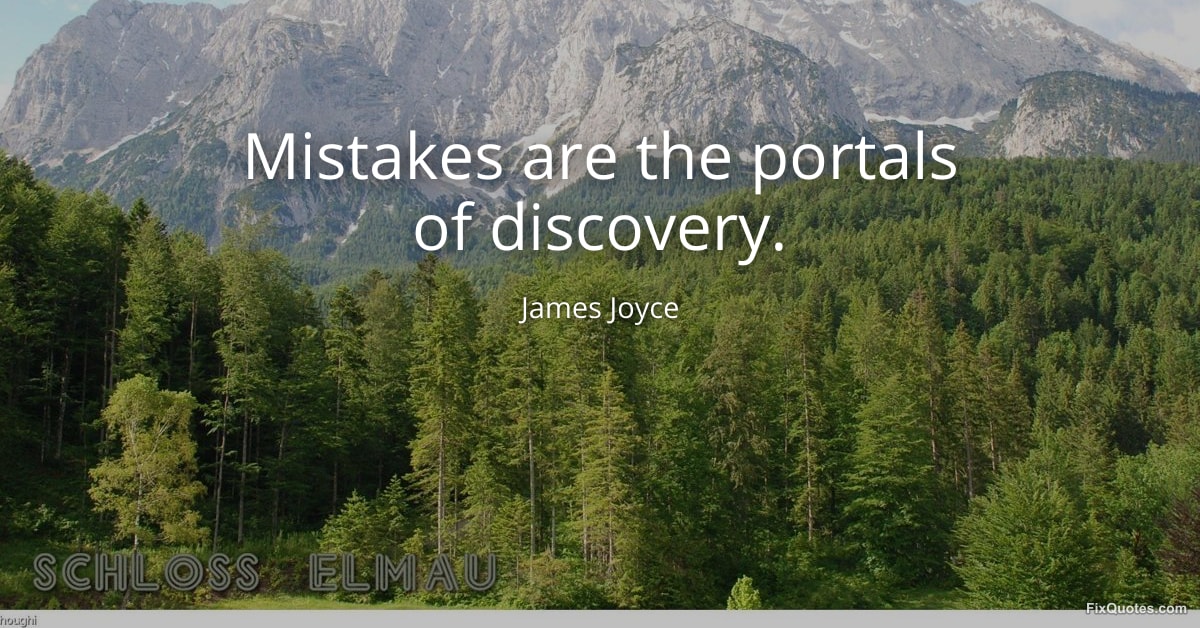
"Mistakes are the portals of discovery"
About this Quote
Joyce doesn’t romanticize failure here; he weaponizes it. “Mistakes are the portals of discovery” is a neat little jailbreak from the classroom idea that errors are stains to be scrubbed out. The key word is “portals,” not “steps” or “lessons.” A portal implies a threshold you can’t cross by staying correct. You stumble, you tear a hole in the expected world, and suddenly there’s an opening into something stranger and truer.
Coming from Joyce, the line reads like an aesthetic manifesto disguised as self-help. His fiction is built on deliberate misbehavior: fractured syntax, obsessive interiority, misheard conversations, slips of memory, bodily distractions. The “mistake” isn’t only factual wrongness; it’s linguistic noise, social awkwardness, the mind’s inability to stay on-script. Joyce treats those glitches as data. Where a more dutiful novelist would smooth a scene into clarity, he follows the smear - the unedited thought, the embarrassing impulse - because that’s where character actually lives.
The subtext is also anti-authoritarian. In Joyce’s Ireland, obedience (to church, empire, convention) was a civic virtue; error carried moral weight. By reframing mistakes as entryways, he strips shame of its power and makes experimentation feel inevitable rather than indulgent. It’s not “Don’t be afraid to fail.” It’s “Failing is how the world becomes visible.” In Joyce’s hands, discovery isn’t a reward for discipline; it’s the byproduct of letting the mind wander into its own mess.
Coming from Joyce, the line reads like an aesthetic manifesto disguised as self-help. His fiction is built on deliberate misbehavior: fractured syntax, obsessive interiority, misheard conversations, slips of memory, bodily distractions. The “mistake” isn’t only factual wrongness; it’s linguistic noise, social awkwardness, the mind’s inability to stay on-script. Joyce treats those glitches as data. Where a more dutiful novelist would smooth a scene into clarity, he follows the smear - the unedited thought, the embarrassing impulse - because that’s where character actually lives.
The subtext is also anti-authoritarian. In Joyce’s Ireland, obedience (to church, empire, convention) was a civic virtue; error carried moral weight. By reframing mistakes as entryways, he strips shame of its power and makes experimentation feel inevitable rather than indulgent. It’s not “Don’t be afraid to fail.” It’s “Failing is how the world becomes visible.” In Joyce’s hands, discovery isn’t a reward for discipline; it’s the byproduct of letting the mind wander into its own mess.
Quote Details
| Topic | Learning from Mistakes |
|---|---|
| Source | Help us find the source |
| Cite |
Citation Formats
APA Style (7th ed.)
Joyce, James. (2026, January 15). Mistakes are the portals of discovery. FixQuotes. https://fixquotes.com/quotes/mistakes-are-the-portals-of-discovery-31790/
Chicago Style
Joyce, James. "Mistakes are the portals of discovery." FixQuotes. January 15, 2026. https://fixquotes.com/quotes/mistakes-are-the-portals-of-discovery-31790/.
MLA Style (9th ed.)
"Mistakes are the portals of discovery." FixQuotes, 15 Jan. 2026, https://fixquotes.com/quotes/mistakes-are-the-portals-of-discovery-31790/. Accessed 4 Apr. 2026.
More Quotes by James
Add to List