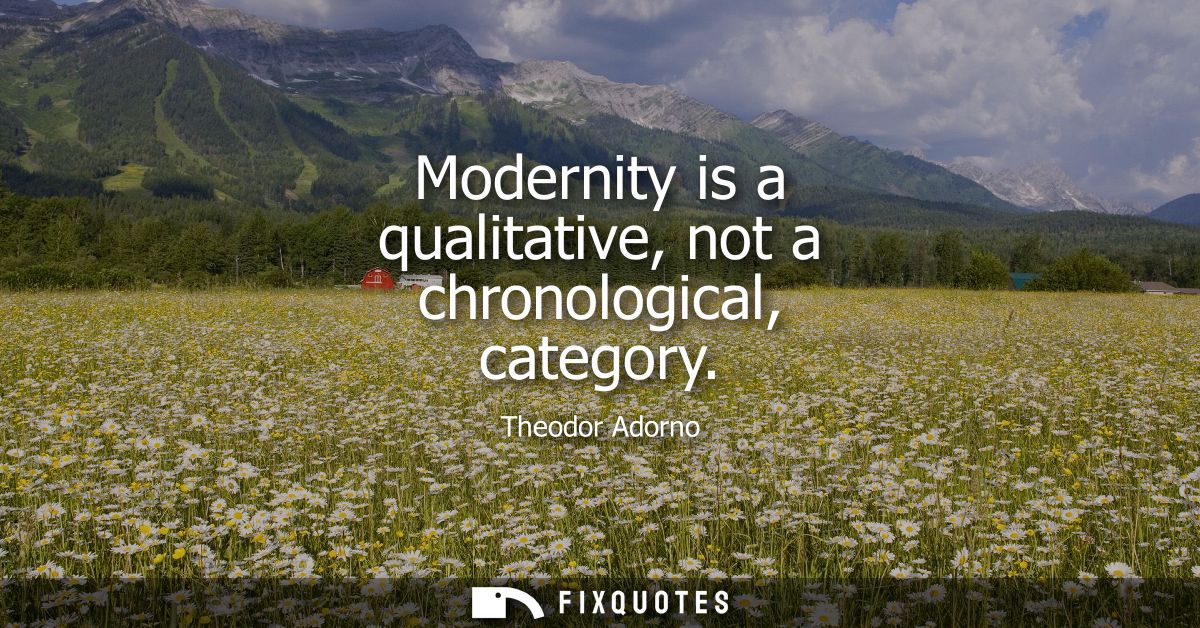
"Modernity is a qualitative, not a chronological category"
About this Quote
Modernity, for Adorno, isn’t a calendar page you tear off; it’s a condition you can fall into or resist. The line is a small act of sabotage against the lazy story that history naturally “progresses” from old to new. Calling modernity “qualitative” reframes it as a mode of experience and social organization: how art is made, how attention is disciplined, how life gets administered, how subjects learn to desire. You can live in 1960 and still think, feel, and obey in pre-modern ways. You can also make work that is “modern” in the Adornian sense precisely because it refuses the easy comforts of its own time.
The subtext is polemical: Adorno is warning that “the modern” is too often treated as a fashion label, a self-congratulating timestamp. Chronology becomes an alibi. If the new is automatically modern, then whatever dominates the present gets to masquerade as emancipation. That’s exactly the kind of ideological shortcut his critical theory is built to expose, especially in a world where capitalism turns novelty into a production line.
Context matters. Writing in the shadow of fascism and amid the rise of mass culture, Adorno saw how technologically advanced societies could be politically and psychologically regressive. Modernity’s defining trait, then, isn’t gadgets; it’s the tension between autonomy and standardization, freedom and the machinery that sells it back to you as a product.
The line also doubles as an aesthetic criterion. Modern art isn’t “new” because it’s recent; it’s modern because it registers social contradictions without smoothing them over. That’s the sting: modernity is a test, not a date.
The subtext is polemical: Adorno is warning that “the modern” is too often treated as a fashion label, a self-congratulating timestamp. Chronology becomes an alibi. If the new is automatically modern, then whatever dominates the present gets to masquerade as emancipation. That’s exactly the kind of ideological shortcut his critical theory is built to expose, especially in a world where capitalism turns novelty into a production line.
Context matters. Writing in the shadow of fascism and amid the rise of mass culture, Adorno saw how technologically advanced societies could be politically and psychologically regressive. Modernity’s defining trait, then, isn’t gadgets; it’s the tension between autonomy and standardization, freedom and the machinery that sells it back to you as a product.
The line also doubles as an aesthetic criterion. Modern art isn’t “new” because it’s recent; it’s modern because it registers social contradictions without smoothing them over. That’s the sting: modernity is a test, not a date.
Quote Details
| Topic | Deep |
|---|---|
| Source | Verified source: Minima Moralia: Reflections from Damaged Life (Theodor Adorno, 1951)
Evidence: Modernität ist eine qualitative Kategorie, keine chronologische. (Aphorism (German): around p. 292 in some German editions; English (Jephcott/VERSO): p. 218). This is the line in Adorno’s own text (German) in Minima Moralia (originally published 1951). The commonly-circulated English wording “Modernity is a qualitative, not a chronological, category.” is a translation of this sentence (often cited from E.F.N. Jephcott’s English translation, where it is frequently given as p. 218 in the Verso edition). The quote is sometimes re-popularized via later secondary works (e.g., Peter Osborne’s 1992 article title), but the primary origin is Adorno’s Minima Moralia. Other candidates (1) Modernism and Fascism (R. Griffin, 2007) compilation87.5% ... Theodor Adorno asserted , ' modernity is a qualitative , not a chronological category'.14 In other words , at lea... |
| Cite |
Citation Formats
APA Style (7th ed.)
Adorno, Theodor. (2026, February 27). Modernity is a qualitative, not a chronological category. FixQuotes. https://fixquotes.com/quotes/modernity-is-a-qualitative-not-a-chronological-28498/
Chicago Style
Adorno, Theodor. "Modernity is a qualitative, not a chronological category." FixQuotes. February 27, 2026. https://fixquotes.com/quotes/modernity-is-a-qualitative-not-a-chronological-28498/.
MLA Style (9th ed.)
"Modernity is a qualitative, not a chronological category." FixQuotes, 27 Feb. 2026, https://fixquotes.com/quotes/modernity-is-a-qualitative-not-a-chronological-28498/. Accessed 5 Apr. 2026.
More Quotes by Theodor
Add to List