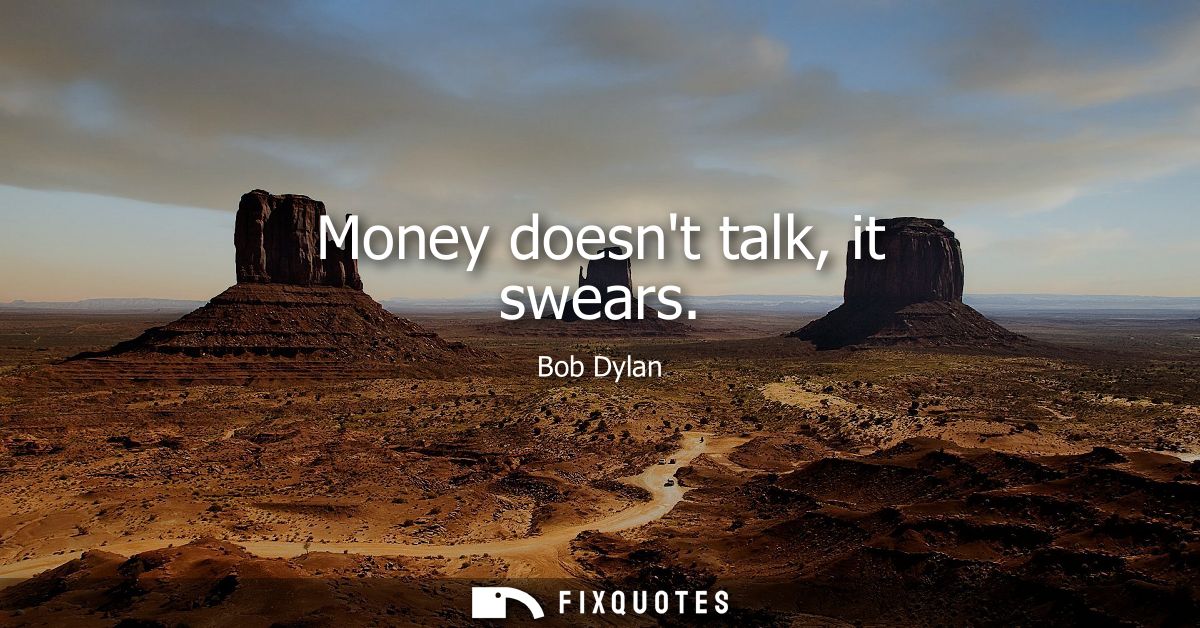
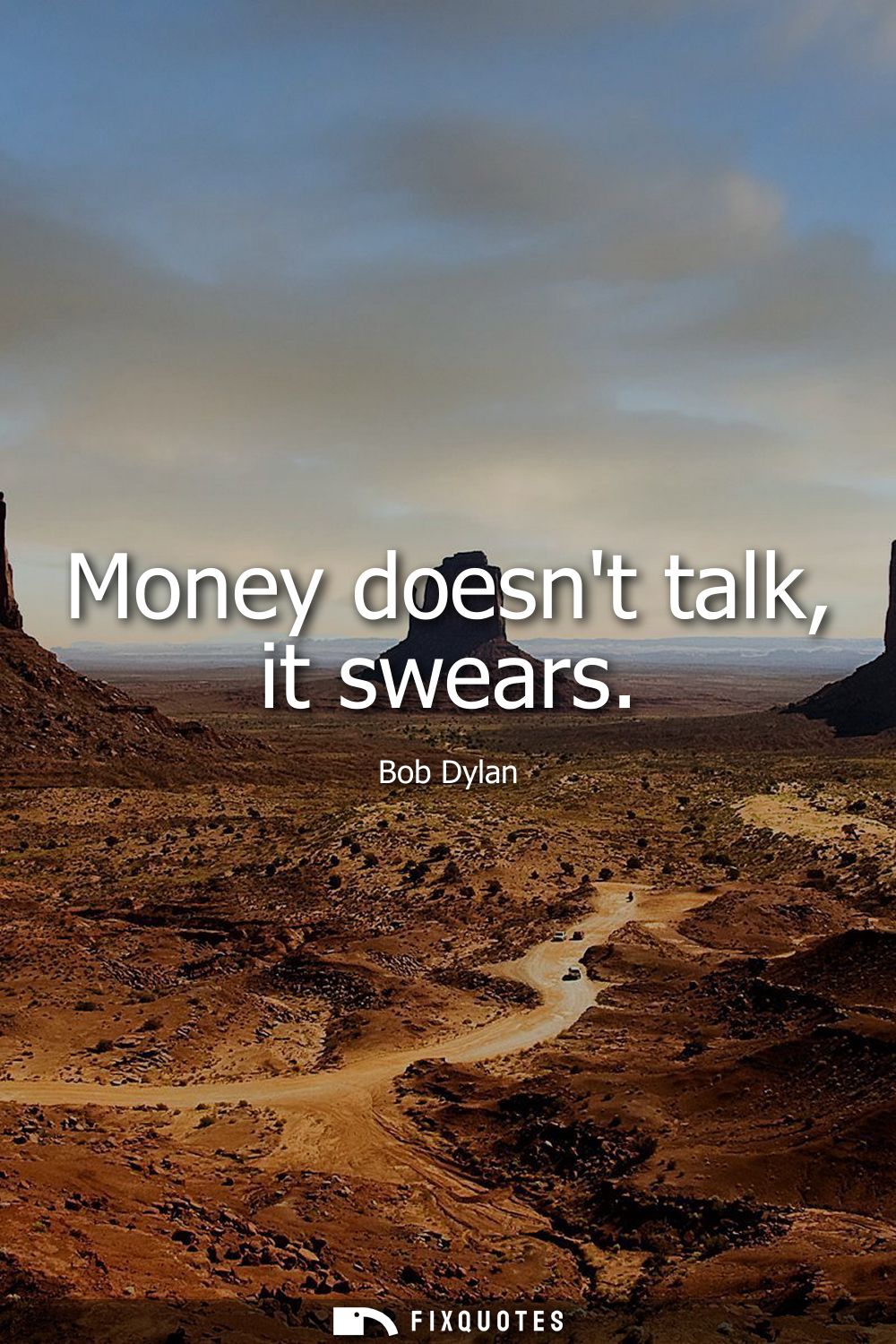
"Money doesn't talk, it swears"
About this Quote
Money, in Dylan's line, isn't merely persuasive; it's obscene. "Talk" suggests negotiation, civility, maybe even democratic give-and-take. "Swears" drags cash into the realm of aggression and intimidation: the kind of language that interrupts, offends, and gets its way by being too loud to ignore. It's a compact reversal of the polite myth that wealth is just a neutral tool. Dylan frames money as a speaker with a foul mouth because that's how it behaves in the real world: it cuts lines, bends rules, and makes everyone else recalibrate their morals in real time.
The genius is the tonal pivot. He doesn't say money "lies" or "corrupts" - those are abstract verbs that let listeners keep their distance. "Swears" is visceral, social, and instantly legible. You can hear it. You can picture the room changing when money enters. The line captures how wealth often communicates: not through reason, but through pressure, threat, and the casual cruelty of knowing it can absorb consequences.
Context matters, too. Dylan comes out of a 1960s-into-70s America where counterculture idealism repeatedly slammed into institutions that couldn't be serenaded into decency. The quote lands like a shrug from someone who has watched sincerity get outbid. It's not anti-money as much as anti-pretending: a reminder that economic power isn't just louder than conscience; it often speaks in a language that conscience wouldn't use.
The genius is the tonal pivot. He doesn't say money "lies" or "corrupts" - those are abstract verbs that let listeners keep their distance. "Swears" is visceral, social, and instantly legible. You can hear it. You can picture the room changing when money enters. The line captures how wealth often communicates: not through reason, but through pressure, threat, and the casual cruelty of knowing it can absorb consequences.
Context matters, too. Dylan comes out of a 1960s-into-70s America where counterculture idealism repeatedly slammed into institutions that couldn't be serenaded into decency. The quote lands like a shrug from someone who has watched sincerity get outbid. It's not anti-money as much as anti-pretending: a reminder that economic power isn't just louder than conscience; it often speaks in a language that conscience wouldn't use.
Quote Details
| Topic | Money |
|---|---|
| Source | Lyric: "Money doesn't talk, it swears." , Bob Dylan, "It's Alright, Ma (I'm Only Bleeding)" (1965), from the album Bringing It All Back Home. |
| Cite |
Citation Formats
APA Style (7th ed.)
Dylan, Bob. (2026, January 15). Money doesn't talk, it swears. FixQuotes. https://fixquotes.com/quotes/money-doesnt-talk-it-swears-135834/
Chicago Style
Dylan, Bob. "Money doesn't talk, it swears." FixQuotes. January 15, 2026. https://fixquotes.com/quotes/money-doesnt-talk-it-swears-135834/.
MLA Style (9th ed.)
"Money doesn't talk, it swears." FixQuotes, 15 Jan. 2026, https://fixquotes.com/quotes/money-doesnt-talk-it-swears-135834/. Accessed 5 Mar. 2026.
More Quotes by Bob
Add to List