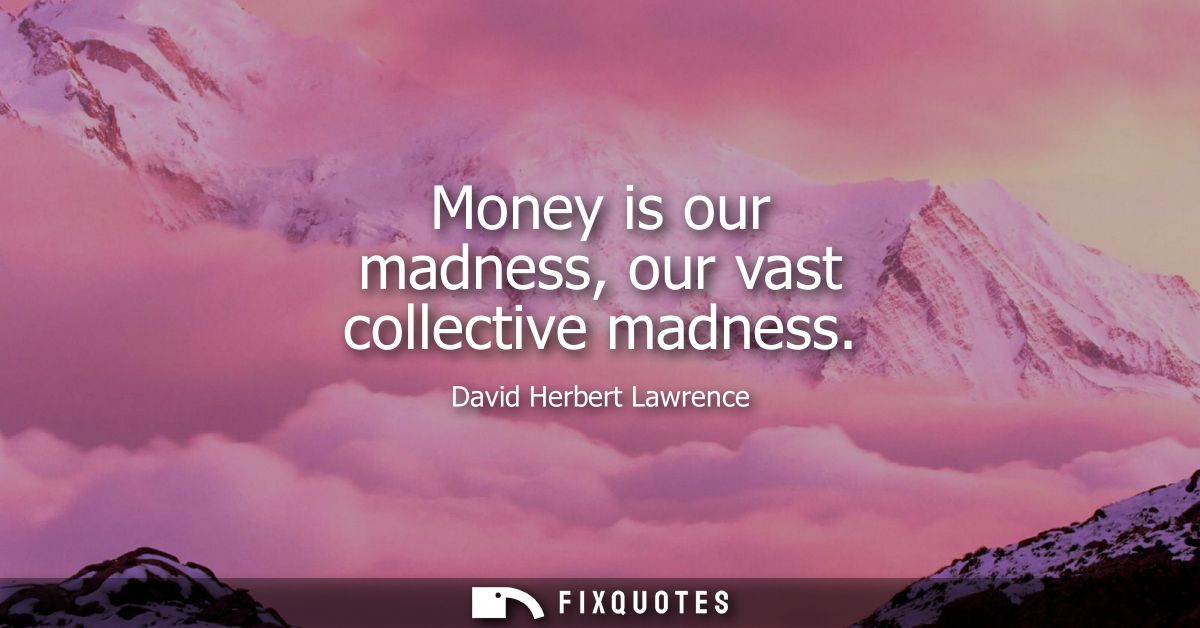
"Money is our madness, our vast collective madness"
About this Quote
Lawrence doesn’t treat money as a tool or even a temptation; he frames it as a shared psychosis, a social fever dream so normalized we mistake it for sanity. The sting in “our” is deliberate. This isn’t a sermon aimed at greedy elites. It’s an indictment of an entire culture that has agreed, quietly and enthusiastically, to outsource meaning to numbers.
“Madness” does double work. It suggests obsession (the compulsive counting, earning, hoarding) and delusion (the belief that symbols of value are value). By calling it “vast collective,” Lawrence points at the eerie comfort of mass agreement: when everyone’s chasing the same abstraction, no one has to ask what they’re running from. The line turns capitalism’s favorite defense - “it’s just how the world works” - into a diagnosis: precisely. A world can “work” and still be sick.
Context matters. Writing in the early 20th century, Lawrence watched industrial modernity reorganize life around wages, productivity, and commodified desire. His fiction is full of bodies, landscapes, and relationships strained by mechanized routine and the cash nexus. So the quote isn’t quaint anti-materialism; it’s a warning about what happens when money becomes the primary language for status, security, even intimacy. The subtext is grief as much as rage: a culture rich in goods, poor in aliveness, mistaking accumulation for appetite.
“Madness” does double work. It suggests obsession (the compulsive counting, earning, hoarding) and delusion (the belief that symbols of value are value). By calling it “vast collective,” Lawrence points at the eerie comfort of mass agreement: when everyone’s chasing the same abstraction, no one has to ask what they’re running from. The line turns capitalism’s favorite defense - “it’s just how the world works” - into a diagnosis: precisely. A world can “work” and still be sick.
Context matters. Writing in the early 20th century, Lawrence watched industrial modernity reorganize life around wages, productivity, and commodified desire. His fiction is full of bodies, landscapes, and relationships strained by mechanized routine and the cash nexus. So the quote isn’t quaint anti-materialism; it’s a warning about what happens when money becomes the primary language for status, security, even intimacy. The subtext is grief as much as rage: a culture rich in goods, poor in aliveness, mistaking accumulation for appetite.
Quote Details
| Topic | Money |
|---|---|
| Source | Help us find the source |
| Cite |
Citation Formats
APA Style (7th ed.)
Lawrence, David Herbert. (2026, January 18). Money is our madness, our vast collective madness. FixQuotes. https://fixquotes.com/quotes/money-is-our-madness-our-vast-collective-madness-12401/
Chicago Style
Lawrence, David Herbert. "Money is our madness, our vast collective madness." FixQuotes. January 18, 2026. https://fixquotes.com/quotes/money-is-our-madness-our-vast-collective-madness-12401/.
MLA Style (9th ed.)
"Money is our madness, our vast collective madness." FixQuotes, 18 Jan. 2026, https://fixquotes.com/quotes/money-is-our-madness-our-vast-collective-madness-12401/. Accessed 15 Mar. 2026.
More Quotes by David
Add to List