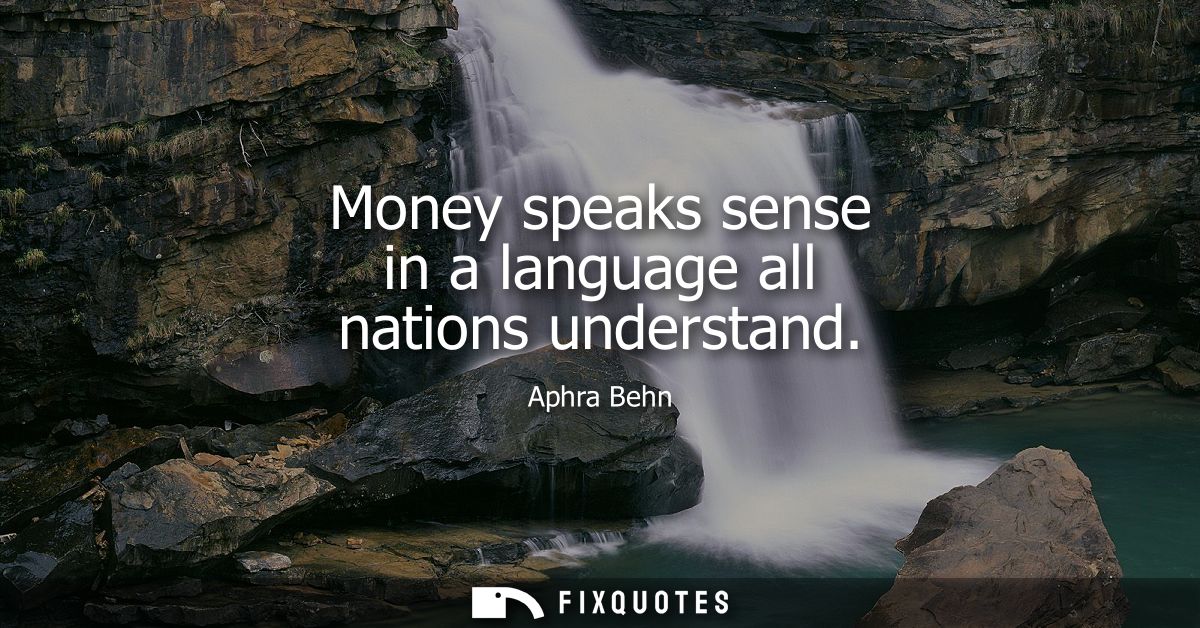
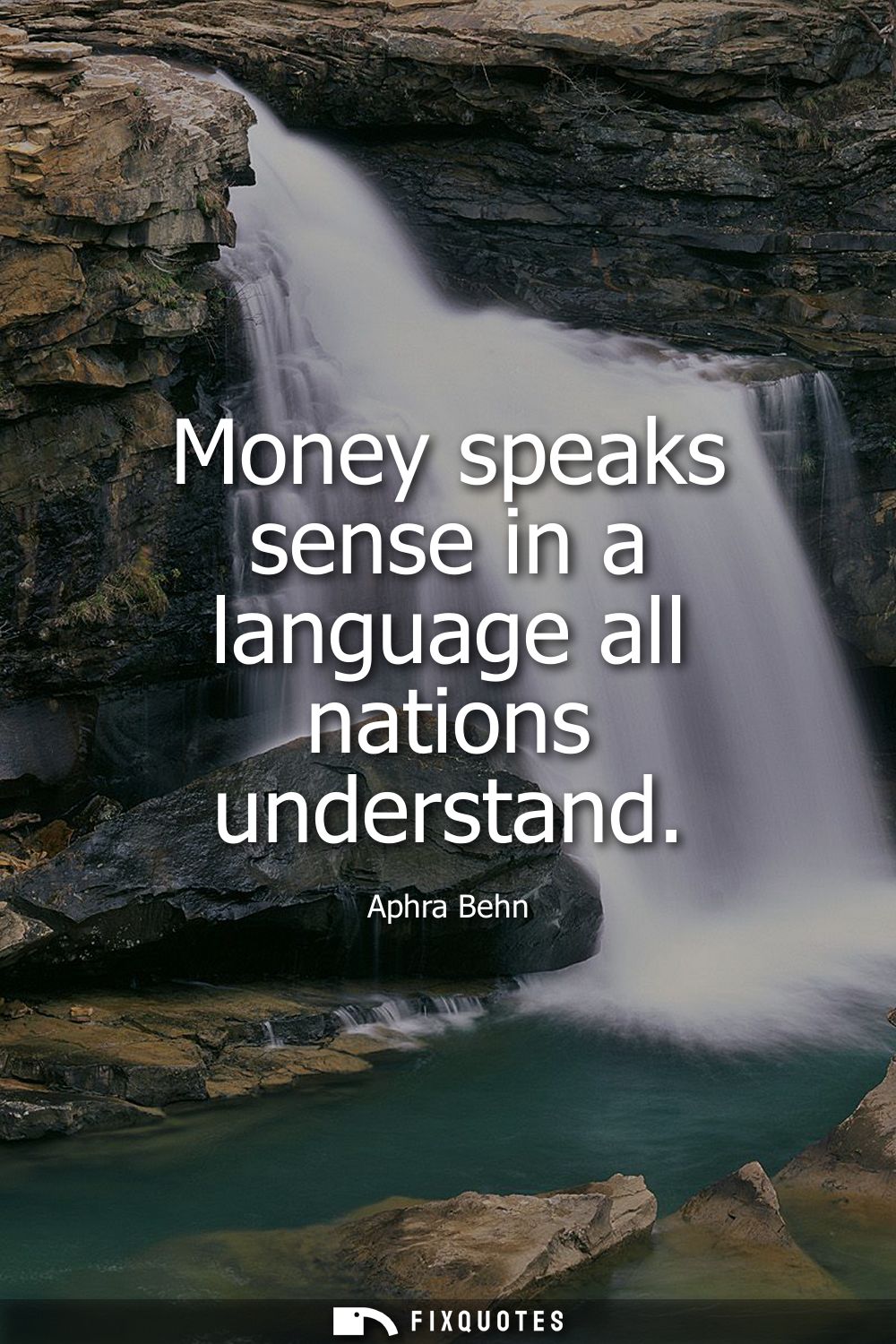
"Money speaks sense in a language all nations understand"
About this Quote
Cash, Behn implies, is the world’s most fluent liar and its most reliable translator. “Money speaks sense” is a delicious turn: sense isn’t truth here, it’s persuasion. The line smuggles in a cynical observation about human behavior by dressing it up as linguistic inevitability. Money doesn’t just buy goods; it buys coherence. It makes motives look reasonable, decisions look “practical,” even cruelties look like policy.
Behn was writing as a Restoration dramatist in a newly mercantile England, where empire, trade, and speculation were turning aristocratic honor into something you could increasingly rent. In that moment, language itself was suspect: courtly rhetoric, religious claims, and political loyalties were constantly being performed, swapped, and betrayed. So she reaches for the one idiom that cuts through performative virtue. Nations may differ on theology and etiquette, but they recognize a bribe, a fee, a dowry, a ransom.
The subtext bites harder because Behn, as a working woman in a male-dominated theater economy, knew “sense” often meant whatever the payer wanted it to mean. Her line is a wink at the audience and an accusation: you may pretend to be guided by principle, but you perk up when the purse opens. It’s also an early, sharp-eyed snapshot of globalization before the term existed: a borderless system of incentives, where the currency is the real lingua franca and morality becomes a local dialect, easily overridden.
Behn was writing as a Restoration dramatist in a newly mercantile England, where empire, trade, and speculation were turning aristocratic honor into something you could increasingly rent. In that moment, language itself was suspect: courtly rhetoric, religious claims, and political loyalties were constantly being performed, swapped, and betrayed. So she reaches for the one idiom that cuts through performative virtue. Nations may differ on theology and etiquette, but they recognize a bribe, a fee, a dowry, a ransom.
The subtext bites harder because Behn, as a working woman in a male-dominated theater economy, knew “sense” often meant whatever the payer wanted it to mean. Her line is a wink at the audience and an accusation: you may pretend to be guided by principle, but you perk up when the purse opens. It’s also an early, sharp-eyed snapshot of globalization before the term existed: a borderless system of incentives, where the currency is the real lingua franca and morality becomes a local dialect, easily overridden.
Quote Details
| Topic | Money |
|---|---|
| Source | Help us find the source |
| Cite | Cite this Quote |
Citation Formats
APA Style (7th ed.)
Behn, Aphra. (n.d.). Money speaks sense in a language all nations understand. FixQuotes. https://fixquotes.com/quotes/money-speaks-sense-in-a-language-all-nations-34459/
Chicago Style
Behn, Aphra. "Money speaks sense in a language all nations understand." FixQuotes. Accessed February 2, 2026. https://fixquotes.com/quotes/money-speaks-sense-in-a-language-all-nations-34459/.
MLA Style (9th ed.)
"Money speaks sense in a language all nations understand." FixQuotes, https://fixquotes.com/quotes/money-speaks-sense-in-a-language-all-nations-34459/. Accessed 2 Feb. 2026.
More Quotes by Aphra
Add to List