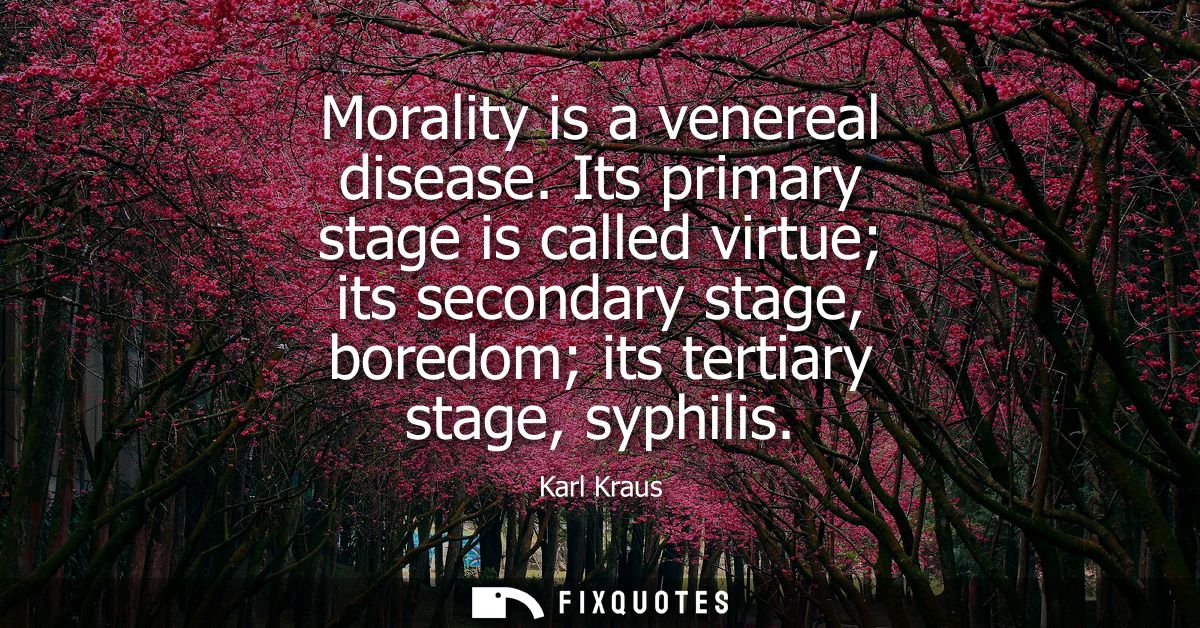
"Morality is a venereal disease. Its primary stage is called virtue; its secondary stage, boredom; its tertiary stage, syphilis"
About this Quote
Morality, for Kraus, isn’t a lighthouse; it’s an infection people brag about catching. The line works because it weaponizes medical specificity against social sanctimony. By mapping morality onto the stages of venereal disease, Kraus turns what bourgeois culture treats as clean and elevating into something acquired, contagious, and ultimately disfiguring. “Virtue” becomes not an achievement but a symptom: the first visible rash of respectability. “Boredom” follows as the lived reality of moral performance - a life organized around prohibition, surveillance, and the deadening repetition of being “good.” Then comes the punch: “syphilis,” the nightmare consequence that retroactively stains the entire enterprise. What began as public hygiene ends as private rot.
The subtext is Kraus’s trademark suspicion of moral rhetoric as cover for power, hypocrisy, and sexual panic. Moral codes, in this view, don’t restrain desire so much as convert it into gossip, punishment, and self-importance. The joke is obscene, but the target is not sex; it’s the culture that can’t speak honestly about sex without dressing itself up as virtue.
Context matters: Kraus wrote in fin-de-siecle Vienna and the early 20th century, when public morality was loud, antisemitism and nationalism were rising, and syphilis was both widespread and mythologized as a mark of decadence. He’s exploiting that fear to expose another one: that “morality” is less ethical commitment than a social pathogen, spreading through language, institutions, and the craving to seem pure.
The subtext is Kraus’s trademark suspicion of moral rhetoric as cover for power, hypocrisy, and sexual panic. Moral codes, in this view, don’t restrain desire so much as convert it into gossip, punishment, and self-importance. The joke is obscene, but the target is not sex; it’s the culture that can’t speak honestly about sex without dressing itself up as virtue.
Context matters: Kraus wrote in fin-de-siecle Vienna and the early 20th century, when public morality was loud, antisemitism and nationalism were rising, and syphilis was both widespread and mythologized as a mark of decadence. He’s exploiting that fear to expose another one: that “morality” is less ethical commitment than a social pathogen, spreading through language, institutions, and the craving to seem pure.
Quote Details
| Topic | Ethics & Morality |
|---|---|
| Source | Help us find the source |
More Quotes by Karl
Add to List