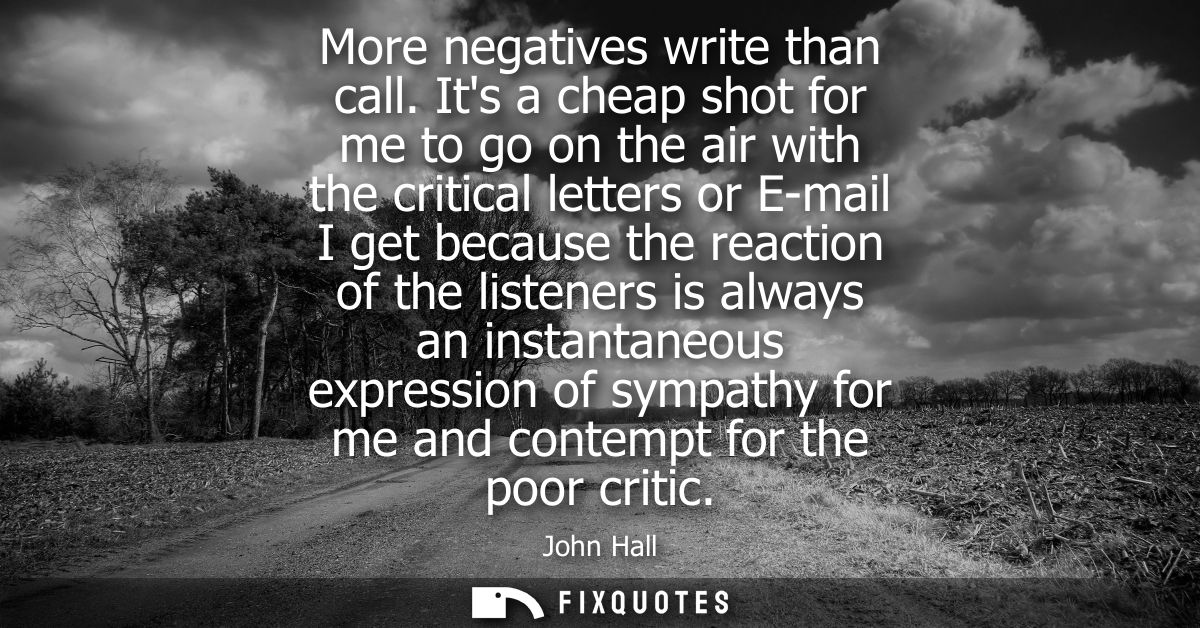
"More negatives write than call. It's a cheap shot for me to go on the air with the critical letters or E-mail I get because the reaction of the listeners is always an instantaneous expression of sympathy for me and contempt for the poor critic"
About this Quote
Then Hall pivots to the more interesting confession: the “cheap shot” of reading critical mail on-air. He’s naming a rigged arena. Once a broadcaster frames a critic as a faceless complainer, the audience’s “instantaneous expression of sympathy” becomes predictable and profitable. It’s the talk-radio version of dunking on a comment section: the host gets to play beleaguered public servant, the listeners get a communal enemy, and the critic becomes “poor” by virtue of being unheard and unrepresented.
The subtext is an awareness of power asymmetry. The critic has one letter; Hall has a microphone, timing, tone, and an audience primed to take his side. By calling it “cheap,” he signals a standard he wants to be judged by, even as he acknowledges the temptation to harvest outrage for engagement.
Contextually, it reads like an era of call-in shows and early email feedback, anticipating today’s creator economy problem: monetizing backlash is easy, resisting it is the actual discipline.
Quote Details
| Topic | Writing |
|---|---|
| Source | Help us find the source |
| Cite |
Citation Formats
APA Style (7th ed.)
Hall, John. (2026, January 16). More negatives write than call. It's a cheap shot for me to go on the air with the critical letters or E-mail I get because the reaction of the listeners is always an instantaneous expression of sympathy for me and contempt for the poor critic. FixQuotes. https://fixquotes.com/quotes/more-negatives-write-than-call-its-a-cheap-shot-114155/
Chicago Style
Hall, John. "More negatives write than call. It's a cheap shot for me to go on the air with the critical letters or E-mail I get because the reaction of the listeners is always an instantaneous expression of sympathy for me and contempt for the poor critic." FixQuotes. January 16, 2026. https://fixquotes.com/quotes/more-negatives-write-than-call-its-a-cheap-shot-114155/.
MLA Style (9th ed.)
"More negatives write than call. It's a cheap shot for me to go on the air with the critical letters or E-mail I get because the reaction of the listeners is always an instantaneous expression of sympathy for me and contempt for the poor critic." FixQuotes, 16 Jan. 2026, https://fixquotes.com/quotes/more-negatives-write-than-call-its-a-cheap-shot-114155/. Accessed 12 Feb. 2026.