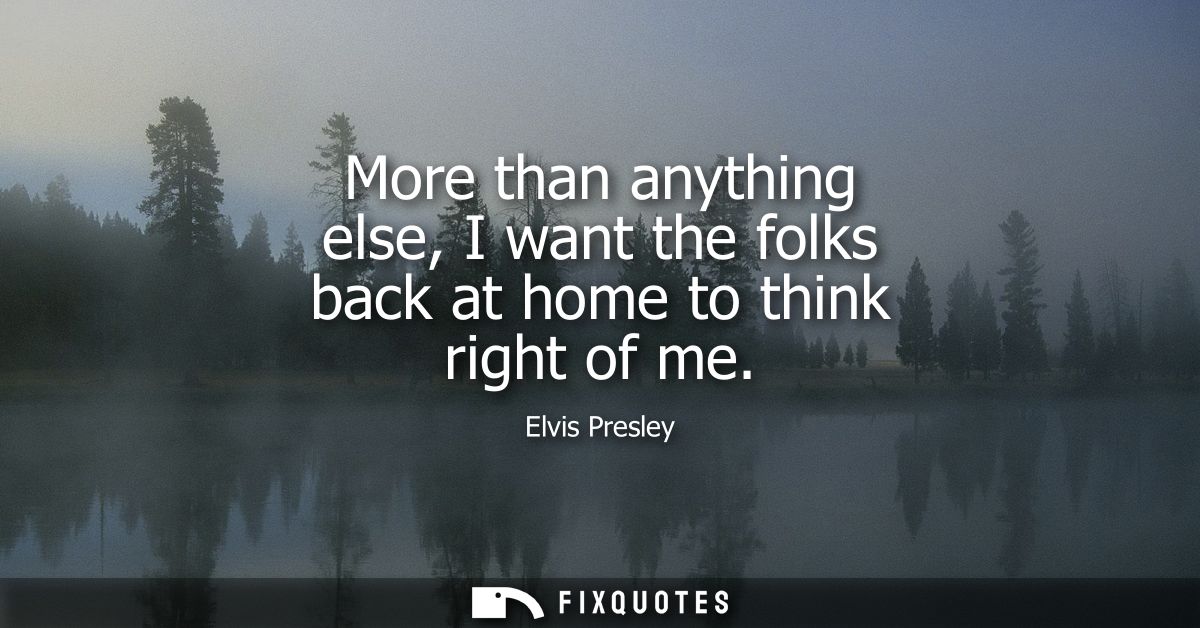
"More than anything else, I want the folks back at home to think right of me"
About this Quote
The phrasing does quiet work. “More than anything else” ranks his priorities with surprising humility for a man being treated like a national event. “Think right of me” is not “understand me” or “forgive me.” It’s a plea for reputation, for being seen as basically decent. In Southern vernacular, “right” carries an ethical charge: correct, respectable, not corrupted. The subtext is that success has put him in danger of being misread - as obscene, arrogant, exploitative, ungrateful, or simply not “one of us” anymore.
Context sharpens the anxiety. Presley’s rise was entangled with mid-century moral panic about youth, sex, and Black-derived music crossing into white mainstream stardom. He became a lightning rod for cultural change he didn’t fully control. So this line reads like a protective charm against the accusation that he sold out his roots. It’s also a small tragedy: the more famous he becomes, the less reachable that simple hometown verdict is - and the more he needs it anyway.
Quote Details
| Topic | Respect |
|---|---|
| Source | Help us find the source |
| Cite |
Citation Formats
APA Style (7th ed.)
Presley, Elvis. (2026, January 18). More than anything else, I want the folks back at home to think right of me. FixQuotes. https://fixquotes.com/quotes/more-than-anything-else-i-want-the-folks-back-at-19378/
Chicago Style
Presley, Elvis. "More than anything else, I want the folks back at home to think right of me." FixQuotes. January 18, 2026. https://fixquotes.com/quotes/more-than-anything-else-i-want-the-folks-back-at-19378/.
MLA Style (9th ed.)
"More than anything else, I want the folks back at home to think right of me." FixQuotes, 18 Jan. 2026, https://fixquotes.com/quotes/more-than-anything-else-i-want-the-folks-back-at-19378/. Accessed 29 Mar. 2026.