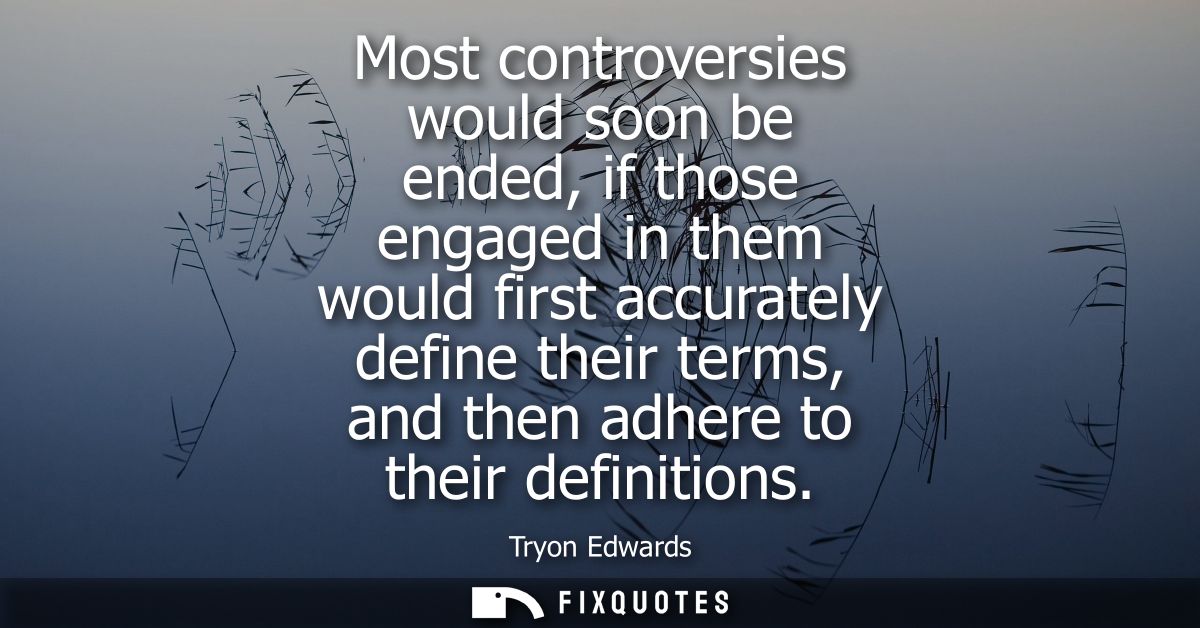
"Most controversies would soon be ended if those engaged in them would first accurately define their terms, and then adhere to their definitions"
About this Quote
The subtext is disciplinary. Coming out of a 19th-century Protestant intellectual world, Edwards knows that theological disputes often hinge on a single word - grace, election, inspiration - and that rival camps can talk past each other for decades while believing they’re defending orthodoxy. His prescription (“define, then adhere”) is basically an anti-hermeneutic improvisation rule. No mid-argument redefinitions, no rhetorical bait-and-switch, no using the same label to mean two different things depending on whether you’re attacking or defending.
It also carries a quiet moral claim: precision is a kind of honesty. To define terms is to risk being pinned down, to become accountable to what you’ve said. That’s why the advice still stings in today’s discourse, where ambiguity is often a strategy, not a flaw. Edwards isn’t promising that definitions will deliver harmony; he’s saying they will expose what the real fight is about - and remove the comfort of winning through confusion.
Quote Details
| Topic | Reason & Logic |
|---|---|
| Source | Unverified source: A Dictionary of Thoughts (Tryon Edwards, 1908)
Evidence: Most controversies would soon be ended, if those engaged in them would tot accu- rately define their terms, and then adhere to their definitions. , Tryon Edwards. (Page 88 (topic heading: CONVERSY/CONTROVERSY section; printed page shows 89 nearby in OCR)). This sentence appears in Tryon Edwards’... Other candidates (1) Disruption by Design (Paul Paetz, 2014) compilation97.6% ... Most controversies would soon be ended, if those engaged in them would first accurately define their terms, and t... |
| Cite |
Citation Formats
APA Style (7th ed.)
Edwards, Tryon. (2026, March 1). Most controversies would soon be ended if those engaged in them would first accurately define their terms, and then adhere to their definitions. FixQuotes. https://fixquotes.com/quotes/most-controversies-would-soon-be-ended-if-those-9789/
Chicago Style
Edwards, Tryon. "Most controversies would soon be ended if those engaged in them would first accurately define their terms, and then adhere to their definitions." FixQuotes. March 1, 2026. https://fixquotes.com/quotes/most-controversies-would-soon-be-ended-if-those-9789/.
MLA Style (9th ed.)
"Most controversies would soon be ended if those engaged in them would first accurately define their terms, and then adhere to their definitions." FixQuotes, 1 Mar. 2026, https://fixquotes.com/quotes/most-controversies-would-soon-be-ended-if-those-9789/. Accessed 11 Mar. 2026.