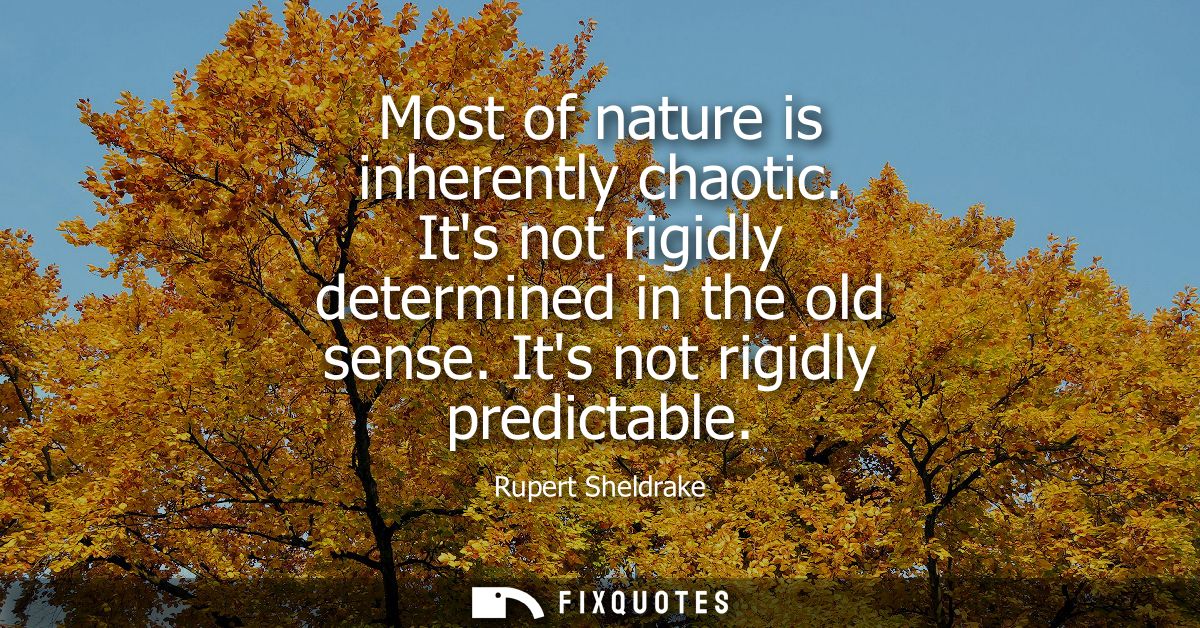
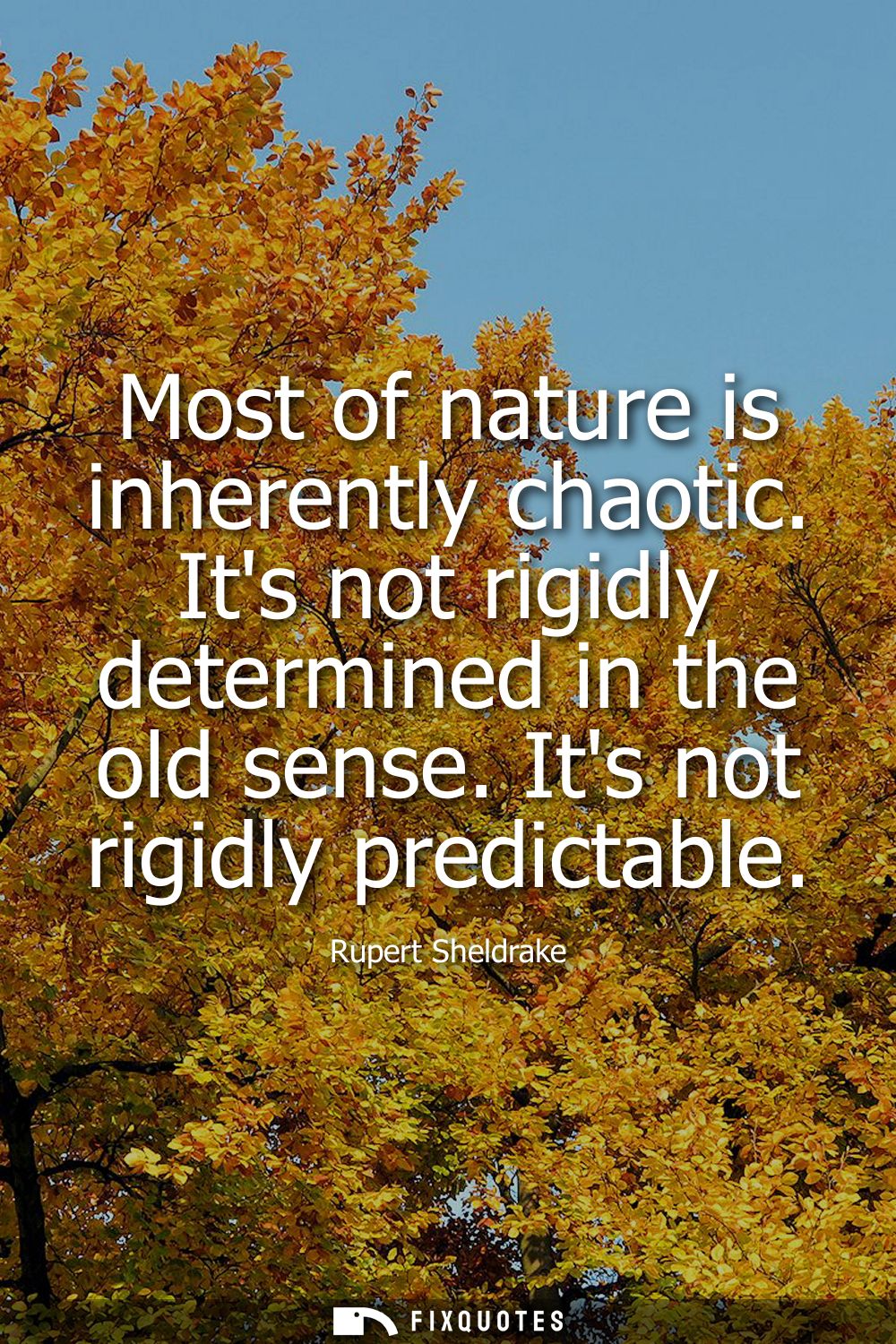
"Most of nature is inherently chaotic. It's not rigidly determined in the old sense. It's not rigidly predictable"
About this Quote
The phrase “in the old sense” is the giveaway. He’s not arguing against science so much as against a 19th-century version of it: Laplacian determinism, the fantasy that perfect knowledge of initial conditions yields perfect foresight. Modern physics already punctured that story (nonlinear dynamics, quantum indeterminacy, measurement limits), but Sheldrake’s rhetoric widens the crack into a doorway. “Most of nature” is an expansive claim that invites listeners to map the same looseness onto biology, mind, even meaning - territory where he’s been most controversial.
Subtext: if prediction is limited, then orthodox authority should be, too. That’s the soft power of the sentence. It doesn’t demand you accept his specific theories; it asks you to feel newly entitled to doubt the idea that reality is fully owned by reductionist explanation. In an era obsessed with modeling, forecasting, and “data-driven” governance, the quote reads less like a lab note and more like a warning: the world keeps a remainder, and anyone promising total predictability is selling metaphysics dressed as math.
Quote Details
| Topic | Free Will & Fate |
|---|---|
| Source | Help us find the source |
| Cite |
Citation Formats
APA Style (7th ed.)
Sheldrake, Rupert. (2026, January 15). Most of nature is inherently chaotic. It's not rigidly determined in the old sense. It's not rigidly predictable. FixQuotes. https://fixquotes.com/quotes/most-of-nature-is-inherently-chaotic-its-not-98558/
Chicago Style
Sheldrake, Rupert. "Most of nature is inherently chaotic. It's not rigidly determined in the old sense. It's not rigidly predictable." FixQuotes. January 15, 2026. https://fixquotes.com/quotes/most-of-nature-is-inherently-chaotic-its-not-98558/.
MLA Style (9th ed.)
"Most of nature is inherently chaotic. It's not rigidly determined in the old sense. It's not rigidly predictable." FixQuotes, 15 Jan. 2026, https://fixquotes.com/quotes/most-of-nature-is-inherently-chaotic-its-not-98558/. Accessed 31 Mar. 2026.