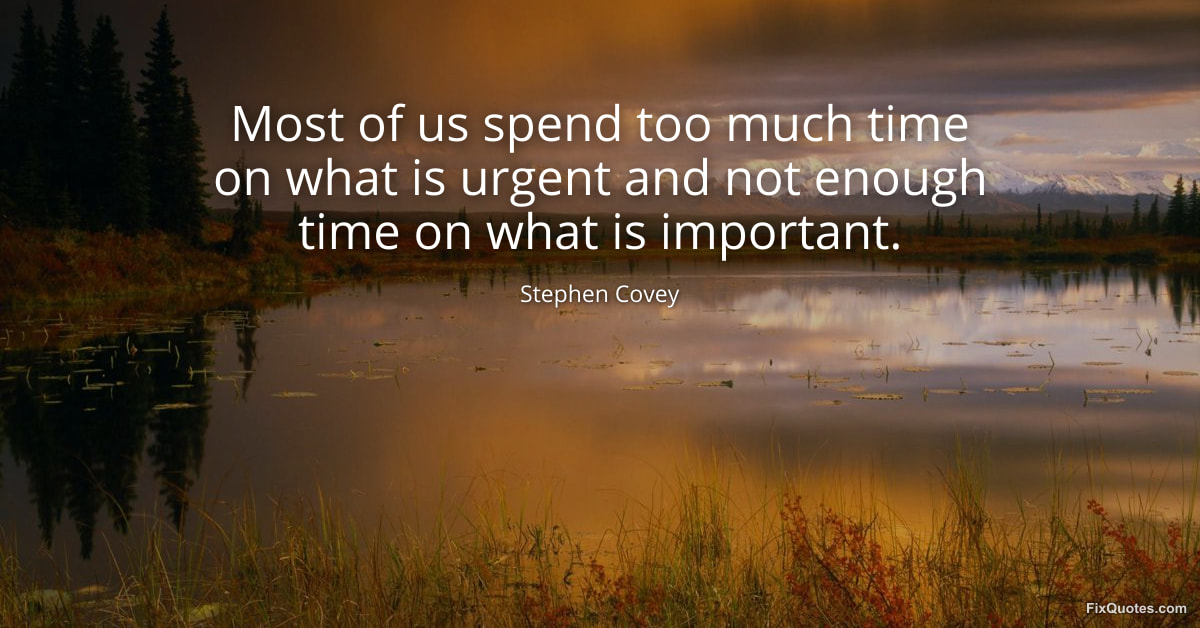
"Most of us spend too much time on what is urgent and not enough time on what is important"
About this Quote
The intent is managerial but also moral. Covey isn’t merely offering time-management advice; he’s challenging the reader’s sense of agency. If you’re always trapped by the urgent, you can blame the environment. If you admit you’re neglecting the important, you have to confront choice, boundaries, and the discomfort of disappointing people. The subtext is that busyness can be a kind of camouflage: a socially acceptable way to avoid the harder work of prioritizing, committing, and saying no.
Context matters: Covey’s “7 Habits” emerged from late-20th-century corporate America, when “productivity” was becoming a personal identity and executives were being asked to do more with less. His urgent/important split offered a simple framework that felt clarifying amid chaos. It still lands today because the economy of attention has only intensified, making urgency easier to manufacture than importance. Covey’s sting is that the crisis isn’t time scarcity; it’s values, expressed in minutes.
Quote Details
| Topic | Time |
|---|---|
| Source | Later attribution: Time Management for Engineering Managers (Vidal Graupera) modern compilationID: pnoGEAAAQBAJ
Evidence:
... Most of us spend too much time on what is urgent , and not enough time on what is important . " Steven Covey No ... Stephen Covey , as the " Time Management Matrix ” or “ 4 Quadrants . ” It gives you an easy way to figure out what ... |
| Cite |
Citation Formats
APA Style (7th ed.)
Covey, Stephen. (2026, February 23). Most of us spend too much time on what is urgent and not enough time on what is important. FixQuotes. https://fixquotes.com/quotes/most-of-us-spend-too-much-time-on-what-is-urgent-183982/
Chicago Style
Covey, Stephen. "Most of us spend too much time on what is urgent and not enough time on what is important." FixQuotes. February 23, 2026. https://fixquotes.com/quotes/most-of-us-spend-too-much-time-on-what-is-urgent-183982/.
MLA Style (9th ed.)
"Most of us spend too much time on what is urgent and not enough time on what is important." FixQuotes, 23 Feb. 2026, https://fixquotes.com/quotes/most-of-us-spend-too-much-time-on-what-is-urgent-183982/. Accessed 19 Mar. 2026.