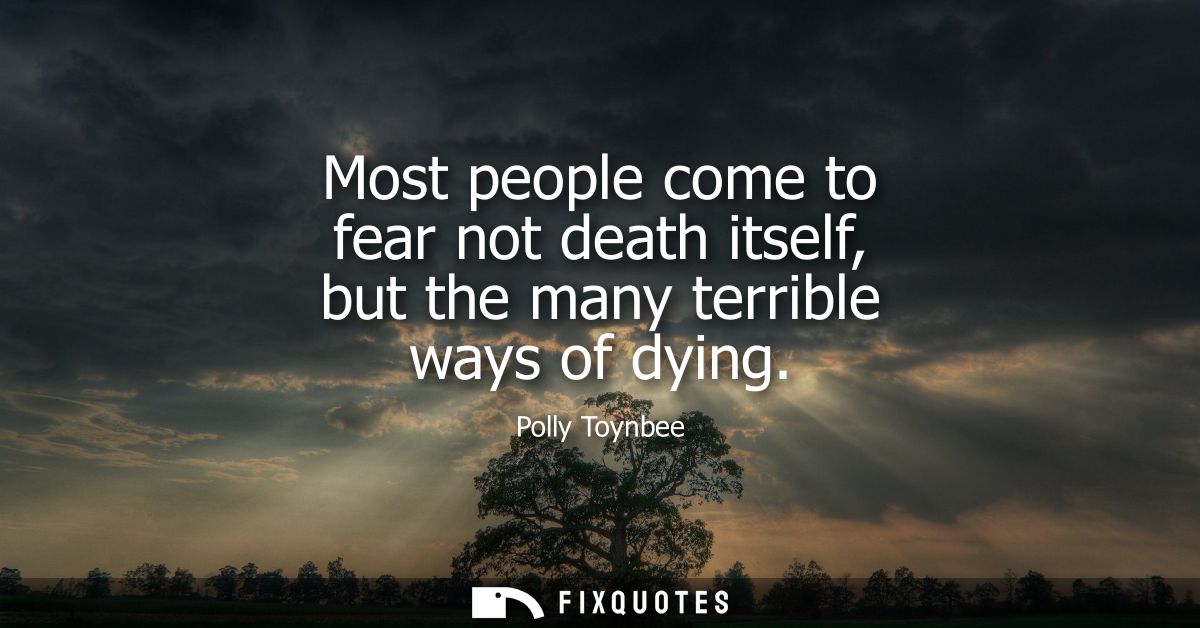
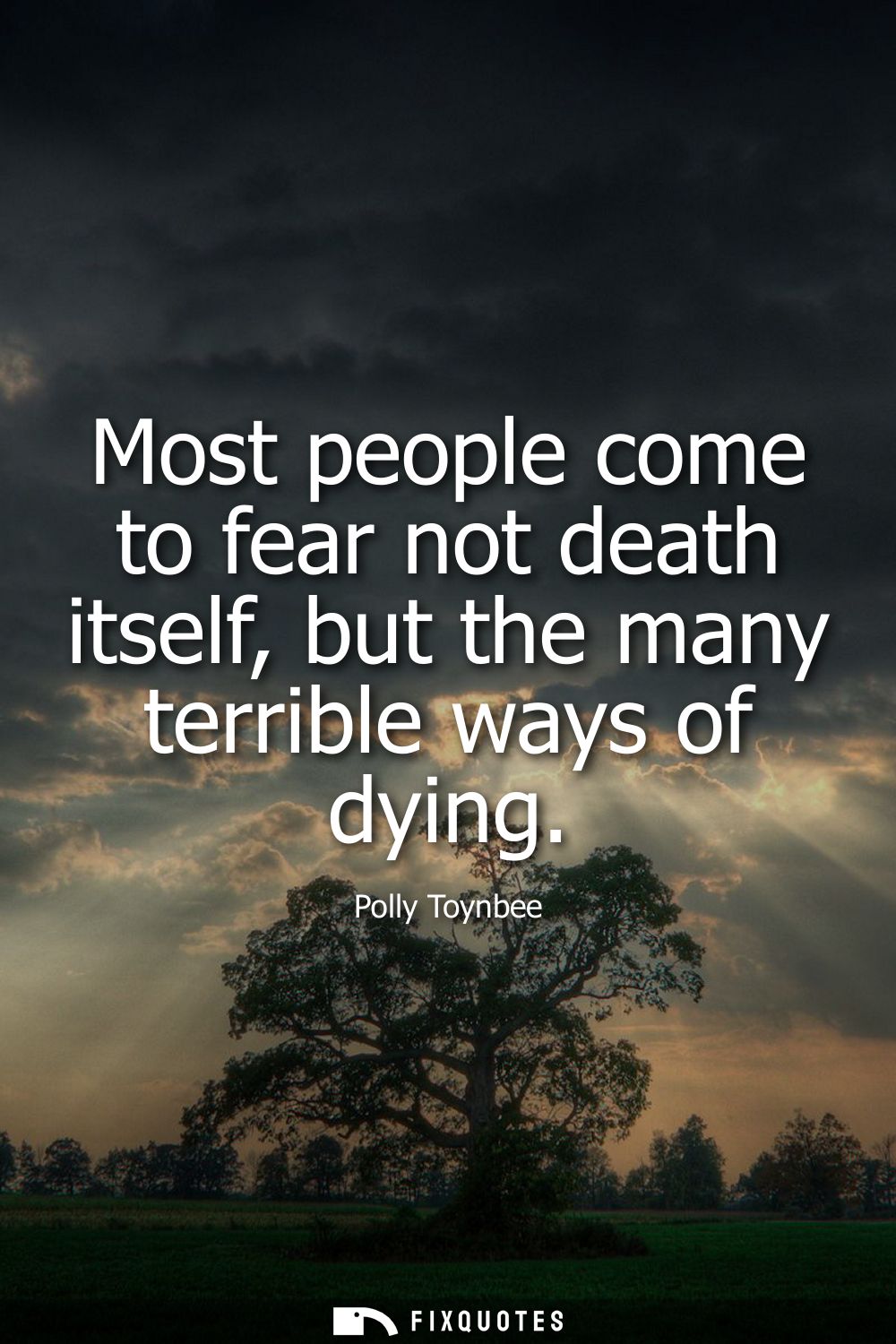
"Most people come to fear not death itself, but the many terrible ways of dying"
About this Quote
The intent is pointed. By distinguishing “death itself” from “the many terrible ways of dying,” Toynbee implicitly indicts a culture that romanticizes stoic acceptance while tolerating preventable suffering. “Many” matters: she’s not talking about one exceptional horror, but a catalogue produced by inequality, under-resourced care, and the quiet indignities of aging. The phrasing also shifts responsibility. If what we fear is the method, then the method can be improved, regulated, funded, humanized. Fear becomes a policy argument.
As a journalist, Toynbee is operating in the British public-square tradition where debates over the NHS, palliative care, and assisted dying are never just “ethical questions” but contests over whose pain counts and who gets choice. The subtext is that end-of-life panic is often a proxy for mistrust: mistrust that we’ll be kept comfortable, listened to, or treated as fully human when we’re least powerful. Her sentence works because it replaces the melodrama of death with the real scandal of dying: the avoidable suffering we’ve decided to live with.
Quote Details
| Topic | Mortality |
|---|---|
| Source | Help us find the source |
| Cite |
Citation Formats
APA Style (7th ed.)
Toynbee, Polly. (2026, January 16). Most people come to fear not death itself, but the many terrible ways of dying. FixQuotes. https://fixquotes.com/quotes/most-people-come-to-fear-not-death-itself-but-the-90540/
Chicago Style
Toynbee, Polly. "Most people come to fear not death itself, but the many terrible ways of dying." FixQuotes. January 16, 2026. https://fixquotes.com/quotes/most-people-come-to-fear-not-death-itself-but-the-90540/.
MLA Style (9th ed.)
"Most people come to fear not death itself, but the many terrible ways of dying." FixQuotes, 16 Jan. 2026, https://fixquotes.com/quotes/most-people-come-to-fear-not-death-itself-but-the-90540/. Accessed 5 Apr. 2026.