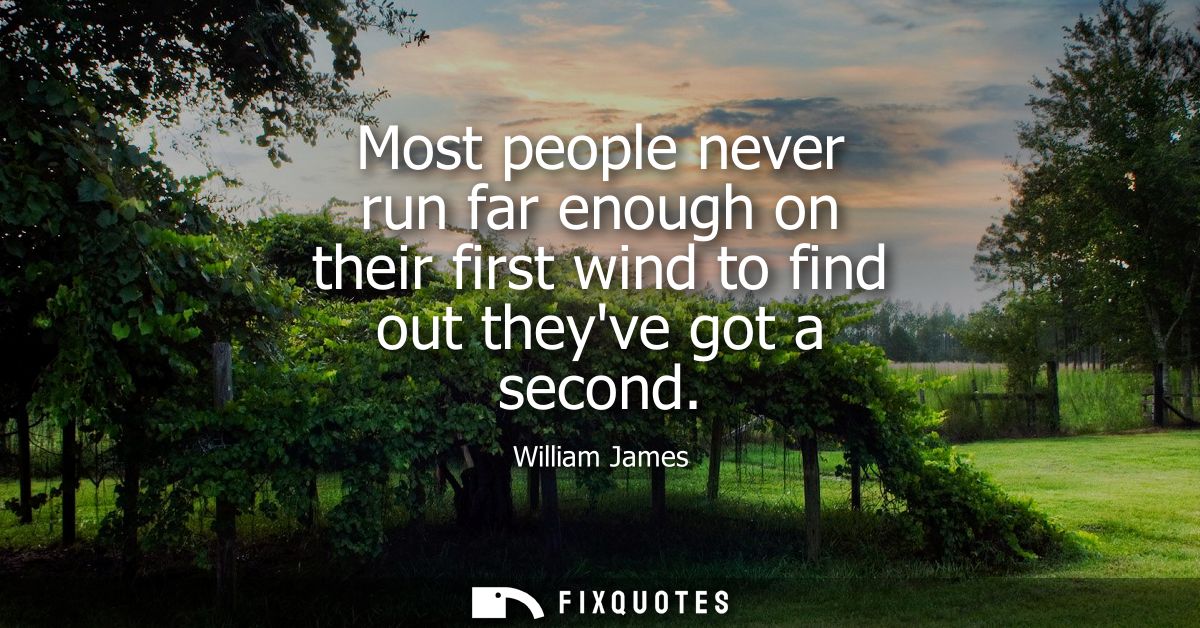
"Most people never run far enough on their first wind to find out they've got a second"
About this Quote
“First wind” is doing double duty. It’s the initial rush of motivation, the early competence, the part of any endeavor where adrenaline can masquerade as character. Most people, he implies, live as if that first surge is the whole engine. The second wind is the unglamorous territory beyond the ego’s comfort zone: the point where will replaces novelty, where the mind stops narrating and starts executing. James isn’t romanticizing grit for its own sake; he’s pointing to a psychological fact with moral consequences. Capacity is often latent, and the only way to discover it is to behave as if you might have more.
The subtext is almost clinical: your sense of “I can’t” is frequently a misread signal, not a verdict. In the late 19th century, as James was mapping habits, attention, and the will, this becomes a kind of counterspell to the era’s determinisms (biological, social, spiritual). Keep going long enough and the self you thought was fixed starts to look like a draft.
Quote Details
| Topic | Perseverance |
|---|---|
| Source | Help us find the source |
| Cite |
Citation Formats
APA Style (7th ed.)
James, William. (2026, January 15). Most people never run far enough on their first wind to find out they've got a second. FixQuotes. https://fixquotes.com/quotes/most-people-never-run-far-enough-on-their-first-25099/
Chicago Style
James, William. "Most people never run far enough on their first wind to find out they've got a second." FixQuotes. January 15, 2026. https://fixquotes.com/quotes/most-people-never-run-far-enough-on-their-first-25099/.
MLA Style (9th ed.)
"Most people never run far enough on their first wind to find out they've got a second." FixQuotes, 15 Jan. 2026, https://fixquotes.com/quotes/most-people-never-run-far-enough-on-their-first-25099/. Accessed 18 Mar. 2026.