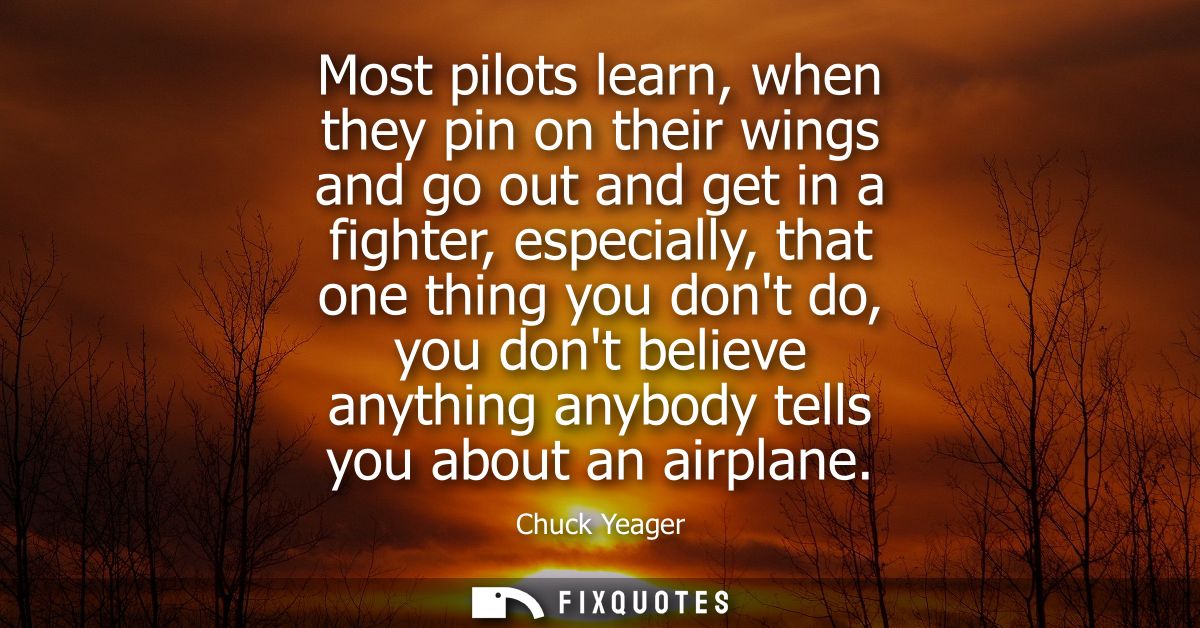
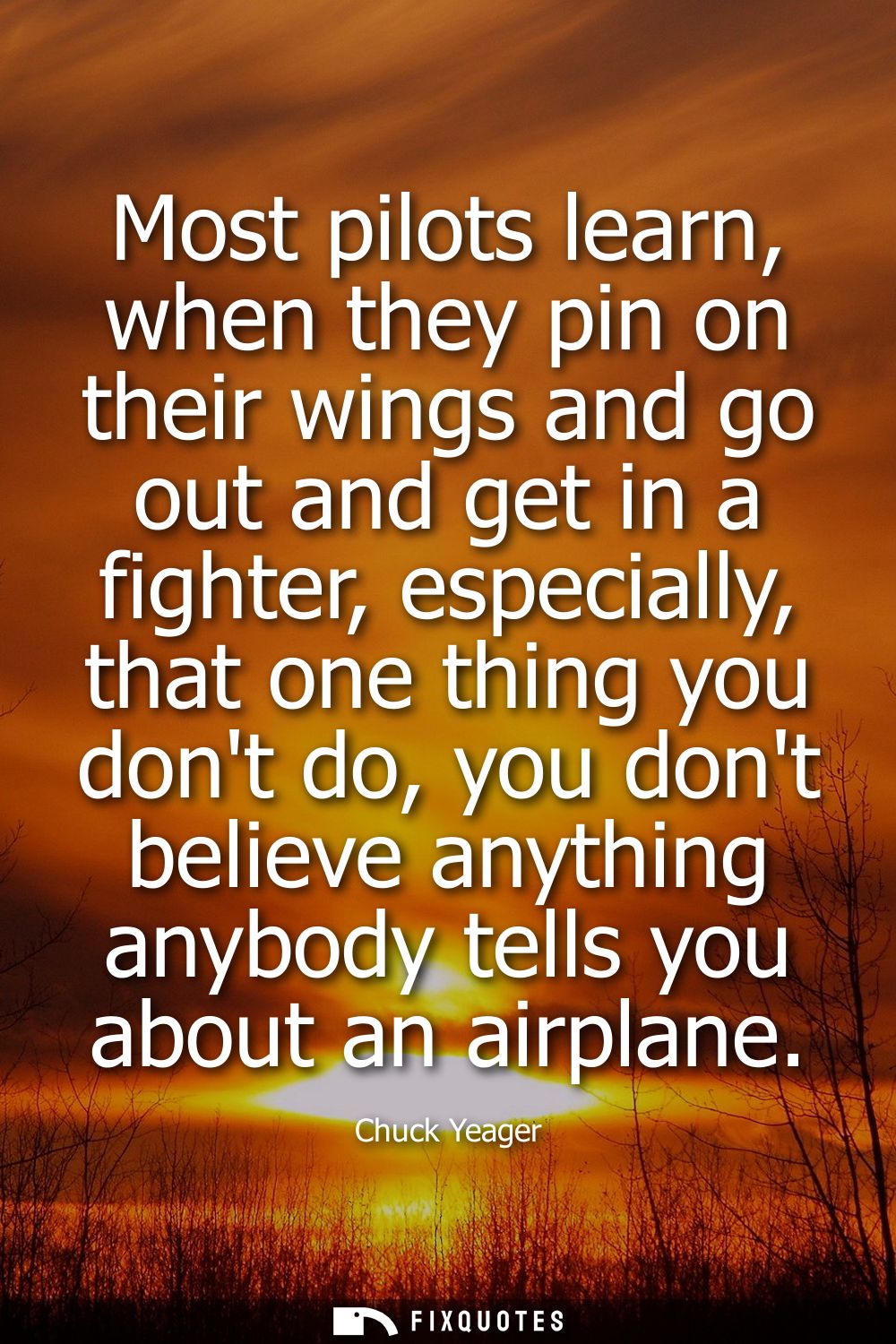
"Most pilots learn, when they pin on their wings and go out and get in a fighter, especially, that one thing you don't do, you don't believe anything anybody tells you about an airplane"
About this Quote
The subtext is Yeager’s test-pilot worldview: an airplane is a set of behaviors revealed under stress, not a story with a happy ending. Aviation is full of narratives - the “reliable” airframe, the “forgiving” handling, the “minor” quirk. Yeager’s intent is to vaccinate new pilots against those narratives. He’s advocating empiricism with skin in the game: you watch, you feel, you verify, you assume the unexpected. It’s a kind of frontier skepticism updated for jet-age machinery.
Context matters: Yeager comes out of a mid-century culture that fetishized hardware and heroism, yet he’s warning against the social halo around both. The quote isn’t anti-knowledge; it’s anti-handwaving. In an era that loves expert reassurance, Yeager’s ethic is bracing: treat every promise as marketing until the airplane itself, in your hands, proves otherwise.
Quote Details
| Topic | Learning |
|---|---|
| Source | Help us find the source |
| Cite |
Citation Formats
APA Style (7th ed.)
Yeager, Chuck. (2026, January 18). Most pilots learn, when they pin on their wings and go out and get in a fighter, especially, that one thing you don't do, you don't believe anything anybody tells you about an airplane. FixQuotes. https://fixquotes.com/quotes/most-pilots-learn-when-they-pin-on-their-wings-3757/
Chicago Style
Yeager, Chuck. "Most pilots learn, when they pin on their wings and go out and get in a fighter, especially, that one thing you don't do, you don't believe anything anybody tells you about an airplane." FixQuotes. January 18, 2026. https://fixquotes.com/quotes/most-pilots-learn-when-they-pin-on-their-wings-3757/.
MLA Style (9th ed.)
"Most pilots learn, when they pin on their wings and go out and get in a fighter, especially, that one thing you don't do, you don't believe anything anybody tells you about an airplane." FixQuotes, 18 Jan. 2026, https://fixquotes.com/quotes/most-pilots-learn-when-they-pin-on-their-wings-3757/. Accessed 12 Feb. 2026.