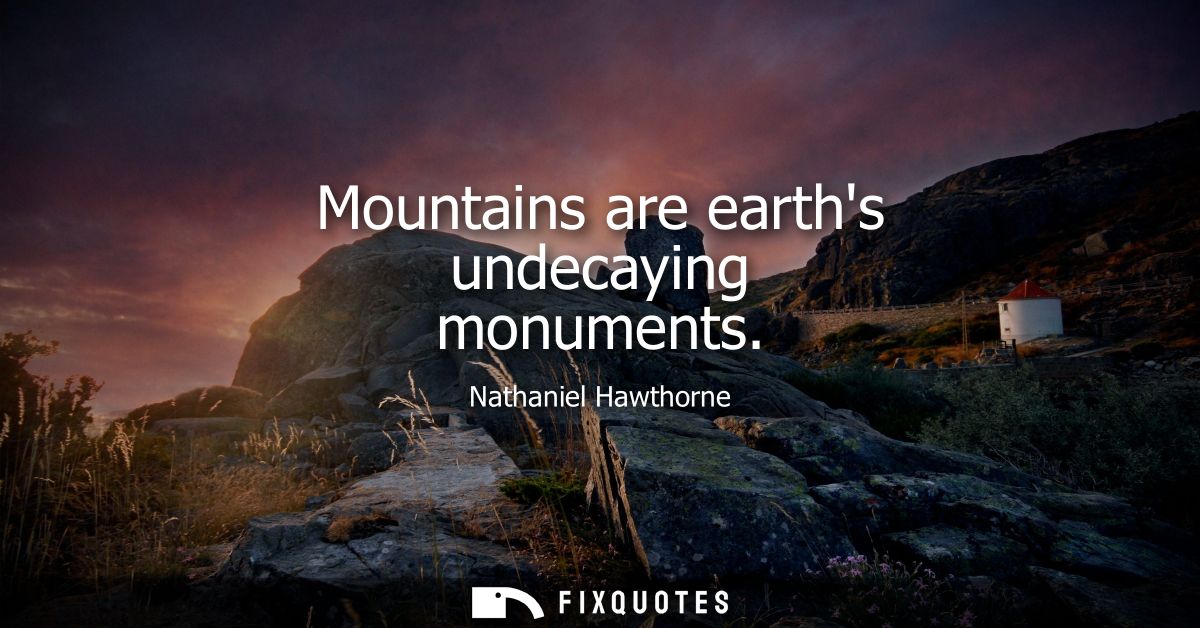
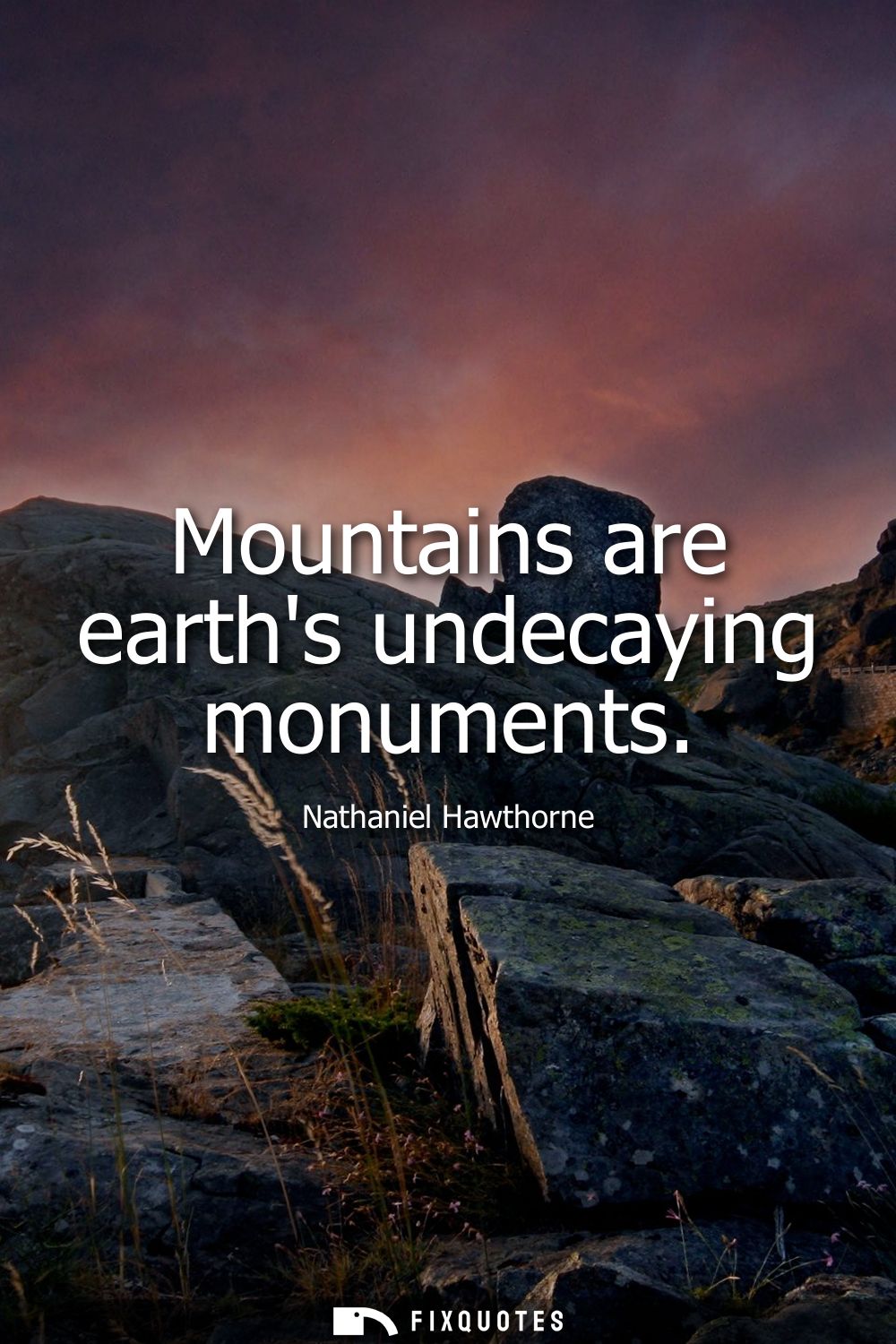
"Mountains are Earth's undecaying monuments"
About this Quote
Hawthorne’s line turns landscape into moral architecture. “Mountains” aren’t just scenery; they’re the planet’s stone memory, standing there with the stubborn permanence Hawthorne rarely grants his human characters. Calling them “earth’s undecaying monuments” smuggles in a Puritan anxiety: people rot, reputations curdle, communities forget or revise the story. Nature doesn’t.
The word “monuments” is the sly hinge. Monuments are supposed to be built, intentional, civic. Hawthorne relocates that impulse from human hands to geology, as if the earth itself is the only reliable commemorator. That’s a quiet indictment of human vanity. We raise statues to outlast us, but our meanings drift; mountains outlast us without needing our permission, and their “message” can’t be voted down or sanded into respectability.
“Undecaying” also lands like a rebuke to Hawthorne’s favorite theme: hidden sin and the decay it breeds. In The Scarlet Letter and his tales, guilt leaks into bodies, homes, and public life. Here, the mountain becomes an anti-allegory: a form that refuses corruption, a mass that doesn’t confess, doesn’t apologize, doesn’t decompose into rumor. The subtext isn’t that nature is pure so much as that human morality is fragile theater beside deep time.
Context matters: mid-19th-century America is busy mythmaking, expanding, naming, claiming. Hawthorne offers a counter-myth, skeptical and awed at once. The only monument that truly endures is the one no one commissioned.
The word “monuments” is the sly hinge. Monuments are supposed to be built, intentional, civic. Hawthorne relocates that impulse from human hands to geology, as if the earth itself is the only reliable commemorator. That’s a quiet indictment of human vanity. We raise statues to outlast us, but our meanings drift; mountains outlast us without needing our permission, and their “message” can’t be voted down or sanded into respectability.
“Undecaying” also lands like a rebuke to Hawthorne’s favorite theme: hidden sin and the decay it breeds. In The Scarlet Letter and his tales, guilt leaks into bodies, homes, and public life. Here, the mountain becomes an anti-allegory: a form that refuses corruption, a mass that doesn’t confess, doesn’t apologize, doesn’t decompose into rumor. The subtext isn’t that nature is pure so much as that human morality is fragile theater beside deep time.
Context matters: mid-19th-century America is busy mythmaking, expanding, naming, claiming. Hawthorne offers a counter-myth, skeptical and awed at once. The only monument that truly endures is the one no one commissioned.
Quote Details
| Topic | Mountain |
|---|---|
| Source | Help us find the source |
| Cite |
Citation Formats
APA Style (7th ed.)
Hawthorne, Nathaniel. (2026, February 18). Mountains are Earth's undecaying monuments. FixQuotes. https://fixquotes.com/quotes/mountains-are-earths-undecaying-monuments-64507/
Chicago Style
Hawthorne, Nathaniel. "Mountains are Earth's undecaying monuments." FixQuotes. February 18, 2026. https://fixquotes.com/quotes/mountains-are-earths-undecaying-monuments-64507/.
MLA Style (9th ed.)
"Mountains are Earth's undecaying monuments." FixQuotes, 18 Feb. 2026, https://fixquotes.com/quotes/mountains-are-earths-undecaying-monuments-64507/. Accessed 4 Mar. 2026.
More Quotes by Nathaniel
Add to List