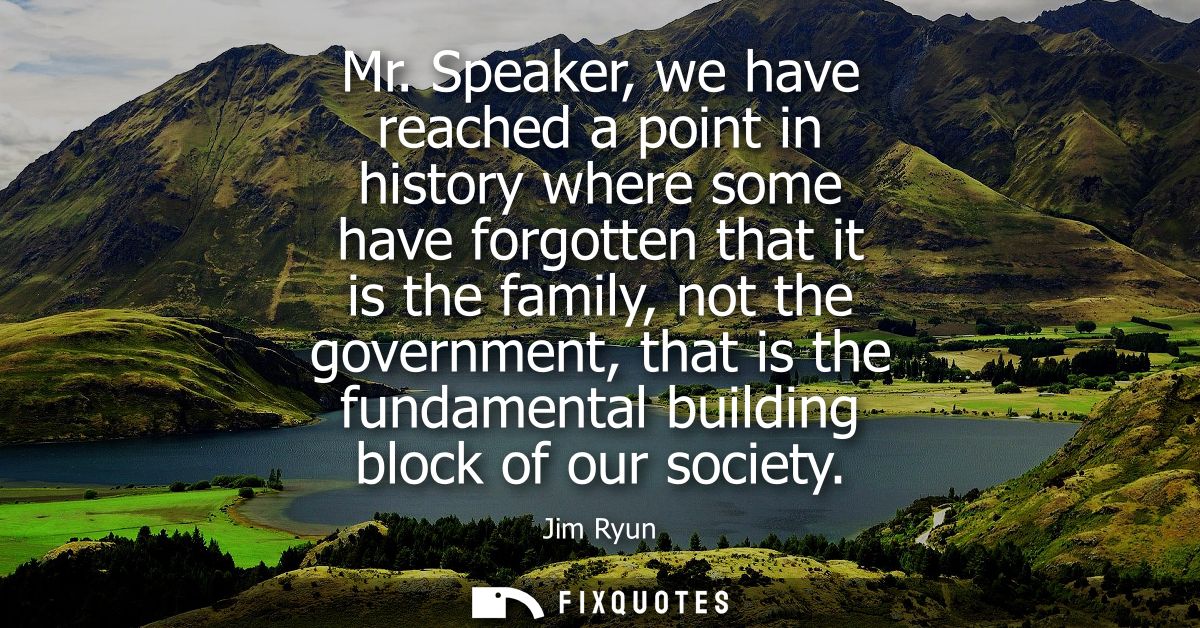
"Mr. Speaker, we have reached a point in history where some have forgotten that it is the family, not the government, that is the fundamental building block of our society"
About this Quote
The key move is the accusation embedded in “some have forgotten.” It’s not a neutral observation; it’s a rebuke that creates an out-group without naming names. “Forgotten” implies negligence or decadence, not disagreement. That framing lets the speaker claim the mantle of common sense while casting opponents as people who’ve drifted from basics.
“Family” versus “government” isn’t just a policy distinction; it’s a contest over who gets to define responsibility. By calling family “the fundamental building block,” Ryun invokes a pre-political, almost naturalized institution, suggesting it’s older, truer, and therefore entitled to priority over bureaucratic solutions. The subtext is clear: welfare programs, federal education mandates, or social services are portrayed less as supports and more as replacements that weaken self-reliance and parental authority.
The congressional address (“Mr. Speaker”) matters, too. It wraps an emotional appeal in institutional ritual, signaling that this isn’t merely personal belief but a principle worthy of national direction. Spoken in the early 2000s climate of “compassionate conservatism,” the intent is to recenter debates about poverty, childcare, and social stability around private obligation and traditional norms, while warning that government help can quietly become government power.
Quote Details
| Topic | Family |
|---|---|
| Source | Help us find the source |
| Cite |
Citation Formats
APA Style (7th ed.)
Ryun, Jim. (2026, January 17). Mr. Speaker, we have reached a point in history where some have forgotten that it is the family, not the government, that is the fundamental building block of our society. FixQuotes. https://fixquotes.com/quotes/mr-speaker-we-have-reached-a-point-in-history-67137/
Chicago Style
Ryun, Jim. "Mr. Speaker, we have reached a point in history where some have forgotten that it is the family, not the government, that is the fundamental building block of our society." FixQuotes. January 17, 2026. https://fixquotes.com/quotes/mr-speaker-we-have-reached-a-point-in-history-67137/.
MLA Style (9th ed.)
"Mr. Speaker, we have reached a point in history where some have forgotten that it is the family, not the government, that is the fundamental building block of our society." FixQuotes, 17 Jan. 2026, https://fixquotes.com/quotes/mr-speaker-we-have-reached-a-point-in-history-67137/. Accessed 12 Mar. 2026.