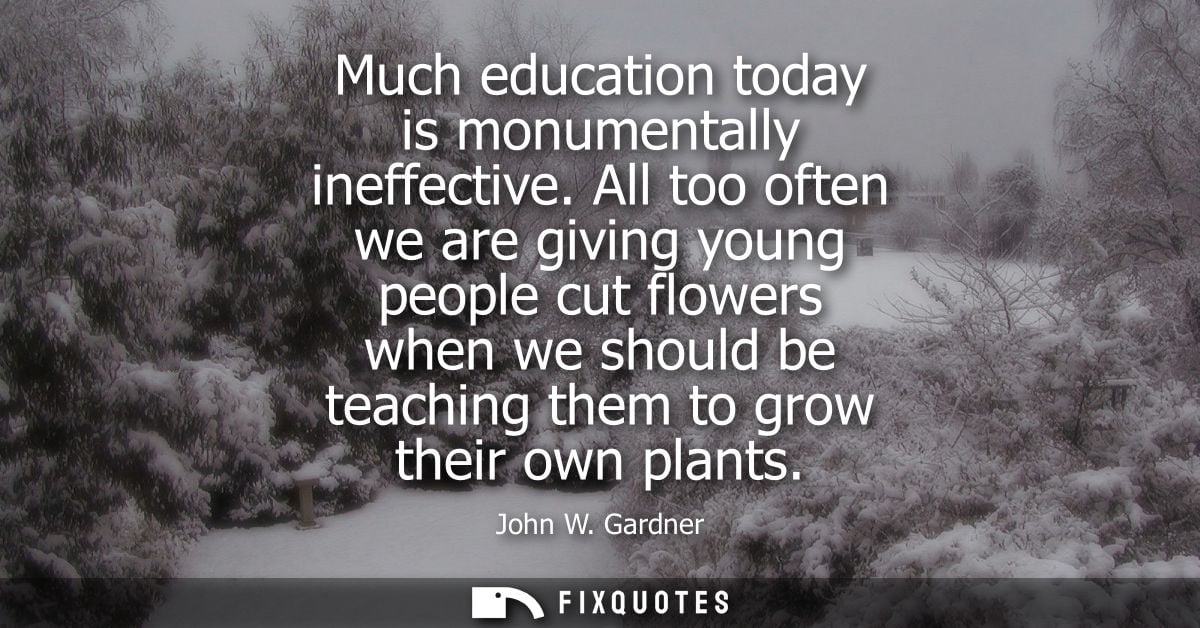
"Much education today is monumentally ineffective. All too often we are giving young people cut flowers when we should be teaching them to grow their own plants"
About this Quote
The subtext is an attack on passivity. Cut flowers are something you receive, display, and forget; growing plants is slow, messy, and demands agency. Gardner isn’t romanticizing “hands-on learning” as a trendy pedagogy so much as arguing for self-renewing competence: curiosity, judgment, learning-how-to-learn. The “we” matters, too. He implicates institutions and adults who prefer manageable outputs over unpredictable students who can think for themselves.
Contextually, Gardner spent his career straddling education and public service in mid-century America, when mass schooling, standardized testing, and credentialism were hardening into a national common sense. The quote reads like a warning from inside the system: the danger isn’t ignorance, it’s a kind of decorative knowing that can’t survive outside the vase. In a culture obsessed with performance, Gardner insists the real measure is whether students leave able to keep growing after the class ends.
Quote Details
| Topic | Teaching |
|---|---|
| Source | Help us find the source |
| Cite |
Citation Formats
APA Style (7th ed.)
Gardner, John W. (2026, January 18). Much education today is monumentally ineffective. All too often we are giving young people cut flowers when we should be teaching them to grow their own plants. FixQuotes. https://fixquotes.com/quotes/much-education-today-is-monumentally-ineffective-5203/
Chicago Style
Gardner, John W. "Much education today is monumentally ineffective. All too often we are giving young people cut flowers when we should be teaching them to grow their own plants." FixQuotes. January 18, 2026. https://fixquotes.com/quotes/much-education-today-is-monumentally-ineffective-5203/.
MLA Style (9th ed.)
"Much education today is monumentally ineffective. All too often we are giving young people cut flowers when we should be teaching them to grow their own plants." FixQuotes, 18 Jan. 2026, https://fixquotes.com/quotes/much-education-today-is-monumentally-ineffective-5203/. Accessed 2 Apr. 2026.