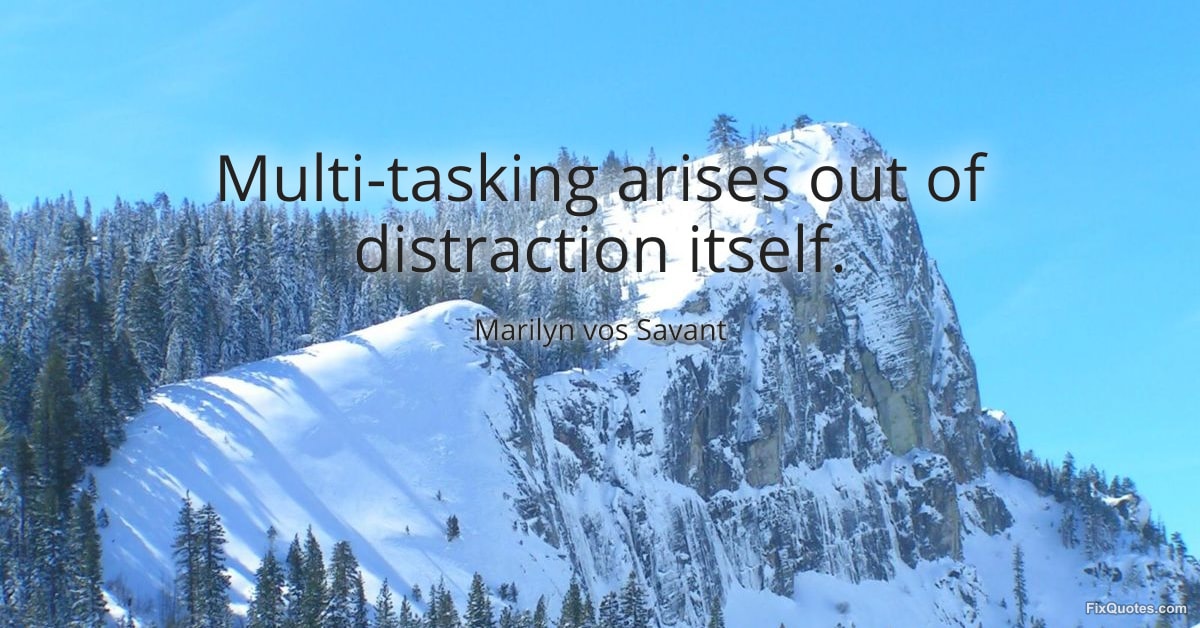
"Multi-tasking arises out of distraction itself"
About this Quote
Multi-tasking, in Marilyn vos Savant's framing, isn’t a superhero skill; it’s a symptom. The line performs a neat reversal of a modern brag. Where the culture sells multi-tasking as competence under pressure, she casts it as what happens after attention has already been cracked open. The verb "arises" matters: multi-tasking isn’t chosen so much as it bubbles up when focus can’t hold.
Vos Savant’s intent feels diagnostic, almost clinical, but the subtext is moral without preaching. She’s naming a quiet self-deception: we treat scattered attention as productivity because it sounds industrious. Calling multi-tasking a product of distraction punctures that narrative and forces the listener to ask whether they’re managing complexity or merely reacting to stimuli. It’s also an argument about cause and effect. The problem isn’t that life is too busy and therefore we must multi-task; the problem is that we’re distracted first, then we rationalize the resulting fragmentation as a strategy.
Contextually, this lands in the late-20th/early-21st century attention economy, where devices turn every idle second into an invitation, and workplaces reward visible busyness over deep work. As an author known for precision and public intellect, vos Savant is pushing back on a cultural myth with a single compressed sentence: if you’re constantly juggling, it may not be evidence of capacity. It may be evidence that something else is driving you.
Vos Savant’s intent feels diagnostic, almost clinical, but the subtext is moral without preaching. She’s naming a quiet self-deception: we treat scattered attention as productivity because it sounds industrious. Calling multi-tasking a product of distraction punctures that narrative and forces the listener to ask whether they’re managing complexity or merely reacting to stimuli. It’s also an argument about cause and effect. The problem isn’t that life is too busy and therefore we must multi-task; the problem is that we’re distracted first, then we rationalize the resulting fragmentation as a strategy.
Contextually, this lands in the late-20th/early-21st century attention economy, where devices turn every idle second into an invitation, and workplaces reward visible busyness over deep work. As an author known for precision and public intellect, vos Savant is pushing back on a cultural myth with a single compressed sentence: if you’re constantly juggling, it may not be evidence of capacity. It may be evidence that something else is driving you.
Quote Details
| Topic | Self-Discipline |
|---|
More Quotes by Marilyn
Add to List