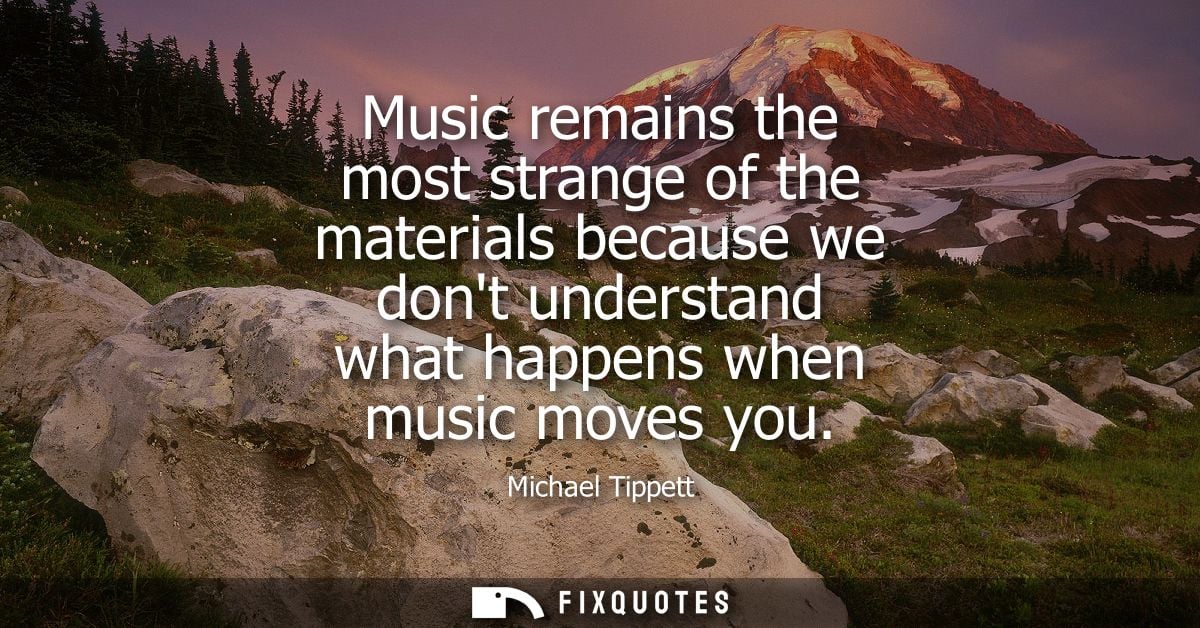
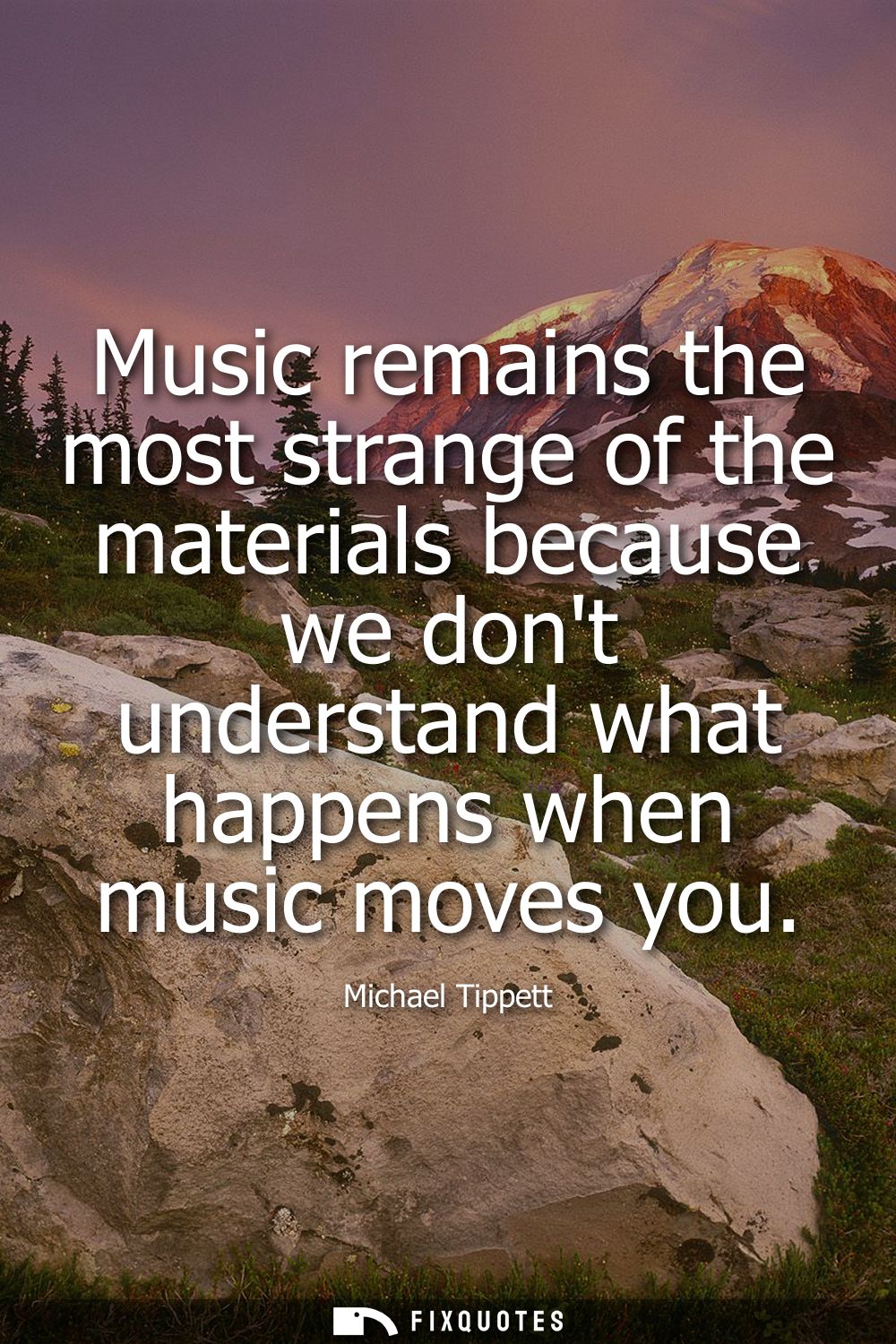
"Music remains the most strange of the materials because we don't understand what happens when music moves you"
About this Quote
The subtext is a quiet rebuke to both scientists and critics: you can map harmonic progressions and still miss the event that matters most, the moment a listener is changed. Tippett isn’t denying craft; he’s insisting that craft doesn’t exhaust the phenomenon. “When music moves you” is phrased like a bodily fact, not a metaphor. Something happens to you, in you, and you can’t fully claim authorship over it. That passivity is part of the strangeness: music doesn’t persuade like rhetoric; it infiltrates like weather.
Context matters here. Tippett’s lifetime runs through world wars, mass media, and the 20th century’s obsession with systems - psychoanalysis, modernism, neuroscience’s early promises. His work often wrestled with moral and spiritual turbulence without sermonizing. This quote protects a final redoubt: the listener’s interior life as an irreducible zone where explanation can circle endlessly, and still fail to capture the spark.
Quote Details
| Topic | Music |
|---|---|
| Source | Help us find the source |
| Cite |
Citation Formats
APA Style (7th ed.)
Tippett, Michael. (2026, January 16). Music remains the most strange of the materials because we don't understand what happens when music moves you. FixQuotes. https://fixquotes.com/quotes/music-remains-the-most-strange-of-the-materials-127769/
Chicago Style
Tippett, Michael. "Music remains the most strange of the materials because we don't understand what happens when music moves you." FixQuotes. January 16, 2026. https://fixquotes.com/quotes/music-remains-the-most-strange-of-the-materials-127769/.
MLA Style (9th ed.)
"Music remains the most strange of the materials because we don't understand what happens when music moves you." FixQuotes, 16 Jan. 2026, https://fixquotes.com/quotes/music-remains-the-most-strange-of-the-materials-127769/. Accessed 3 Apr. 2026.