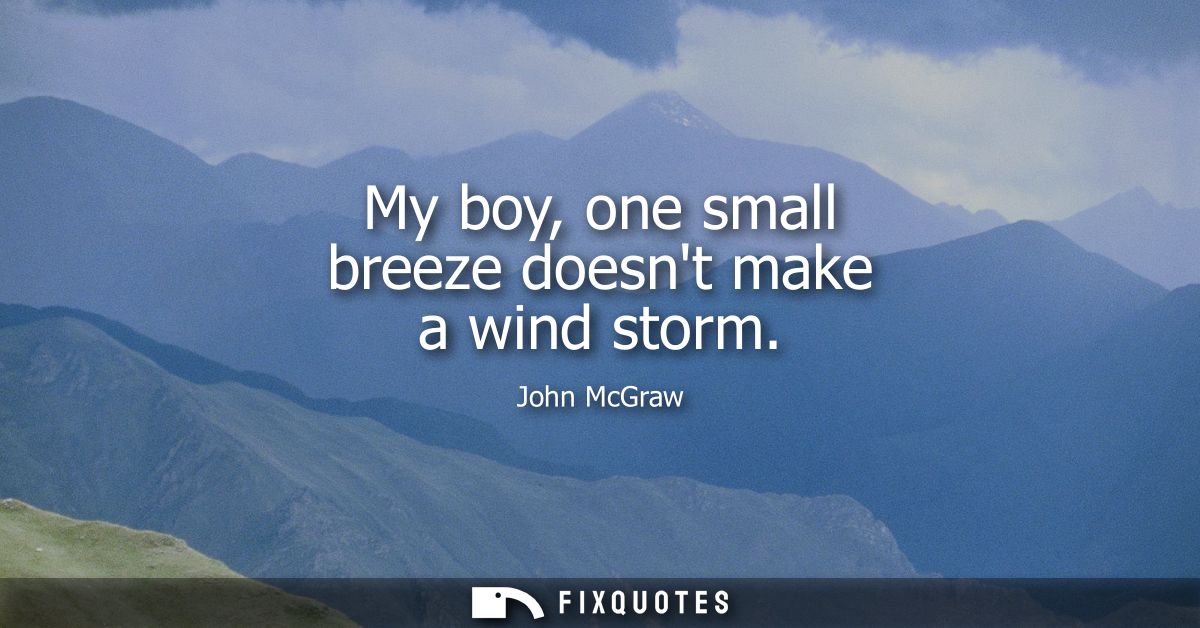
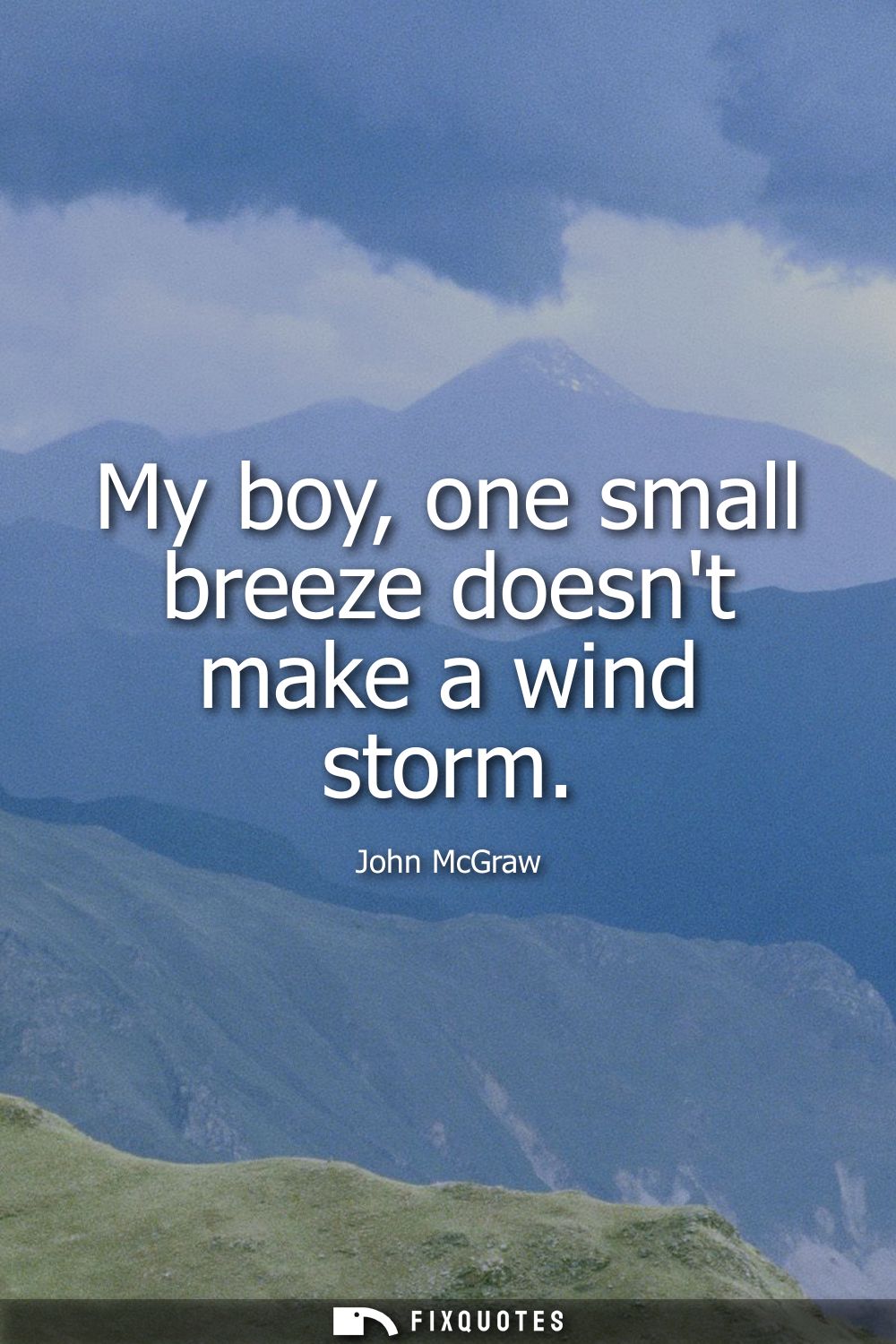
"My boy, one small breeze doesn't make a wind storm"
About this Quote
McGraw’s line has the plainspoken snap of advice meant to land fast, stick, and spare the listener a longer lecture. “My boy” isn’t just a term of endearment; it establishes hierarchy and intimacy at once, the voice of someone older (or at least positioned as older) taking charge of the emotional temperature in the room. The metaphor does the rest. A “small breeze” is real enough to feel, but not real enough to reorganize the weather. The rhetorical move is to downgrade the evidence without denying it: yes, something happened, but no, it doesn’t justify panic, triumphalism, or a wholesale narrative shift.
The intent is calibration. McGraw is warning against the human reflex to treat the first signal as the whole story - the early compliment that becomes destiny, the first setback that becomes catastrophe, the first flicker of progress that gets mistaken for momentum. By choosing wind as the vehicle, he leans on a system everyone understands: weather is noisy, changeable, easy to misread. One gust can be random; a storm implies pattern, pressure, persistence.
Subtextually, it’s also a critique of drama. The listener is likely revved up, either elated or spooked, and McGraw’s phrasing punctures that inflation without sounding cruel. The line carries a cultural suspicion of overinterpretation: don’t build a worldview on a single data point.
Context matters: whether he’s talking to a literal “boy” or an adult being addressed as one, the quote performs mentorship as restraint. It’s a miniature philosophy of patience disguised as a weather report.
The intent is calibration. McGraw is warning against the human reflex to treat the first signal as the whole story - the early compliment that becomes destiny, the first setback that becomes catastrophe, the first flicker of progress that gets mistaken for momentum. By choosing wind as the vehicle, he leans on a system everyone understands: weather is noisy, changeable, easy to misread. One gust can be random; a storm implies pattern, pressure, persistence.
Subtextually, it’s also a critique of drama. The listener is likely revved up, either elated or spooked, and McGraw’s phrasing punctures that inflation without sounding cruel. The line carries a cultural suspicion of overinterpretation: don’t build a worldview on a single data point.
Context matters: whether he’s talking to a literal “boy” or an adult being addressed as one, the quote performs mentorship as restraint. It’s a miniature philosophy of patience disguised as a weather report.
Quote Details
| Topic | Wisdom |
|---|---|
| Source | Help us find the source |
| Cite |
Citation Formats
APA Style (7th ed.)
McGraw, John. (2026, January 16). My boy, one small breeze doesn't make a wind storm. FixQuotes. https://fixquotes.com/quotes/my-boy-one-small-breeze-doesnt-make-a-wind-storm-136800/
Chicago Style
McGraw, John. "My boy, one small breeze doesn't make a wind storm." FixQuotes. January 16, 2026. https://fixquotes.com/quotes/my-boy-one-small-breeze-doesnt-make-a-wind-storm-136800/.
MLA Style (9th ed.)
"My boy, one small breeze doesn't make a wind storm." FixQuotes, 16 Jan. 2026, https://fixquotes.com/quotes/my-boy-one-small-breeze-doesnt-make-a-wind-storm-136800/. Accessed 27 Mar. 2026.
More Quotes by John
Add to List