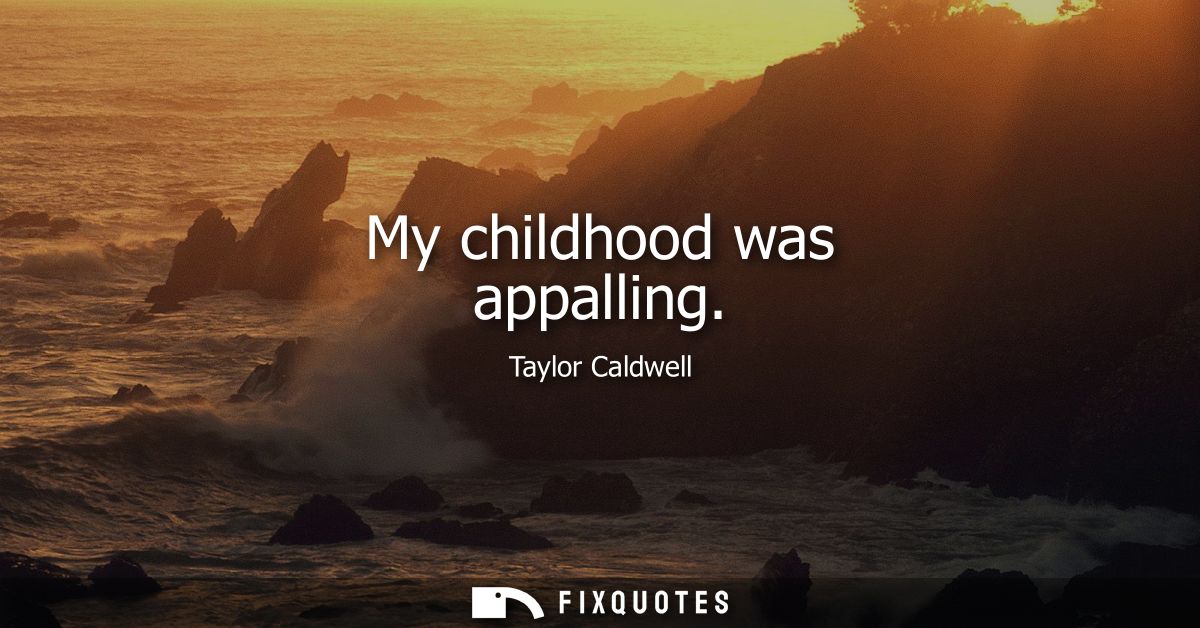
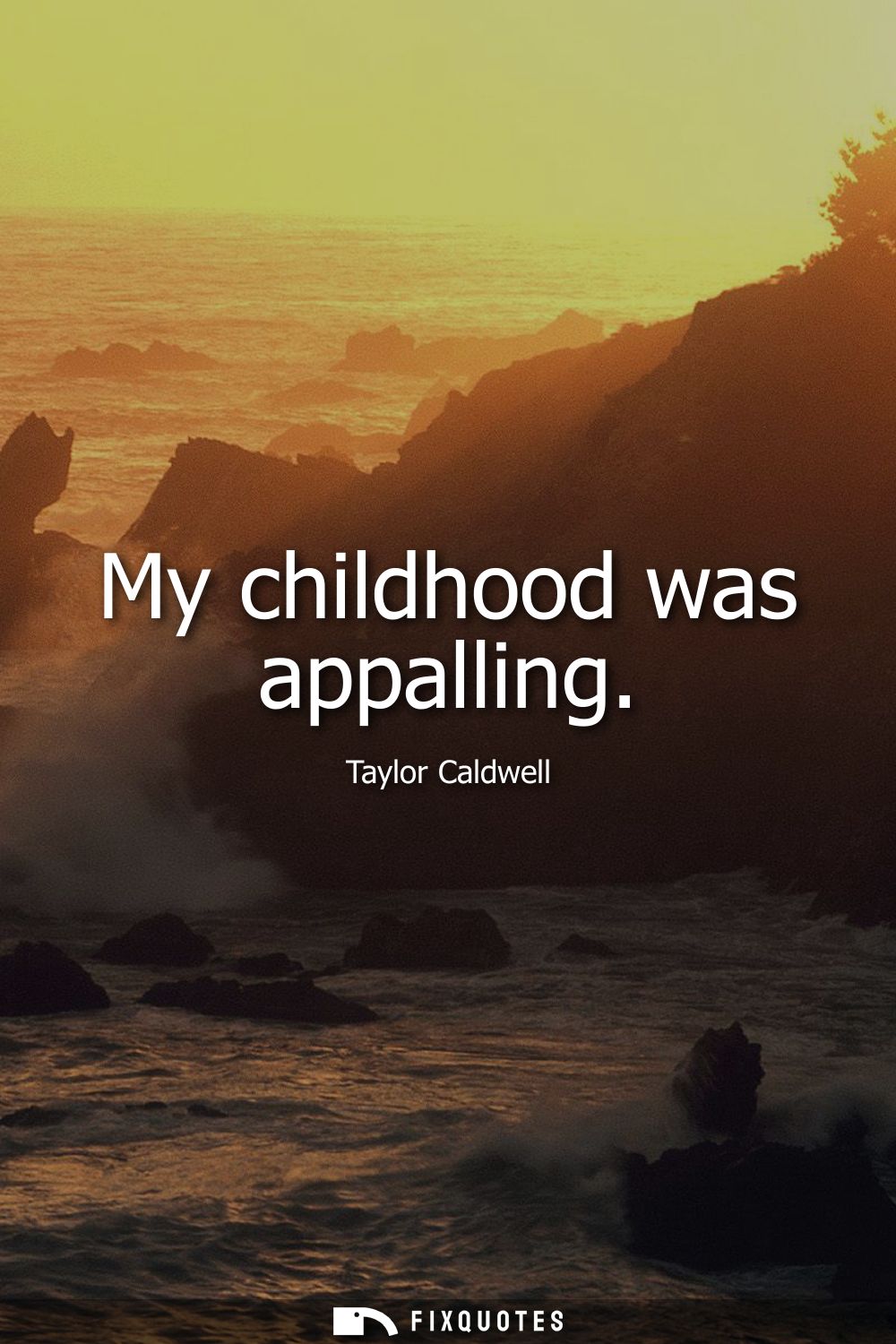
"My childhood was appalling"
About this Quote
Four blunt words, no alibi, no ornament: "My childhood was appalling". Taylor Caldwell doesn’t narrate; she pronounces. The line’s power is in its refusal to perform the polite rituals of autobiography - the softened phrasing, the tasteful distance, the careful calibration of pain for public consumption. "Appalling" isn’t clinical or confessional. It’s moral language. It implies a witness, an audience that ought to be shocked, and by extension a world that failed its most basic duty.
Caldwell, a prolific mid-century novelist who trafficked in big stakes - family power, historical forces, private ruin - understood that suffering becomes culturally legible only when it’s shaped. Here she shapes it by compressing it. The subtext is strategic: she’s not inviting voyeurism; she’s setting a boundary. You don’t get the details yet. You get the verdict. That protects the speaker while still demanding recognition.
The phrasing also works as an origin story without the sentimental uplift. In a culture that loves the redemption arc, Caldwell offers the anti-hallmark version: damage as fact, not as branding. Coming from a woman writer whose era often required toughness to be taken seriously, the sentence reads like a declaration of authority: she has earned her hard-edged understanding of human motives.
It’s a small statement with a big shadow. It tells you to look for the bruise under the plot, the wound beneath the grandeur - and to take seriously how early life can script a person’s entire imaginative economy.
Caldwell, a prolific mid-century novelist who trafficked in big stakes - family power, historical forces, private ruin - understood that suffering becomes culturally legible only when it’s shaped. Here she shapes it by compressing it. The subtext is strategic: she’s not inviting voyeurism; she’s setting a boundary. You don’t get the details yet. You get the verdict. That protects the speaker while still demanding recognition.
The phrasing also works as an origin story without the sentimental uplift. In a culture that loves the redemption arc, Caldwell offers the anti-hallmark version: damage as fact, not as branding. Coming from a woman writer whose era often required toughness to be taken seriously, the sentence reads like a declaration of authority: she has earned her hard-edged understanding of human motives.
It’s a small statement with a big shadow. It tells you to look for the bruise under the plot, the wound beneath the grandeur - and to take seriously how early life can script a person’s entire imaginative economy.
Quote Details
| Topic | Tough Times |
|---|---|
| Source | Help us find the source |
| Cite |
Citation Formats
APA Style (7th ed.)
Caldwell, Taylor. (2026, January 15). My childhood was appalling. FixQuotes. https://fixquotes.com/quotes/my-childhood-was-appalling-156074/
Chicago Style
Caldwell, Taylor. "My childhood was appalling." FixQuotes. January 15, 2026. https://fixquotes.com/quotes/my-childhood-was-appalling-156074/.
MLA Style (9th ed.)
"My childhood was appalling." FixQuotes, 15 Jan. 2026, https://fixquotes.com/quotes/my-childhood-was-appalling-156074/. Accessed 5 Mar. 2026.
More Quotes by Taylor
Add to List