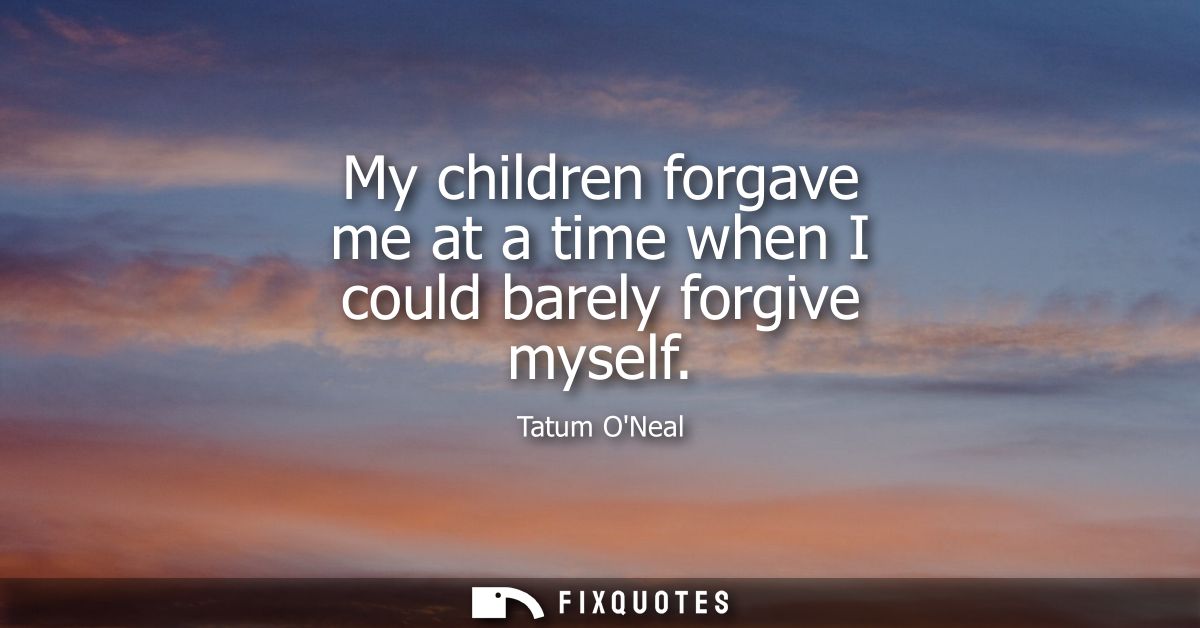
"My children forgave me at a time when I could barely forgive myself"
About this Quote
There is a quiet brutality in the way O'Neal lets the children lead the moral timeline. The line refuses the usual celebrity redemption arc where the adult narrates recovery as a triumphant comeback. Instead, it flips the power: the kids, typically cast as collateral damage in stories of addiction, divorce, and tabloid fallout, become the ones with agency. They are the early adopters of grace. She is the holdout.
The specific intent feels less like an apology and more like a confession about shame's mechanics. "At a time" does heavy lifting, hinting at a period when she was still inside the wreckage, when sobriety or stability (if they came) hadn't yet translated into self-trust. The phrasing is almost legalistic, careful not to claim she deserved forgiveness. That's the subtext: she isn't asking to be absolved; she's describing how undeserved mercy can arrive anyway, and how uncomfortable that can be.
Context matters because O'Neal's public story has long been a tug-of-war between precocious success and highly visible personal collapse. In that light, the quote reads like a corrective to the spectacle. It's not about the scandal; it's about the afterlife of it, the private work that doesn't photograph well. The emotional resonance is in the asymmetry: children offering something emotionally expensive, while the parent cannot yet meet them there. That gap is the real sentence, and it lands because it admits what most rehab narratives skip: forgiveness from others doesn't automatically repair your relationship with yourself.
The specific intent feels less like an apology and more like a confession about shame's mechanics. "At a time" does heavy lifting, hinting at a period when she was still inside the wreckage, when sobriety or stability (if they came) hadn't yet translated into self-trust. The phrasing is almost legalistic, careful not to claim she deserved forgiveness. That's the subtext: she isn't asking to be absolved; she's describing how undeserved mercy can arrive anyway, and how uncomfortable that can be.
Context matters because O'Neal's public story has long been a tug-of-war between precocious success and highly visible personal collapse. In that light, the quote reads like a corrective to the spectacle. It's not about the scandal; it's about the afterlife of it, the private work that doesn't photograph well. The emotional resonance is in the asymmetry: children offering something emotionally expensive, while the parent cannot yet meet them there. That gap is the real sentence, and it lands because it admits what most rehab narratives skip: forgiveness from others doesn't automatically repair your relationship with yourself.
Quote Details
| Topic | Forgiveness |
|---|---|
| Source | Help us find the source |
More Quotes by Tatum
Add to List