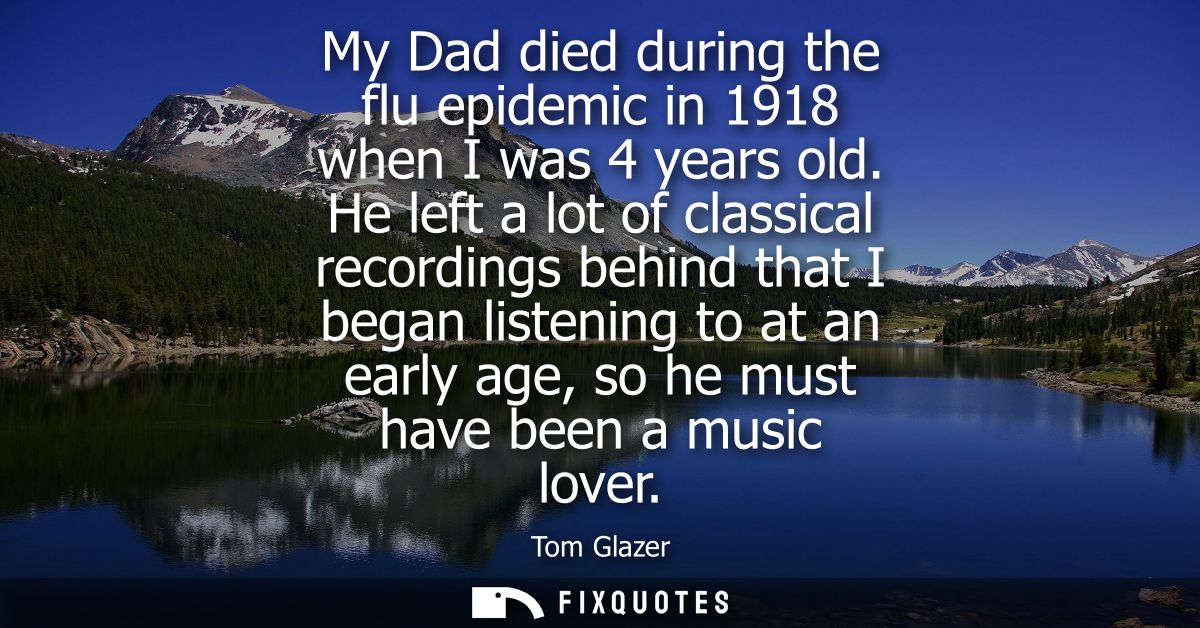
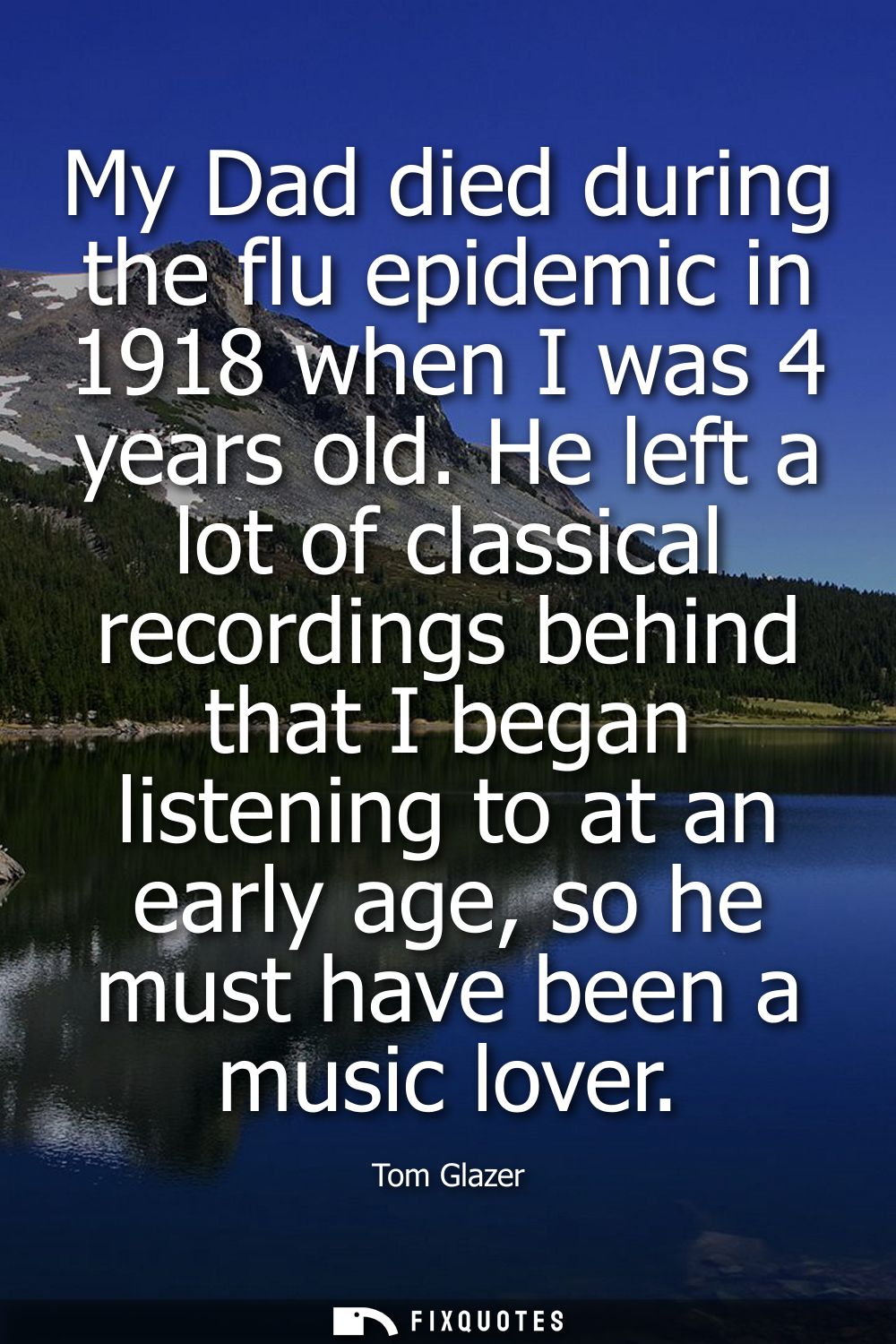
"My Dad died during the flu epidemic in 1918 when I was 4 years old. He left a lot of classical recordings behind that I began listening to at an early age, so he must have been a music lover"
About this Quote
The line “so he must have been a music lover” is doing quiet psychological work. Glazer admits he can’t actually know his father; he has to infer him from objects. That “must” is both deduction and longing, a child’s logic grown into an adult’s sentence. It also dodges sentimentality. He doesn’t claim inherited genius or destiny. He claims evidence: recordings left behind, a habit formed early, a personality reconstructed from taste.
Culturally, the quote positions music as continuity when family structure gets severed. Classical records in particular signal aspiration and seriousness, the kind of household marker that hints at immigrant ambition or middle-class self-making in early 20th-century America. Glazer’s subtext is that art isn’t just expression; it’s inheritance in the most literal sense, a physical collection that outlives disease and becomes a map for a life. The pandemic takes the father; the records quietly recruit the son.
Quote Details
| Topic | Father |
|---|---|
| Source | Help us find the source |
| Cite |
Citation Formats
APA Style (7th ed.)
Glazer, Tom. (2026, January 16). My Dad died during the flu epidemic in 1918 when I was 4 years old. He left a lot of classical recordings behind that I began listening to at an early age, so he must have been a music lover. FixQuotes. https://fixquotes.com/quotes/my-dad-died-during-the-flu-epidemic-in-1918-when-83790/
Chicago Style
Glazer, Tom. "My Dad died during the flu epidemic in 1918 when I was 4 years old. He left a lot of classical recordings behind that I began listening to at an early age, so he must have been a music lover." FixQuotes. January 16, 2026. https://fixquotes.com/quotes/my-dad-died-during-the-flu-epidemic-in-1918-when-83790/.
MLA Style (9th ed.)
"My Dad died during the flu epidemic in 1918 when I was 4 years old. He left a lot of classical recordings behind that I began listening to at an early age, so he must have been a music lover." FixQuotes, 16 Jan. 2026, https://fixquotes.com/quotes/my-dad-died-during-the-flu-epidemic-in-1918-when-83790/. Accessed 31 Mar. 2026.