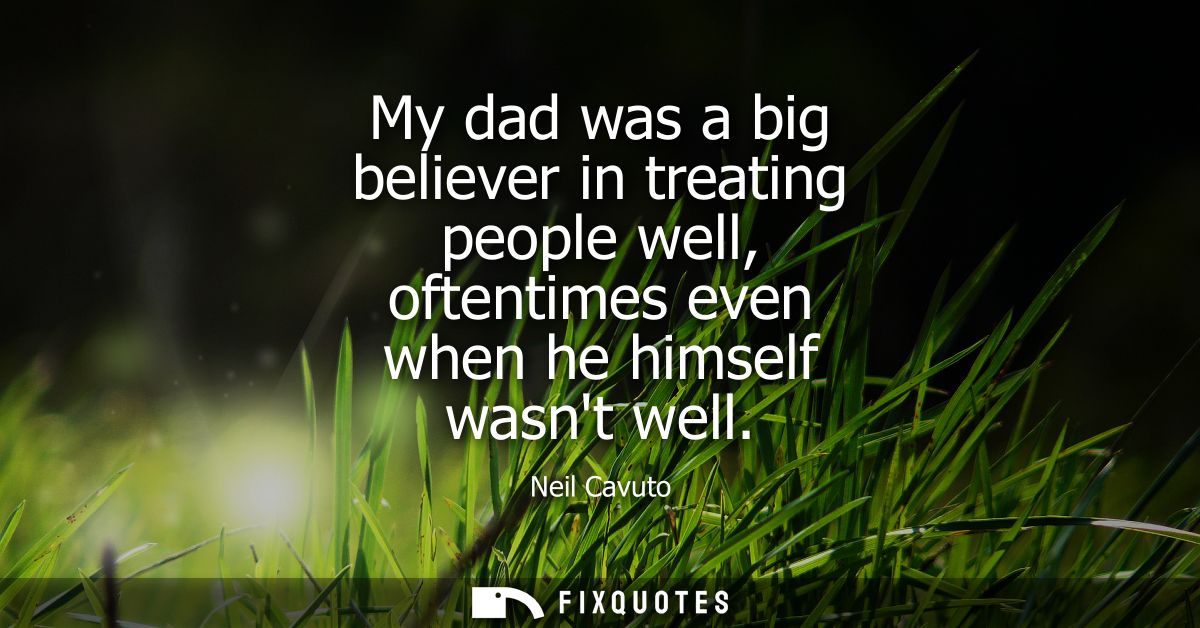
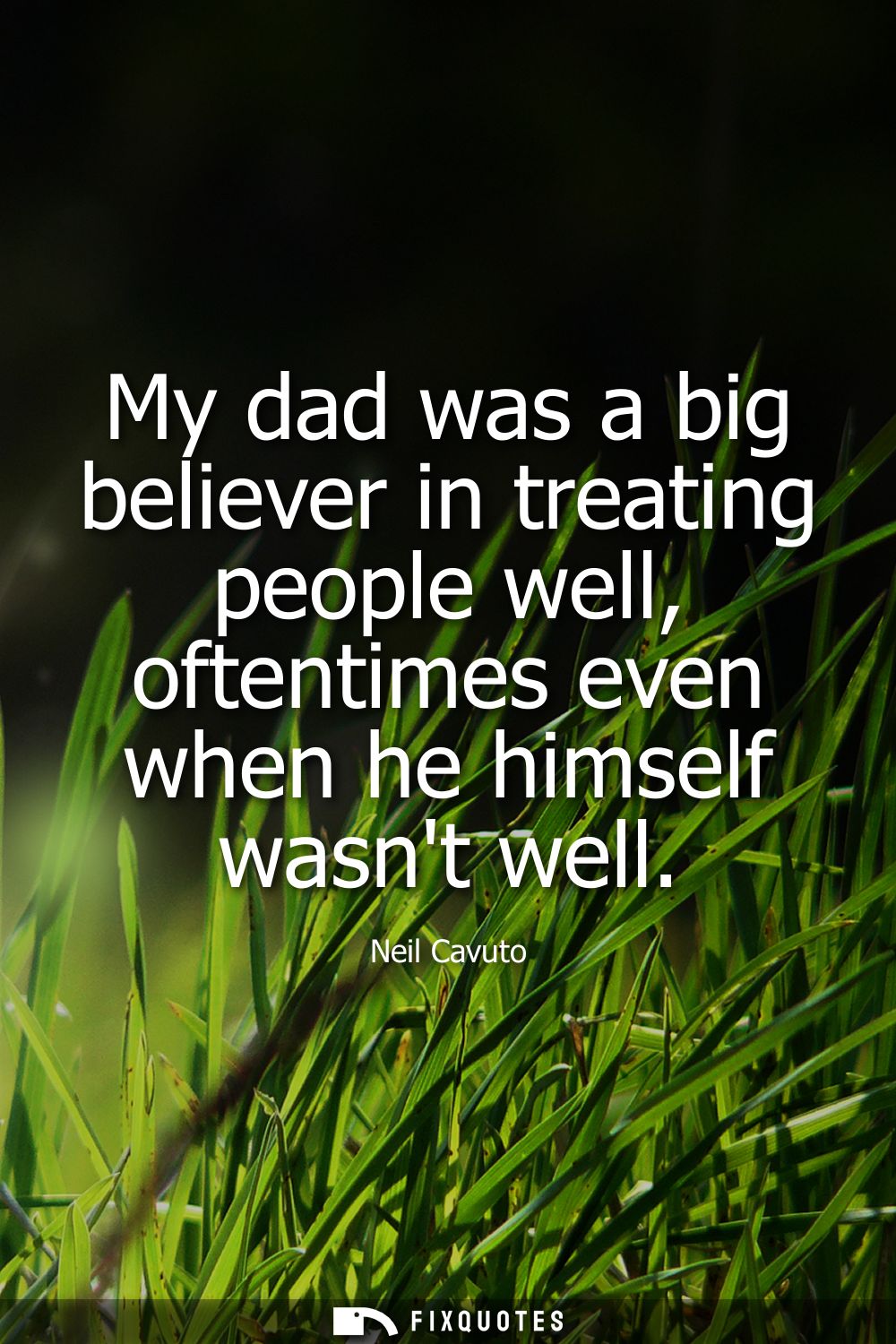
"My dad was a big believer in treating people well, oftentimes even when he himself wasn't well"
About this Quote
As a journalist who has publicly dealt with serious health issues, Cavuto is likely speaking from a place where “be nice” can feel like a luxury item. The subtext is a rebuttal to the contemporary permission slip for bad behavior: the idea that pain, stress, or trauma automatically licenses cruelty. Cavuto’s father becomes a model of restraint, the kind that doesn’t trend because it’s not performative. It’s private ethics.
The line also smuggles in a generational portrait. Many fathers weren’t taught to narrate feelings; they demonstrated them through conduct. Cavuto honors that without mythologizing it. “Oftentimes” suggests repetition, practice, a pattern observed over years. The intent isn’t to canonize a saint; it’s to argue that decency matters most when it’s inconvenient, when you’re sick, scared, or irritable - when the world gives you every excuse to be smaller.
Quote Details
| Topic | Father |
|---|---|
| Source | Help us find the source |
| Cite |
Citation Formats
APA Style (7th ed.)
Cavuto, Neil. (2026, January 16). My dad was a big believer in treating people well, oftentimes even when he himself wasn't well. FixQuotes. https://fixquotes.com/quotes/my-dad-was-a-big-believer-in-treating-people-well-89381/
Chicago Style
Cavuto, Neil. "My dad was a big believer in treating people well, oftentimes even when he himself wasn't well." FixQuotes. January 16, 2026. https://fixquotes.com/quotes/my-dad-was-a-big-believer-in-treating-people-well-89381/.
MLA Style (9th ed.)
"My dad was a big believer in treating people well, oftentimes even when he himself wasn't well." FixQuotes, 16 Jan. 2026, https://fixquotes.com/quotes/my-dad-was-a-big-believer-in-treating-people-well-89381/. Accessed 6 Apr. 2026.