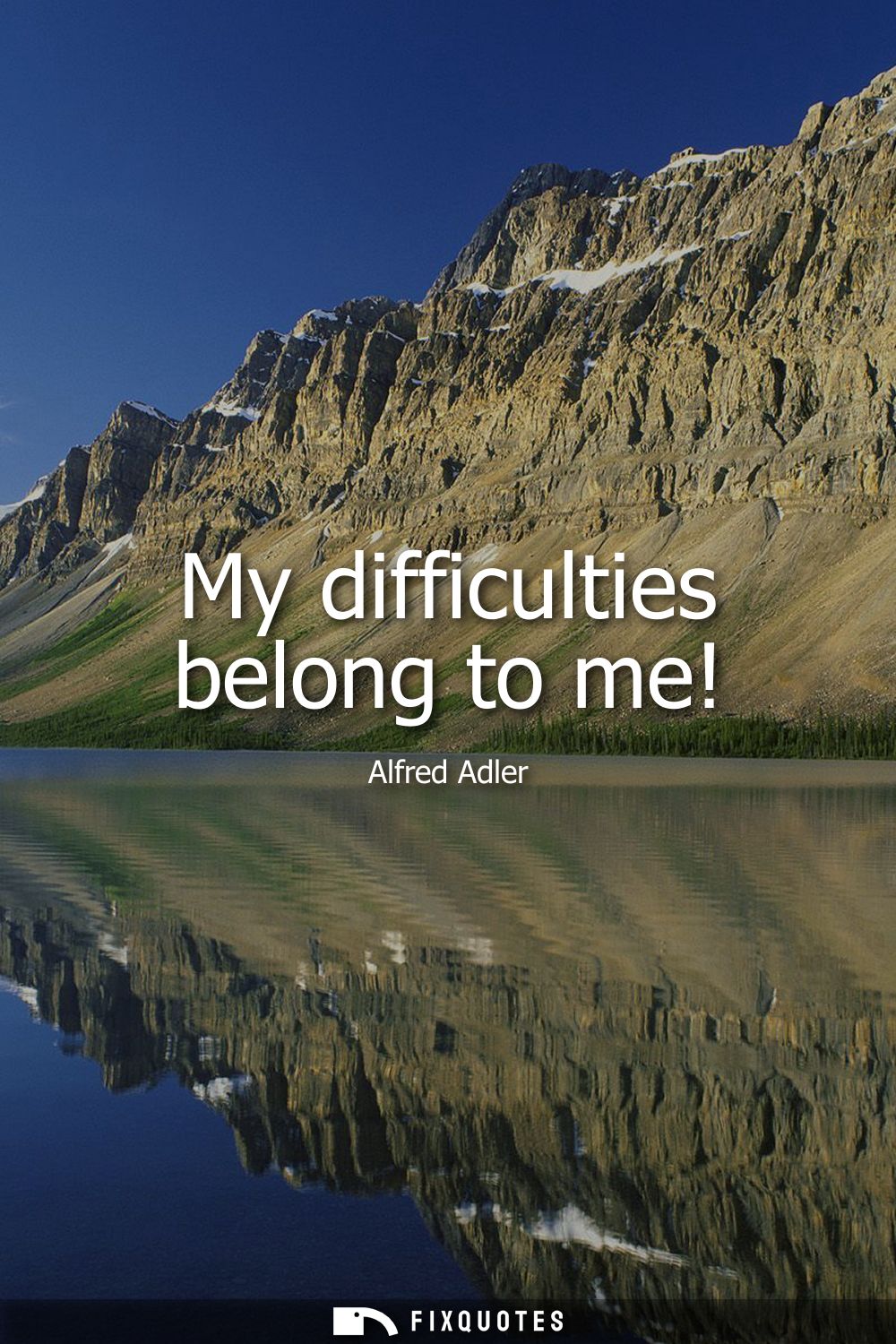
"My difficulties belong to me!"
About this Quote
A defiant little sentence, "My difficulties belong to me!" reads like Adler handing the patient back their steering wheel. As an early rival to Freud and founder of Individual Psychology, Adler was less interested in excavating hidden drives than in watching how people build a life-story around goals, feelings of inferiority, and the need to matter. The line is an antidote to the seductive comfort of explanation-as-exoneration.
The intent is not self-blame; its punch is ownership. Adler is insisting that hardship isn’t just something that happens to you, or something you can outsource to fate, parents, society, or diagnosis. Difficulties are part of your private logic: the meaning you assign them, the uses you put them to, the ways they become alibis or fuel. In Adler’s world, symptoms can function as strategies - unconscious, yes, but purposeful - to protect self-esteem, avoid risk, or win attention. Saying they "belong" to you reframes the problem from a mysterious curse into something with agency attached.
The subtext is quietly confrontational: if your difficulties are yours, then so is the possibility of change. It’s also a boundary-setting move. Adler worked against the moralizing culture of "weakness" while refusing the Victorian impulse to treat sufferers as passive objects. Belonging here means dignity: your struggle is not a public verdict, not a therapist’s possession, not your family’s property. It’s yours to interpret, to work with, and, crucially, to outgrow.
The intent is not self-blame; its punch is ownership. Adler is insisting that hardship isn’t just something that happens to you, or something you can outsource to fate, parents, society, or diagnosis. Difficulties are part of your private logic: the meaning you assign them, the uses you put them to, the ways they become alibis or fuel. In Adler’s world, symptoms can function as strategies - unconscious, yes, but purposeful - to protect self-esteem, avoid risk, or win attention. Saying they "belong" to you reframes the problem from a mysterious curse into something with agency attached.
The subtext is quietly confrontational: if your difficulties are yours, then so is the possibility of change. It’s also a boundary-setting move. Adler worked against the moralizing culture of "weakness" while refusing the Victorian impulse to treat sufferers as passive objects. Belonging here means dignity: your struggle is not a public verdict, not a therapist’s possession, not your family’s property. It’s yours to interpret, to work with, and, crucially, to outgrow.
Quote Details
| Topic | Self-Improvement |
|---|---|
| Source | Help us find the source |
| Cite |
Citation Formats
APA Style (7th ed.)
Adler, Alfred. (2026, January 15). My difficulties belong to me! FixQuotes. https://fixquotes.com/quotes/my-difficulties-belong-to-me-5313/
Chicago Style
Adler, Alfred. "My difficulties belong to me!" FixQuotes. January 15, 2026. https://fixquotes.com/quotes/my-difficulties-belong-to-me-5313/.
MLA Style (9th ed.)
"My difficulties belong to me!" FixQuotes, 15 Jan. 2026, https://fixquotes.com/quotes/my-difficulties-belong-to-me-5313/. Accessed 12 Feb. 2026.
More Quotes by Alfred
Add to List